

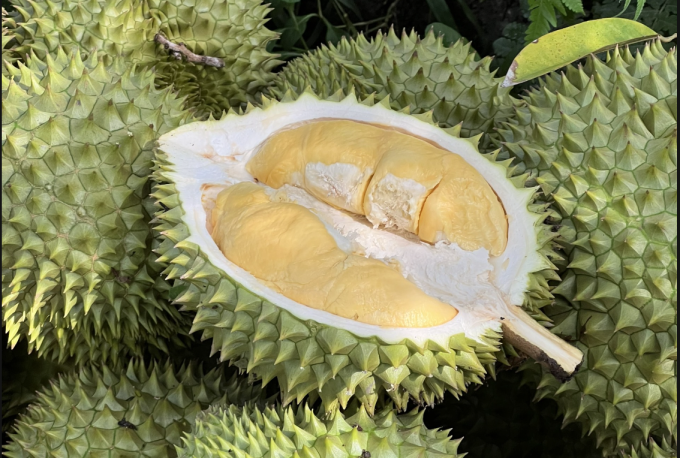
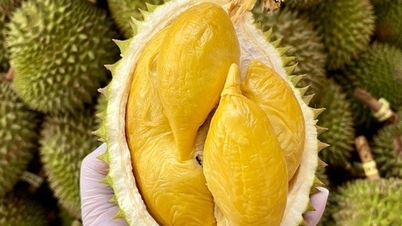
Difficulties in exporting to China have caused durian to drop from the leading position to third, with lower export value than dragon fruit and bananas.
Durian, once the top-selling fruit in the country, is facing numerous challenges. Recently released customs data shows that in the first two months of 2025, the export value of this fruit reached only nearly $52.7 million, a decrease of 69% compared to the same period last year. Notably, exports to its largest market, China, fell by 83%, to just $27 million, pushing durian down to third place after dragon fruit and bananas.
Amidst this bleak picture, some bright spots emerged. Exports of this product to Hong Kong and Taiwan surged, increasing 31-fold and 74-fold respectively, reaching $3.7 million and $1.34 million. These are the third and fourth largest markets after China and Thailand. The US also recorded a slight increase, reaching nearly $1.2 million, up 8.3% year-on-year, maintaining its fifth position on the list of durian importing markets from Vietnam.
Compared to other fruits, this one is lagging behind. While durian reached a turnover of $52.7 million, dragon fruit took the lead with $93.8 million, and bananas ranked second with $71.6 million.
According to Mr. Dang Phuc Nguyen, General Secretary of the Vietnam Fruit and Vegetable Association, the main reason for the sharp decline in fruit prices is the strict control regulations from China and other export markets. China has tightened inspections of the content of Yellow O – a substance with potential carcinogenic effects – causing many shipments to be held up, forcing businesses to resell domestically at low prices.
The US has also intensified controls, banning seven types of pesticide active ingredients and requiring growing area codes and packaging codes issued by the US Department of Agriculture . Europe has increased the pesticide residue testing rate from 10% to 20%, putting further pressure on Vietnamese fruit exports.
Domestically, many farmers are struggling with cadmium control, while packing facilities face difficulties in post-harvest preservation. The durian market is highly fragmented. Well-managed orchards that meet food safety standards can sell at high prices, while small-scale orchards relying on traditional methods can only sell at very low prices. Although purchasing centers are quoting relatively good prices, the percentage of durian that meets the standards to qualify for these prices is very small.
A survey conducted on April 7th showed that the purchase price of Grade A Ri6 durian at wholesale markets fluctuated around 75,000 VND per kilogram, while Grade C and D durians were only 35,000 - 40,000 VND per kilogram.
Mr. Manh Khuong, a major buyer in the Mekong Delta, said he only imports goods from farms with which he has long-standing relationships and guaranteed farming techniques. The South Korean and Japanese markets maintain stable demand, while China still faces many barriers. Currently, most of the goods he purchases are supplied to the domestic market, so prices remain relatively stable and have not fluctuated significantly.
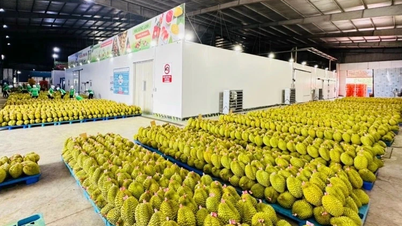
However, businesses expect that as frozen fruit shipments increase to China, the market will see more positive changes. Especially during the peak season from June to October, export volumes could boom, and this fruit has the opportunity to regain its leading position in the fruit export industry.
Previously, the first shipment of frozen durian from Vietnam was exported to China on March 24th. This shipment, weighing 24 tons, was handled by Nam Do Agricultural Products Joint Stock Company and originated from their factory in Krong Pac district, Dak Lak province. Prior to this, on August 19th, 2024, the Ministry of Agriculture and Environment of Vietnam and the General Administration of Customs of China signed a protocol on the export of frozen durian, paving the way for the official export of this product.
Source
![[Photo] National Assembly Chairman Tran Thanh Man successfully concludes his participation in IPU-152](https://vphoto.vietnam.vn/thumb/1200x675/vietnam/resource/IMAGE/2026/04/18/1776502638199_vna-potal-chu-tich-quoc-hoi-ket-thuc-tot-dep-chuong-trinh-tham-du-ipu-152-8709975-jpg.webp)









































































Comment (0)