

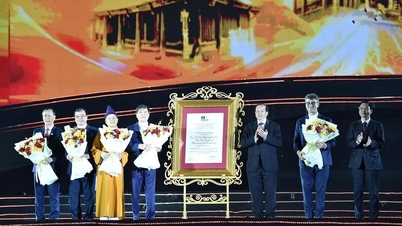
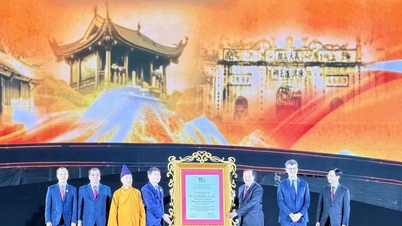
The inscription of the Nine Dynastic Urns in the Hue Imperial Palace as a Regional Documentary Heritage of Asia- Pacific has raised the total number of Vietnamese documentary heritage sites inscribed by UNESCO to 10 (including 3 World Documentary Heritage sites and 7 Regional Documentary Heritage sites of Asia-Pacific).
Three invaluable documentary heritage sites of global significance.
1. Woodblock prints from the Nguyen Dynasty
The Nguyen Dynasty woodblocks, recognized in 2009, are Vietnam's first World Documentary Heritage site to be recognized by UNESCO.
Woodblock printing involves carving Chinese or Vietnamese characters in reverse on wooden blocks to print pages from books. This was a printing technique from an earlier period.

A woodblock print illustrating Vietnam's sovereignty over the Paracel and Spratly Islands.
The Nguyen Dynasty woodblock collection comprises 34,555 woodblocks, representing the "printing" of 152 books on various topics such as history, geography, socio-political issues, military affairs, law, education, literature, and poetry.
The woodblock archives contain many rare and valuable works such as "Dai Nam Thuc Luc," "Dai Nam Nhat Thong Chi," "Kham Dinh Viet Su Thong Giam Cuong Muc," "Kham Dinh Dai Nam Hoi Dien Su Le," etc., in addition to works such as "Imperial-composed prose" and "Imperial-composed poetry" composed by famous emperors such as Minh Mang, Thieu Tri, and Tu Duc.
The content of the Nguyen Dynasty woodblock collection is rich and diverse, reflecting all aspects of Vietnamese society during the feudal period, such as history, geography, politics-society, military, law, culture-education, religion-ideology-philosophy, literature, language-writing.
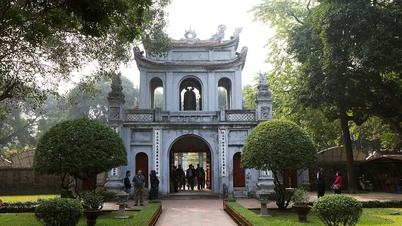
2. Doctoral Examination Stele at the Temple of Literature - National University
The Doctoral Examination Stele at the Temple of Literature - National University was recognized by UNESCO as a World Documentary Heritage site in 2011.
The 82 doctoral steles correspond to 82 examinations held between 1484 and 1780, recording the names of those who passed the highest-level examinations. These are the only original documents still remaining at the Temple of Literature - National University, considered one of the invaluable cultural legacies left by our ancestors. They are also authentic documents, reflecting a vivid picture of the system of training and recruiting talent in Vietnam, which lasted for more than 300 years during the Le-Mac dynasties.

Doctoral steles at the Temple of Literature - National University.
The system of 82 doctoral steles is also a unique work of art, reflecting the sculptural art of many feudal dynasties of Vietnam. Each inscription on the stele is a model of literature, expressing philosophical and historical ideas, as well as views on education, training, and the appreciation of talent.
3. Nguyen Dynasty Archives
Recognized as a World Documentary Heritage in 2017, the Nguyen Dynasty archives are administrative documents of the Nguyen Dynasty - the last dynasty in the feudal history of Vietnam (1802 - 1945).

The Nguyen Dynasty's Imperial Records, a World Documentary Heritage, clearly demonstrates the activities of ensuring security in the Quang Nam-Da Nang sea region during the Nguyen Dynasty.
These documents were created during the operation of the state apparatus under the Nguyen dynasty, including: documents from central and local government agencies submitted to the king for approval, documents issued by the Nguyen kings, and some diplomatic documents.
This is the only surviving collection of administrative documents from a Vietnamese feudal dynasty, preserving the handwritten approvals of the Nguyen dynasty kings on national affairs.
Seven documentary heritage sites in the Asia-Pacific region.
1. Woodblock prints from Vinh Nghiem Pagoda (Bac Giang)
The woodblock prints of Vinh Nghiem Pagoda were recognized by UNESCO as a Regional Documentary Heritage of Asia-Pacific in 2012.

The woodblock prints are carefully preserved at Vinh Nghiem Pagoda.
The collection of wooden printing blocks at Vinh Nghiem Pagoda is a documentary heritage in both Chinese and Nom script, comprising 3,050 carved wooden blocks. Among them are two sets of Buddhist scriptures and the monastic rules for novices, as well as commentaries, explanations of Buddhist scriptures, and writings by Emperor Tran Nhan Tong and other high-ranking monks of the Truc Lam Zen sect.
The special value of the woodblocks at Vinh Nghiem Pagoda lies in the fact that the thoughts and teachings of Truc Lam Zen Monastery are preserved with exceptional clarity, reflecting a strong national identity and profound humanistic values, all meticulously expressed on each woodblock.
2. Poetry and literature on the architecture of the Hue imperial palace.
Recognized by UNESCO in 2016, the system of poetry and literature on Hue's imperial architecture comprises selected works from countless writings of the Nguyen dynasty emperors, which began to be used to decorate palaces, temples, and royal tombs from the time of Minh Mang (1820-1841) to the time of Khai Dinh (1916-1925).
Besides its vast collection, this place is also typical of the "one poem, one painting" style of decoration.

The poems displayed in the Thai Hoa Palace praise the peaceful country and its people, and describe the country's scenery.
According to numerous studies, the system of poetry and literature on the architecture of the Hue imperial palace is a unique decorative art, a precious heritage not found anywhere else in the world.
Except for some important monuments decorated with numerous poems and inscriptions that were destroyed during the war (1947) such as Thai To Temple, Can Chanh Palace, Can Thanh Palace, Khon Thai Palace..., the list of monuments with inscriptions and the number of inscription panels that remain (not including the ceramic-inlaid poetry panels in Khai Dinh Mausoleum) is as much as 2,742 poetry panels.
Within the Imperial Citadel alone, the Thai Hoa Palace has 242 gilded and lacquered poetry panels; the The Mieu Temple has 679 gilded and lacquered poetry panels; the Hung Mieu Temple has 110 gilded and lacquered poetry panels; and the Trieu Mieu Temple has 62 gilded and lacquered poetry panels.
The tombs of Minh Mạng, Thiệu Trị, Đồng Khánh, Quốc Tử Giám - Tân Thơ Viện... were also decorated with poetic verses, painted in red and gold in large quantities.
3. Phuc Giang School Woodblock Prints
This is the only and oldest surviving collection of educational woodblocks from a single family lineage in Vietnam, dating from the 18th to the early 20th century, located at Phuc Giang School, Truong Luu village, Lai Thach commune, Lai Thach district, La Son county, Duc Tho prefecture, Nghe An province (now Truong Luu village, Truong Loc commune, Can Loc district, Ha Tinh province).
The wooden printing blocks were carved with reversed Chinese characters to print three volumes of classic textbooks (comprising 12 books): "Complete Essentials of Principles and Principles," "Complete Essentials of the Five Classics," and "Regulations of the Library."

Woodblock prints of Phuc Giang School.
The Phúc Giang school's woodblock prints were carved between 1758 and 1788, and are associated with three generations of fathers and sons, grandfathers and grandsons, and brothers, including five prominent figures: Nguyễn Huy Tựu, Nguyễn Huy Oánh, Nguyễn Huy Cự, Nguyễn Huy Quýnh, and Nguyễn Huy Tự.
Woodblock printing was continuously used for teaching and learning by thousands of teachers and students for nearly three centuries (from the 18th to the 20th century).
The Phuc Giang School woodblocks are the only original collection of documents created by prominent figures of the Nguyen Huy family and a team of engravers in the mid-18th century.
The Phuc Giang School woodblocks were recognized by UNESCO as a Regional Documentary Heritage of Asia-Pacific in 2016.
4. The Imperial Envoy's Journey (The Journey of an Envoy to China)
"Hoang Hoa Su Trinh Do" is an ancient book that describes one of the diplomatic activities between Vietnam and China in the 18th century. It depicts the journey of a Vietnamese embassy to China, reflecting the interaction between countries in the Asia-Pacific region.
The book "Hoang Hoa Su Trinh Do" was copied by Nguyen Huy Trien in 1887 from the original manuscript by Tham Hoa Nguyen Huy Oanh, and is currently preserved by the Nguyen Huy-Truong Luu family in Truong Loc commune, Can Loc district, Ha Tinh province. The book measures 30cm x 20cm, is 2cm thick, and is printed on woodblock-printed Do paper.

The Hoàng Hoa Envoy's Journey Map.
"Hoang Hoa Su Trinh Do" contains numerous documents that provide evidence of diplomatic activities between Vietnam and China from the mid-10th to the 18th centuries. It is also a rare and unique work, valuable in terms of geography, history, politics, diplomacy, culture, customs, and art.
"Hoang Hoa Su Trinh Do" was recognized by UNESCO in 2018 and is considered a valuable and rare document detailing diplomatic relations between two countries in the Asia-Pacific region during the 18th century, contributing to maintaining peace among nations in the region and the world.
5. Rock formations at the Marble Mountains scenic area, Da Nang (recognized in 2022)
The rock inscriptions at the Marble Mountains scenic area in Da Nang, recognized in 2022, are a valuable treasure trove of documentary heritage in both Chinese and Nom scripts, comprising a large number of 78 rock inscriptions (including 76 in Chinese script and 2 in Nom script).

The rock-cutting steles at the Marble Mountains scenic area in Da Nang.
The content and style of expression are diverse, and the forms are unique, encompassing many genres such as imperial inscriptions, stelae, eulogies, poems, prefaces, dedications, couplets, etc., by the kings and officials of the Nguyen dynasty, high-ranking monks, and generations of poets and scholars who stopped and left their inscriptions on the cliffs and caves of the Marble Mountains, from the first half of the 17th century to the 1960s.
Rock inscriptions are extremely valuable, authentic, and unique documents, clearly demonstrating the interaction and harmony of economic, cultural, and social aspects between countries such as Japan, China, and Vietnam in Vietnam from the 17th to the 20th centuries. These are unique and impressive works on stone, featuring various writing styles such as Regular, Running, Cursive, Seal, and Clerical scripts.
6. Sino-Vietnamese texts of Truong Luu village, Ha Tinh (1689 - 1943) (recognized in 2022)
“The Han Nom Texts of Truong Luu Village, Ha Tinh (1689-1943)” is a unique collection of handwritten documents, including 26 original royal decrees granted by the Le and Nguyen dynasties; 19 official documents, and 3 silk banners, written in Han and Nom characters from 1689 to 1943.

The royal decree for Mr. Nguyen Cong Ban (1693), one of the royal decrees belonging to the collection of Han Nom documents of Truong Luu village.
The text possesses original, unique value, a clear origin, and related events… it has served as a source material for compiling books, and much of the information can be verified and compared through official Vietnamese historical documents such as the Continuation of the Dai Viet History Chronicle and the Imperial Annotated History of Vietnam; as well as through research books such as Phan Huy Chu's Lich Trieu Hien Chuong Loai Chi and Bui Duong Lich's Nghe An Ky.
Recognized in 2022, these are original documents that aid in studying social relations and the historical development of the village in the past, especially during the period from the late 17th century to the mid-20th century.
7. The relief carvings on the nine bronze cauldrons in the Hue Imperial Palace.
The reliefs on the nine bronze cauldrons in the Hue Imperial Palace are the only surviving positive reproductions, currently placed in front of the The To Mieu courtyard within the Hue Imperial Palace. They comprise 162 images and Chinese characters that were commissioned by Emperor Minh Mang in Hue in 1835 and completed in 1837.
This is a unique and rare source of information that is of great interest to researchers in Vietnam and abroad because it contains valuable content on history, culture and education, geography, feng shui, medicine, and calligraphy.
Particularly emphasizing the status of women under the feudal system, Emperor Minh Mạng used the practice of naming canals after women to commemorate their contributions, a rare occurrence under the feudal regime.

The Hai Van Pass motif is carved on the nine bronze cauldrons.
Most noteworthy is the art of bronze casting and the skill of the craftsmen in creating these distinctive and unique works. In particular, due to the profound influence of Eastern culture, the concept of the number "9" and the casting of nine bronze cauldrons symbolizes the unity and longevity of the dynasty.
The relief carvings on the nine bronze cauldrons ensure their integrity, serving as historical "witnesses" to the rise and fall of the dynasty. Most importantly, this documentary heritage, presented in the form of images and Chinese characters, remains intact, and even the positions of the nine cauldrons have never been moved.
The relief carvings on the nine bronze cauldrons in the Hue Imperial Palace preserve the values of the cultural and social interaction and contact between Vietnam and other countries in the East Asian region.
Source


![[Photo] Prime Minister Pham Minh Chinh presides over a meeting on private sector economic development.](/_next/image?url=https%3A%2F%2Fvphoto.vietnam.vn%2Fthumb%2F1200x675%2Fvietnam%2Fresource%2FIMAGE%2F2025%2F12%2F20%2F1766237501876_thiet-ke-chua-co-ten-40-png.webp&w=3840&q=75)

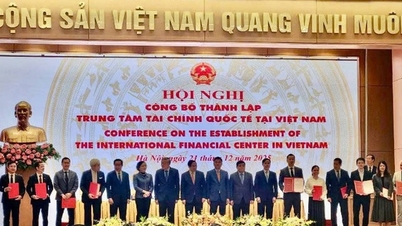
![[Photo] Prime Minister Pham Minh Chinh presides over the conference announcing the establishment of the International Finance Centre in Vietnam.](/_next/image?url=https%3A%2F%2Fvphoto.vietnam.vn%2Fthumb%2F1200x675%2Fvietnam%2Fresource%2FIMAGE%2F2025%2F12%2F21%2F1766309817714_ndo_br_dsc-3400-jpg.webp&w=3840&q=75)















































Comment (0)