

170 year old temple
Ong Bon Temple is located on Truong Phung Xuan Street, Ly Van Lam Ward, Ca Mau Province. The main gate is covered with curved tiles, decorated with a dragon at the top. The upper part of the gate has a row of yellow Chinese characters standing out on a red background: Phuoc Duc Temple. Below is a line of Vietnamese characters: Ong Bon Temple. In the main hall, on both sides of the pillars, there are parallel sentences written in Chinese characters praising Phuoc Duc Chanh Than for giving luck and peace to the people.
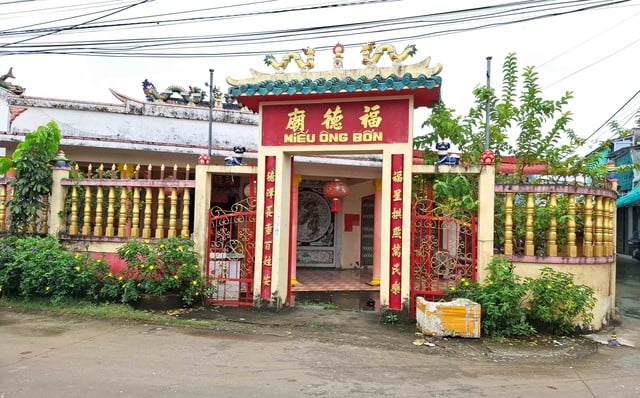
Ong Bon Temple Gate
PHOTO: HOANG PHUONG
"The Blessed Star Shines On All People, Bringing Happiness
Duc Trach Truong Thuy Bach Tinh An"
Below the Ong Bon statue altar is an altar to the tiger god.
Author Nghe Van Luong in Ca Mau Xua, An Xuyen Now wrote: Ong Bon Temple in the past had 2 royal decrees "Phuoc Duc Chanh Than" in the 8th year of Tu Duc (1856). The first royal decree had the word Lac Hoa and the second royal decree had the word Lac Hoi. In addition, on the altar in the main hall there was a red and gold-plated gong, a tablet engraved with the word "Than" very large and worshiped a wooden statue about 3 inches high that the people of Phuc Kien called Ong Bon.
Nowadays, the statue of Ong Bon has been remade larger, wearing a crown, with a five-stranded silver beard, and is placed in a solemn altar, with two frames of holes on both sides. The Chinese people of Fujian in Ca Mau believe that their Ong Bon is Trinh Hoa, one of the most famous admirals, explorers and diplomats in Chinese history during the Ming Dynasty, so he is worshiped as a guardian god, especially in the beliefs of seafarers, fishermen or merchants...
The old Ong Bon Pagoda was located at the junction of the Ganh Hao River. When the French arrived, the above location was requisitioned to build the office and the District Chief's residence, so the temple was forced to move elsewhere. After examining the terrain, the Chinese people of Fujian contributed money to move the pagoda to Rach Rap estuary, and rebuilt a new temple, which is the current location.
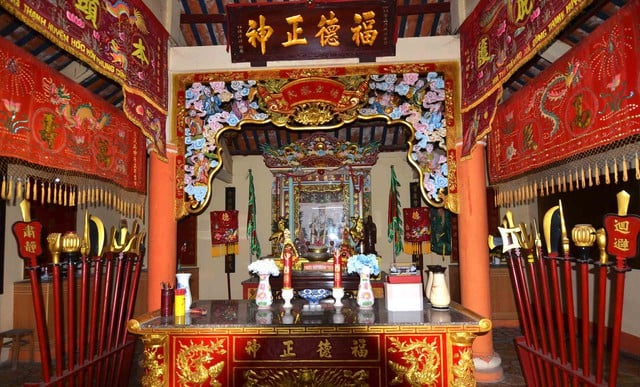
Main hall of Ong Bon temple
PHOTO: HOANG PHUONG
War broke out. In 1945, the temple was burned down, and the ancient banyan trees in front of the temple were gone. When the people of Phuoc Kien village returned from evacuation, they pooled their resources to rebuild a small temporary temple made of bamboo and leaves as a place of worship. It was not until 1960 that Ong Bon temple was rebuilt with bricks and tiles.
Unique village feast
The old Ong Bon Temple has two worshiping rituals: the 29th day of the third lunar month is the Ong's birthday and the 15th and 16th of the first lunar month every year. During each festival, hundreds of boats of the Phuoc Kien people in the Rach Goc and Nam Can areas, dozens of kilometers away, also gather to attend, filling a section of the river from Vam Rach Rap to the confluence of the Ganh Hao River.
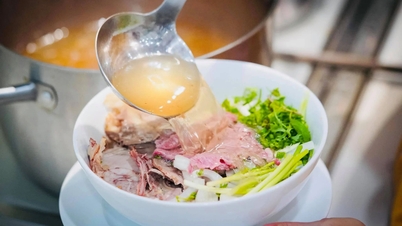
Offerings to Ong Bon also include pigs, chickens, cakes, fruits, incense and flowers... like in other temples. But here, there is a special custom that guests only eat fried noodles. This dish is called "mi ky" and is made from wheat flour, eggs and a small amount of lye water to increase the toughness, stir-fried with fresh oysters, dried shrimp and pork. During each festival, people make dozens of "chao dap" fried noodles to eat instead of rice. After the offering, the food is served on 9-10 sets of boards and then someone beats a gong loudly to let the villagers know and come to the party. But from 1960 onwards, the offering custom has changed. On the 15th day of the lunar month, people make offerings and eat vegetarian food, but on the 16th day, they make offerings of meat and the custom of eating fried noodles is no longer there.
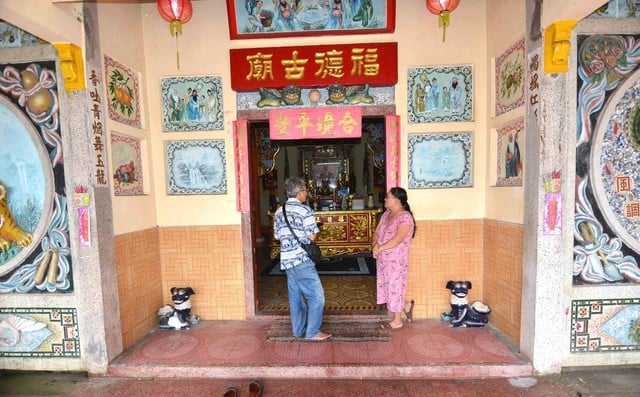
The keeper of the temple, Quach Thi My Van
PHOTO: HOANG PHUONG
Ms. Quach Thi My Van, 71 years old, the keeper of the Ong Bon temple, said that in the past, during the worship ceremony, people also held a planchette to ask "The Lord" for words to know their luck in the year. In particular, in front of the temple yard, there is an old tree stump. Whenever people were sick, they would come to pray and carve a piece of wood to bring home to boil water to drink, hoping to be cured.
Nowadays, the practice of using planchette to ask for words and healing with wood chips is no longer appropriate, so the temple's Board of Directors no longer allows it. The custom of worshiping Ong is only once a year on the 29th day of the third lunar month. Each time, dozens of feasts are offered, but they are held in restaurants and not cooked on-site like in the past. On this occasion, not only the Fujianese but also most of the Chinese and Vietnamese gather to offer incense and pray for Ong to bless their families and protect the country and its people, Ms. Van said. (to be continued)
Source: https://thanhnien.vn/chuyen-xua-tich-cu-xu-ca-mau-doc-dao-tiec-lang-o-mieu-ong-bon-185251203223757983.htm


![[Photo] Cat Ba - Green island paradise](/_next/image?url=https%3A%2F%2Fvphoto.vietnam.vn%2Fthumb%2F1200x675%2Fvietnam%2Fresource%2FIMAGE%2F2025%2F12%2F04%2F1764821844074_ndo_br_1-dcbthienduongxanh638-jpg.webp&w=3840&q=75)




































![[VIMC 40 days of lightning speed] Da Nang Port: Unity - Lightning speed - Breakthrough to the finish line](https://vphoto.vietnam.vn/thumb/402x226/vietnam/resource/IMAGE/2025/12/04/1764833540882_cdn_4-12-25.jpeg)
































Comment (0)