

Need to untie the "bottleneck" of teacher shortage
The Prime Minister has just approved the Project to make English the second language in schools for the period 2025 - 2035, with a vision to 2045. According to the draft of the Ministry of Education and Training (MOET), by 2045, English will not only be a subject, but will also become the language used in management, teaching and educational activities at nearly 50,000 institutions. This system serves about 30 million students and one million teachers and industry officials. That requires a strong force of English teachers in both quantity and quality.
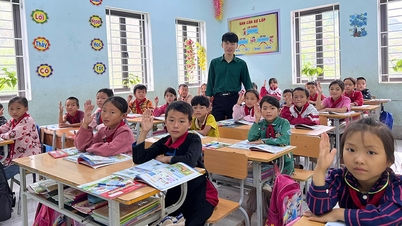
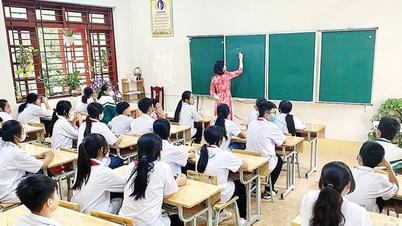
Current reality shows that, out of a total of more than 1.05 million preschool and primary school teachers, only about 30,000 teach English, mainly at primary and secondary levels. Particularly at preschool and grades 1-2, many localities have almost no teachers. In some mountainous areas, there are only a few English teachers in charge of dozens of schools, causing the organization of regular teaching and learning to be interrupted and patchy.
Mr. Lam The Hung, Deputy Director of the Department of Education and Training of Tuyen Quang province, pointed out another specific challenge: “Many first graders are not yet proficient in Vietnamese, so the requirement to learn English as the main language is very difficult to achieve. There needs to be a separate roadmap for specific regions.”
In large cities, the conditions for implementation are more favorable. Ho Chi Minh City is building a set of criteria for teaching in English, reviewing facilities, integrated programs and teacher evaluation standards. Meanwhile, in Hanoi, by the end of October, more than 600 primary school teachers had been trained on building an English environment in schools. However, many school leaders frankly said that many teachers still teach using old methods, lack updated learning materials, and are confused when applying English in science subjects because of limited bilingual ability.
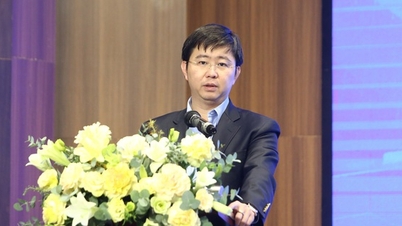
To successfully implement, experts emphasize that it is necessary to clearly distinguish between “teaching English” and “teaching in English”. Dr. Do Tuan Minh, Chairman of the Council of the University of Foreign Languages - VNU, analyzed: teaching English is to equip language; while teaching in English requires teachers to have the ability to use foreign languages fluently to teach Math, Science, History, etc. “It is impossible to suddenly switch. It is necessary to build a language ecosystem where students can listen - speak - interact every day”, Mr. Minh said, at the same time proposing to pilot in qualified facilities first and then expand.
The leaders of the Ministry of Education and Training identified “institutions and teacher training” as the two pillars of the project. Deputy Minister Pham Ngoc Thuong said that it is necessary to innovate the teacher training program and have appropriate remuneration policies for those who teach both English and other subjects in English.
English - the second language in the National Target Program 2026 - 2035
Discussing at the National Assembly about the National Target Program on Education Modernization for the 2026 - 2035 period, many delegates focused on the roadmap to make English the second language.
Delegate Huynh Thi Anh Suong (Quang Ngai) proposed to build a feasible and synchronous roadmap from facilities, textbooks to staff. According to her, the goal of "30% of preschools and general schools having English teaching equipment" by 2030 is feasible if funding is guaranteed, but must be accompanied by teacher training targets.
Delegate Ha Anh Phuong (Phu Tho) emphasized the big difference between teaching English as a foreign language and teaching it as a second language; at the same time, warned of the risk of waste if only focusing on equipment without improving teacher capacity and practice environment.
The issue of the lack of qualified teachers was reiterated by many delegates. Delegate Tran Khanh Thu (Hung Yen) said that the country lacks about 4,000 qualified English teachers; many teachers in mountainous areas are old and have difficulty accessing new methods. She proposed stronger attraction policies such as 70-100% basic salary allowance, housing support, and prioritizing investment in standard foreign language rooms for mountainous areas. Along with that, technology applications - online classes, AI - should be considered as solutions to make up for the shortage.
Many opinions suggest increasing decentralization, giving local authorities and schools the initiative in investment decisions, avoiding inappropriate centralized procurement. Public-private partnership (PPP) is considered an effective channel for resource mobilization, especially in developing learning materials, training teachers and equipping equipment.
The National Target Program 2026 - 2035 focuses on breakthroughs according to Resolution 71, not covering the entire education system. The total estimated capital by 2035 is about 560,000 - 580,000 billion VND, allocated for two periods 2026 - 2030 and 2031 - 2035. In the first phase, the central budget capital is about 100,000 billion VND, the local budget is 45,000 billion VND, the counterpart capital of schools is 20,000 billion VND and the expected socialized source is about 9,000 billion VND. Although the average figure for more than 54,000 educational institutions, 1.6 million teachers and about 25 million students is modest, this capital structure is still based on reality and has been assessed and synthesized by the Ministry of Finance from current national target programs to avoid duplication.
Source: https://baophapluat.vn/tim-loi-giai-cho-khoang-trong-giao-vien-tieng-anh.html


![[Photo] Cat Ba - Green island paradise](/_next/image?url=https%3A%2F%2Fvphoto.vietnam.vn%2Fthumb%2F1200x675%2Fvietnam%2Fresource%2FIMAGE%2F2025%2F12%2F04%2F1764821844074_ndo_br_1-dcbthienduongxanh638-jpg.webp&w=3840&q=75)



































![[VIMC 40 days of lightning speed] Da Nang Port: Unity - Lightning speed - Breakthrough to the finish line](https://vphoto.vietnam.vn/thumb/402x226/vietnam/resource/IMAGE/2025/12/04/1764833540882_cdn_4-12-25.jpeg)



































Comment (0)