

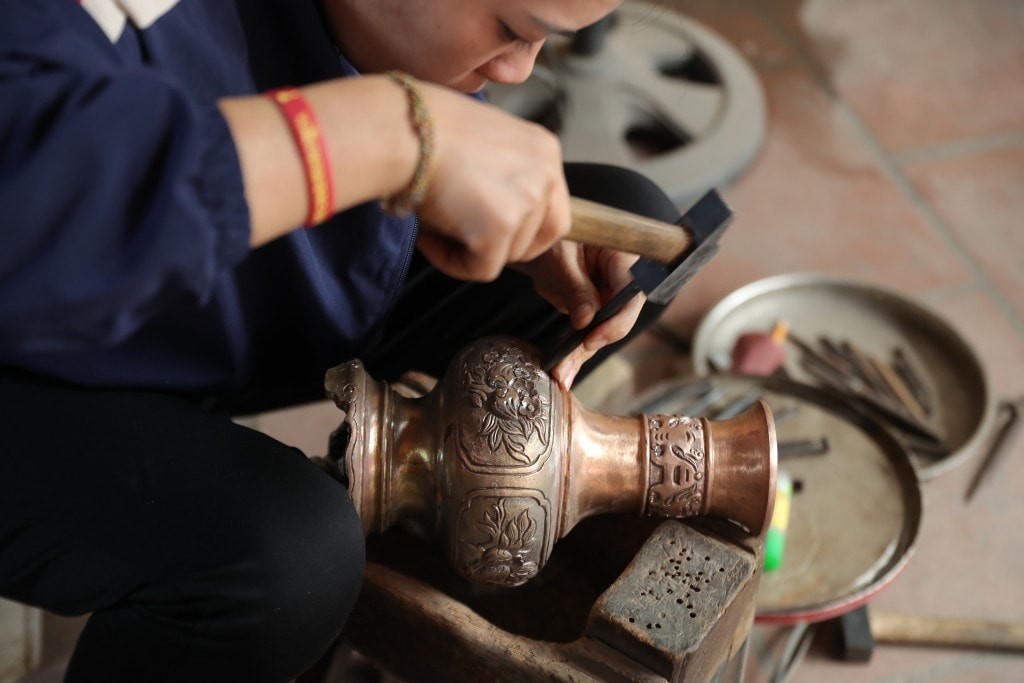
According to historical records, around the early Le Dynasty, bronze casters from five villages in what is now Van Lam (Hung Yen) and Thuan Thanh ( Bac Ninh ) came to Thang Long (Hanoi) to establish workshops for casting coins and religious artifacts. These five villages were Dong Mai, Chau My, Lang Thuong, Dien Tien, and Dao Nien. When they settled and established themselves in this new land, they named their settlements Ngu Xa, meaning "five villages," to commemorate their origins.
From mold making and copper melting to pouring, each stage demands absolute precision. The combination of long-standing experience, skillful hands, and a refined aesthetic sense has created bronze statues and religious artifacts found in many large temples and pagodas throughout the country.
When mentioning the pinnacle of bronze casting in Ngũ Xã, one cannot fail to mention the statue of Huyền Thiên Trấn Vũ at Quán Thánh Temple. This black bronze statue, 3.95 meters tall and weighing approximately 4 tons, was cast in 1677 during the reign of Lê Hy Tông. The majestic image of the Taoist master seated on the back of a turtle, holding a sword with a snake coiled around it, is proof of the masterful bronze casting techniques of the Ngũ Xã craftsmen in the 17th century. This is not only a unique sculptural work but also a spiritual symbol associated with the legend of Huyền Thiên Trấn Vũ helping An Dương Vương defeat demons while building Cổ Loa citadel.
Another masterpiece is the statue of Amitabha Buddha at Than Quang Pagoda (also known as Phuc Long Temple) in the village. The statue was cast in a single piece over three years (1950-1953), weighing more than 10 tons. The seated statue alone is nearly 4 meters tall, with a gracefully spreading lotus base of 96 petals. The process of moving the statue from the casting site to its final resting place, over 500 meters away, was accomplished entirely by human effort and meticulous planning – a remarkable feat of ingenuity and community solidarity.
Ngũ Xã Pagoda is dedicated to Buddha and honors Zen Master Nguyễn Minh Không – considered the founder of the bronze casting craft. Every year, on the 1st day of the 11th lunar month, the villagers hold a village festival to commemorate the founder of the craft and express gratitude to their ancestors.
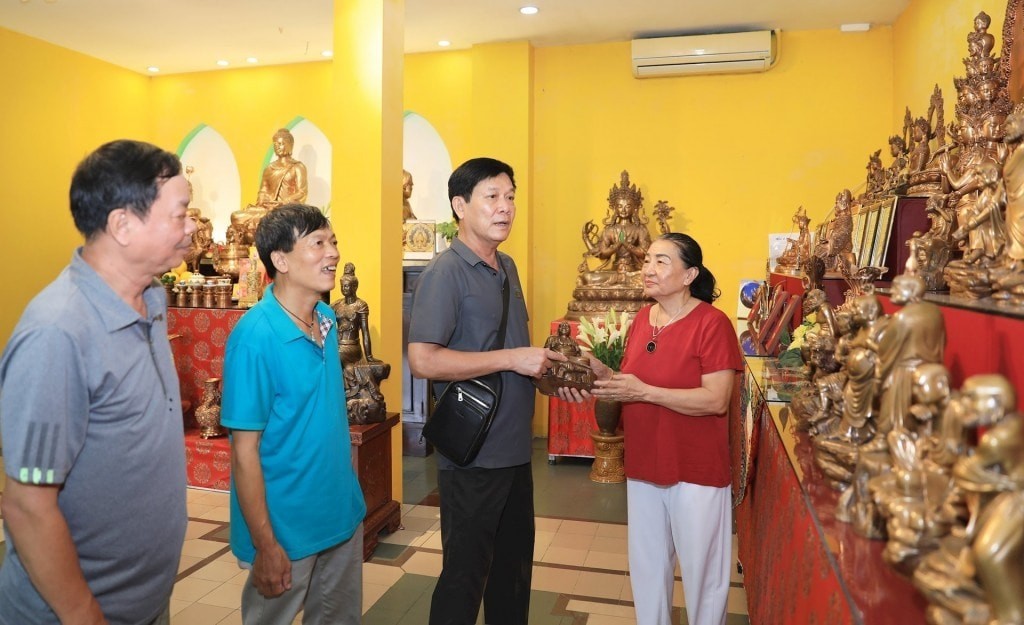
The revival of the bronze casting craft here is not just an economic story, but also a journey of preserving cultural identity.
Entering the 20th and 21st centuries, the bronze casting craft of Ngũ Xã continues to be preserved by dedicated artisans such as Mr. Nguyễn Văn Ứng and Ms. Ngô Thị Đan. In the context of rapid urbanization, with the absence of large open spaces for furnaces as in the past, production households have had to adapt, downsizing their operations while maintaining exquisite quality. Many large works, such as the Lotus Buddha statue, the Amitabha Buddha statue, and large bronze cranes, continue to be created, affirming the skill of Ngũ Xã craftsmen in this new context.
Today, Ngu Xa has become a bustling urban area. Tall buildings are gradually replacing the traditional village landscape. However, amidst the hustle and bustle, the sounds of chiseling and carving still echo in some small workshops, like the silent heartbeat of memory. Those who have left the village and returned can still recognize the "soul" of Ngu Xa in the exquisite details and intricate patterns on the copper products.
In the modern urban landscape, Ngu Xa remains a testament to the enduring vitality of Thang Long's traditional craft villages – where tradition and the present coexist, allowing the flame of the 500-year-old foundry to continue burning brightly in the heart of Hanoi .
Source: https://baolaocai.vn/500-nam-giu-lua-nghe-duc-dong-giua-long-ha-noi-post896071.html





















![[Photo] Prime Minister Pham Minh Chinh receives the Director of RMIT University Melbourne (Australia)](https://vphoto.vietnam.vn/thumb/1200x675/vietnam/resource/IMAGE/2026/04/02/1775142120087_thiet-ke-chua-co-ten-2026-04-02t214220784-png.webp)
























































Comment (0)