


Hanoi is known as a land where traditional craft villages converge. In the context of integration, these craft villages are gradually becoming a driving force for economic development. According to statistics from the Hanoi Department of Industry and Trade, revenue from Hanoi's craft villages is estimated at over 25,000 billion VND per year, creating jobs for approximately 800,000 workers. Handicraft products from the capital city have been exported to 89 countries and territories, including major markets such as the United States, the EU, Japan, South Korea, and China. To date, there are 100 craft villages with OCOP (One Commune One Product) products, with 929 products evaluated and ranked 3 stars or higher.
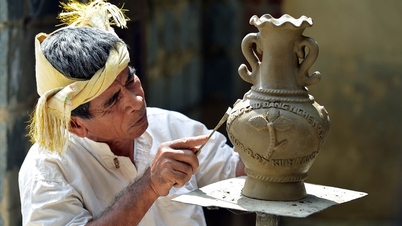
According to Mr. Vo Nguyen Phong, Director of the Hanoi Department of Industry and Trade, Hanoi has the most craft villages in the country, with approximately 1,350 villages with crafts and traditional crafts. Of these, 337 craft villages, traditional craft villages, and traditional crafts have been recognized by the Hanoi People's Committee, including 269 craft villages, 61 traditional craft villages, and 7 traditional crafts. Currently, Hanoi has 415 artisans, including 19 People's Artisans, 72 Outstanding Artisans, and 324 Hanoi artisans, playing a crucial role in preserving and developing traditional crafts. Beyond being production centers, craft villages have also become cultural tourism destinations, contributing to the socio-economic development of the locality.
Recognizing the great potential of craft village tourism, Deputy Director of the Hanoi Department of Tourism Nguyen Tran Quang said that Hanoi has identified the development of rural tourism and craft village tourism as an important direction, linked to the new rural development program, cultural heritage preservation, and sustainable local economic development. Currently, many craft villages in the capital are gradually exploiting their tourism potential, changing towards green and sustainable development, such as Quang Phu Cau incense village (Ung Hoa commune), Phu Vinh rattan and bamboo weaving village (Phu Nghia commune), Chang Son fan village (Thach Xa commune), or Ha Thai lacquer village (Duyen Thai commune)... These craft villages not only offer tourists the opportunity to explore the handicraft production process but also create unique cultural spaces rich in identity.
Despite their great potential and value, experts believe that traditional craft villages in the capital are currently facing numerous difficulties and challenges, and require a green transformation to develop and increase their attractiveness.
According to Nguyen Tien Dat, Vice President of the Hanoi Tourism Association, some craft villages lack systematic planning for tourism activities; infrastructure and services for tourists are still inconsistent. Tourism products in many places remain monotonous. In addition, environmental issues also pose significant challenges.
To ensure the sustainable development of craft village tourism in Hanoi, making it one of Vietnam's key tourism products, Mr. Dat suggested that localities should focus on "greening" craft villages by improving the environment and landscape. Investing in waste treatment systems, encouraging the use of environmentally friendly materials, and minimizing pollution during production will help ensure a healthy living environment for residents and create a positive impression on tourists. Simultaneously, beautifying the craft village space, planting trees, and preserving traditional architecture will also contribute to building green, clean, and beautiful craft villages.
From a management perspective, Mr. Ha Van Sieu, Deputy Director of the National Tourism Administration, shared that tourism consumption trends are shifting strongly from "sightseeing and shopping" to "diverse experiences, creativity, and a focus on local values." Tourists not only want to explore but also want to directly experience green consumption trends and the application of digital technology. This is both an opportunity and a challenge for Vietnamese craft village tourism to transform from a traditional model to creative, green tourism, keeping pace with global trends such as sustainable development, circular economy, and Net Zero tourism.
Source: https://daidoanket.vn/xanh-hoa-lang-nghe.html
![[Photo] General Secretary and President To Lam presides over a meeting on assessing national development resources.](https://vphoto.vietnam.vn/thumb/1200x675/vietnam/resource/IMAGE/2026/05/20/1779253785852_a1-bnd-2943-8519-jpg.webp)














































































Comment (0)