

The agreement between Mr. Biden and the Speaker of the US House of Representatives addresses many important budgetary issues, the most crucial of which is the provision to prevent government default.
Just days before the US government was on the verge of default, President Joe Biden and House Speaker Kevin McCarthy announced on the evening of May 27th that they had reached an agreement on the debt ceiling and secured funding for the government for the next two years.
President Biden hailed it as a "significant step" that would eliminate the threat of a "catastrophic default" and protect the momentum of the American economic recovery. The agreement will be considered by the US House of Representatives and the Senate, with some key points already agreed upon by the White House and McCarthy during tense negotiations.
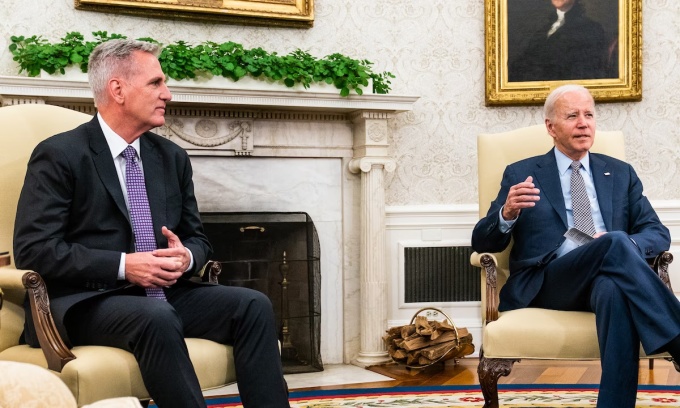
US President Joe Biden (right) and House Speaker Kevin McCarthy at the White House on May 22. Photo: Washington Post
Let's put the debt ceiling issue aside.
The agreement will suspend the limit on how much the U.S. government can borrow until January 1, 2025, preventing a potential default on June 5 if the debt ceiling is not raised.
This has always been a top priority for President Biden because he never wants an economic disaster caused by default to occur during his term.
Extending the debt ceiling for another two years means Congress won't have to deal with the issue until after the 2024 presidential election. If President Biden is re-elected and the Democrats regain control of the House of Representatives after the election, a US default is unlikely, according to observers.
Set spending limits for two years.
The agreement sets annual spending limits for the government over the next two years, keeping non-defense spending unchanged in 2024 and increasing it by 1% in 2025.
This means that funding for domestic programs, in addition to Social Security and Medicare, will remain unchanged. The agreement also aims to increase funding to improve healthcare for veterans.
This is seen as a concession by the Republicans, who initially wanted to set an annual government spending cap for the next 10 years.
Increased demands for welfare programs
The final sticking point before President Biden and Chairman McCarthy reached an agreement was the dispute over increasing job requirements for beneficiaries of welfare programs, something Republicans wanted to push for but the White House opposed.
According to the final agreement reached by both parties, the Supplemental Nutrition Assistance Program was modified, requiring healthy adults aged 54 and under without dependent children to receive food assistance vouchers only for a limited time if they are unable to meet certain specific job requirements.
But the agreement would also increase food assistance for the homeless and veterans, a provision seen as a victory for the White House.
The agreement sets out additional employment requirements for those receiving benefits from the Temporary Assistance for Needy Families program, but makes no changes to Medicaid, which President Biden has insisted he will not support.
Reduce the budget for the US Internal Revenue Service.
Another concession the Republicans secured was an agreement to recover $10 billion of the $80 billion in funding for the Internal Revenue Service (IRS) approved under President Biden's Inflation Reduction Act last year. This act was enacted to give the IRS greater capacity to combat tax evasion by wealthy individuals and large corporations.
Increasing the IRS budget has long been a target of criticism from Republican members of Congress. They have consistently expressed dissatisfaction with the IRS hiring an additional 87,000 auditors and tax officials, who will intensify investigations into tax evasion.
The $10 billion budget that the Biden administration plans to allocate to the IRS aims to modernize a tax agency that is understaffed, with the goal of cracking down on property tax fraud.
The US tax deficit has increased significantly, from $441 billion per year between 2011 and 2013 to $584 billion in 2019. Over the next decade, this deficit is estimated to reach $7 trillion.
Recover unused Covid-19 relief funds.
Responding to further calls from Republicans, the agreement would recover billions of dollars in unspent Covid-19 relief funds.
A memo circulated among Republican House leadership indicated that the restrictions would include a $400 million cut from the U.S. Centers for Disease Control and Prevention's Global Health Fund.
Opponents of the provision expressed concerns that the funding cuts would impact efforts to prepare for the next pandemic and affect crucial funding from a public health system already facing budget shortfalls. House Democrats said the government still needs the money to keep the National Strategic Stockpile fully stocked with essential medical supplies.
A Democratic source familiar with the matter said President Biden's priority regarding Covid-19 funding is "to protect money for public health, which we can do."
Maintain tax incentives for the wealthy.
President Biden hopes to limit spending cuts by increasing revenue through measures such as revoking tax breaks granted by former President Donald Trump in 2017 to the wealthiest Americans and corporations, and closing tax loopholes exploited by the super-rich.
But the agreement reached with House Speaker McCarthy made no mention of this issue at all, meaning that tax breaks for wealthy Americans remain in effect.
With the tax system yet to be addressed, President Biden is likely to make the call for wealthy Americans to "pay their taxes fairly" a central focus of his re-election campaign, experts predict.
The White House has also succeeded in its efforts to keep the Inflation Reduction Act and the President's program to forgive student loans, which could impact millions of Americans.
Republicans had previously proposed eliminating both laws. The most significant change to student loans would be requiring borrowers, who had their monthly payments temporarily suspended during the pandemic, to begin repaying the government.
However, the fate of the agreement remains uncertain, as it must be approved by both houses of Congress. Conservatives have opposed the deal, arguing that it is insufficient to cut federal spending, while some liberals worry that it will sacrifice funding for their core priorities.
"I earnestly urge both houses of Congress to approve that agreement," President Biden declared after announcing the deal he had worked so hard to reach with House Speaker McCarthy.
Vu Hoang (Based on Washington Post and USA Today )
Source link





































































































Comment (0)