 |
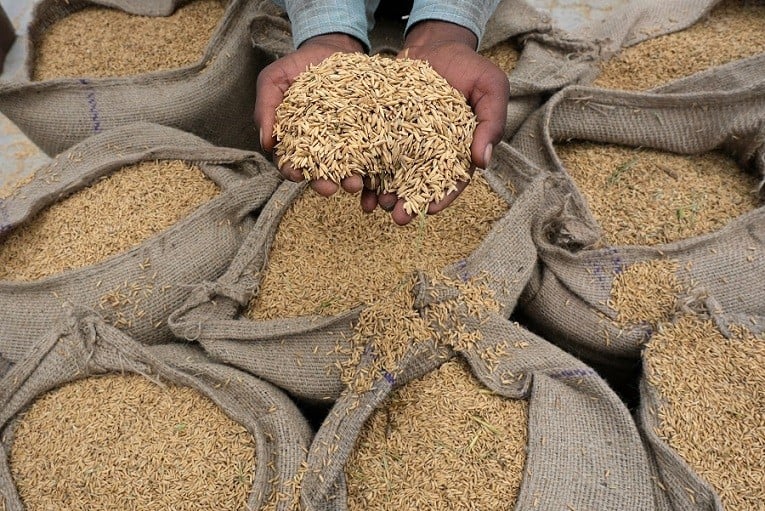
| With the latest tariffs, Indian parboiled rice will become as expensive as rice from Thailand and Pakistan. (Source: Bloomberg) |
The decision was announced by the Indian Ministry of Finance on the evening of August 25th to control rising prices while ensuring sufficient supply for the domestic market. With this new measure, India has now imposed export restrictions on all non-basmati rice varieties, which account for 25% of the country's total rice exports.
Imposing a 20% tariff on parboiled rice exports could further drive up its price on the world market. Parboiled rice is rice in which the paddy is soaked in hot water before processing.
A Mumbai-based dealer said the earlier ban on exporting all rice except basmati rice had prompted some customers to increase their purchases of parboiled rice, driving its price to record highs.
With the latest tariffs, parboiled Indian rice will become as expensive as rice from Thailand and Pakistan. Buyers now have virtually no other options.



A Mumbai-based dealer pointed out that global rice prices have begun to stabilize in the past few days after surging by more than 25% due to India's export restrictions last month. However, prices are expected to rise again following this move.
In July 2023, the United Nations Food and Agriculture Organization's rice price index rose to its highest level in nearly 12 years. This development was due to soaring prices in key rice-exporting countries driven by strong demand following India's imposition of export restrictions.
The price of Vietnamese 5% broken rice on August 24th was quoted at 650-660 USD/ton, compared to 660 USD/ton a week earlier. Meanwhile, the price of Thai 5% broken rice for export also increased to 630 USD/ton from 615-620 USD/ton last week.
Prices of agricultural commodities under futures contracts on the Chicago Mercantile Exchange (USA) moved in opposite directions during the weekend trading session, with corn and wheat prices falling while soybean prices rose.
At the close of trading, December 2023 corn futures fell 0.25 US cents (0.05%) to $4.88 per bushel. December 2023 wheat futures fell 10 US cents (1.58%) to $6.2175 per bushel. Conversely, November 2023 soybean futures rose slightly by 16 US cents (1.17%) to $13.8775 per bushel (1 bushel of wheat/soybeans = 27.2 kg; 1 bushel of corn = 25.4 kg).



Observers say wheat futures prices fell due to the strengthening US dollar. On the other hand, US and global agricultural markets maintained high prices while awaiting the Pro Farmer survey report. This is the most thorough and closely watched report on potential yields at this crucial time of the season.
The risk of average soybean yields across the U.S. falling to or below 50 bushels per acre and corn yields falling to 170-173 bushels per acre is growing. Chicago-based agricultural market research firm AgResource is recommending that traders buy on price corrections over the next 10 days.
Source
![[Photo] Prime Minister Le Minh Hung presides over the thematic session on promoting science and technology development and innovation.](https://vphoto.vietnam.vn/thumb/1200x675/vietnam/resource/IMAGE/2026/06/23/1782207872934_ndo_br_dsc-1724-jpg.webp)