

However, amidst expectations of making AI a universal skill, many experts warn that limitations in teacher training, infrastructure, and rote learning habits could hinder the program's effectiveness.
According to an announcement from the Ministry of Education late last month, AI education will be “naturally integrated” starting in grade 3, instead of being taught only at the secondary school level as is currently the case. The government is committed to providing guidance materials, teacher handbooks, and digital resources by December 2025 to support schools. Prior to this, since 2020, AI has been included in the curriculum as part of the new National Education Policy, alongside other contemporary subjects such as environmental education.
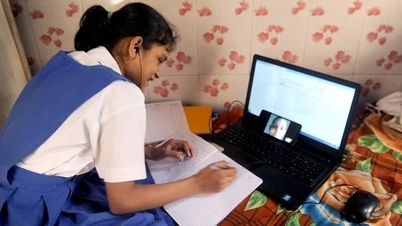
Currently, public schools and some private schools offer 15-hour AI skills modules for students in grades 6 through 8 and AI-related elective courses for high school students. Expanding down to the preparatory level, the number of children with access to AI education is projected to reach nearly 200 million by 2026.
However, significant challenges lie ahead. Many experts fear that the heavy workload will place immense pressure on teachers, who are still struggling with basic technological skills.
Akshay Mashelkar, founder of the educational organization Experimind Labs, commented: “Introducing AI into schools is a positive step because free tools are readily available. However, expecting teachers to be able to teach AI immediately is unrealistic, especially since the majority of teachers are not yet familiar with digital teaching methods.”
Furthermore, technological infrastructure is also a major issue. Data from the Ministry of Education shows that only 63% of schools have internet access and 65% have computers, but only 58% of these computers are functioning properly. This means that more than a third of schools lack the basic resources to implement AI education.
In many rural areas, the limitations are even more severe. Some schools have only one shared lab for multiple grade levels, and students sometimes have to huddle around a single computer at lunchtime just to access Wi-Fi.
Methodologically, experts recommend that AI education for young children should be visual and connected to real life, rather than overly technical. They suggest using games, stories, and illustrations related to familiar environments, such as voice assistants, weather apps, or translation tools, to help children understand AI naturally.
Yamini Aiyar, former Chair of the Centre for Policy Research, stated: “The biggest weakness of the Indian education system is rote learning, which could derail AI education. If students only learn to pass tests and don’t develop critical thinking skills, then even AI knowledge can reinforce outdated learning habits. The most important skill is questioning data.”
Source: https://giaoducthoidai.vn/an-do-day-ai-cho-tre-tu-8-tuoi-post759133.html











































































Comment (0)