

 |
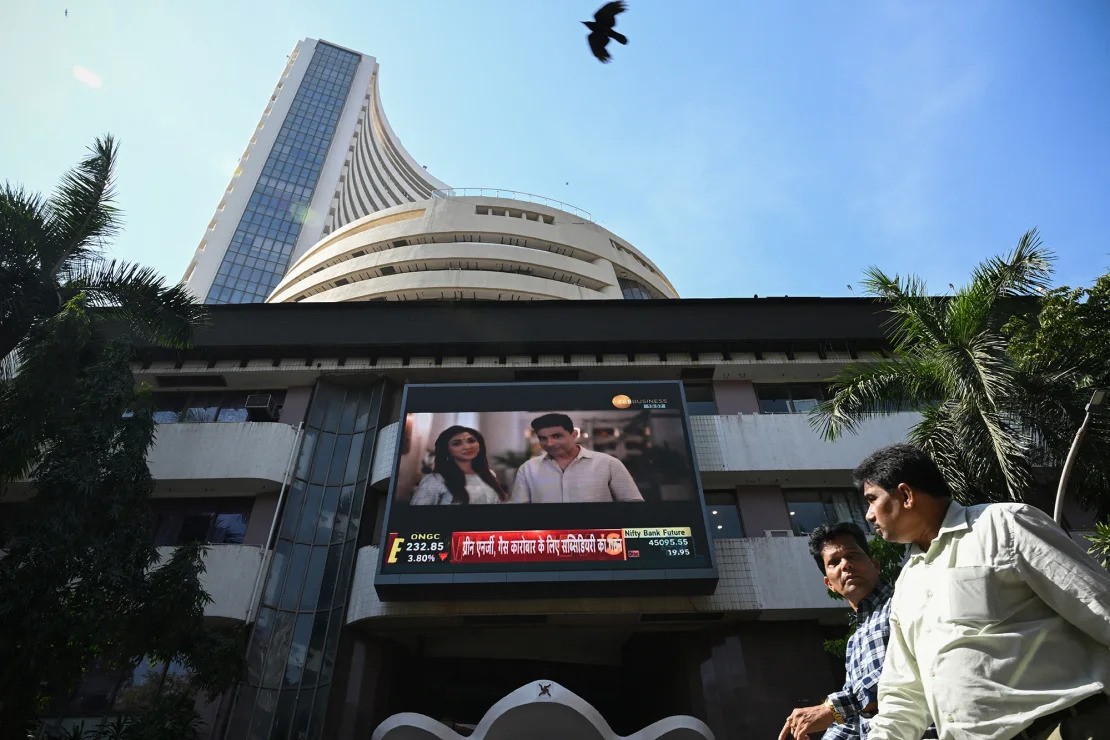
| Pedestrians walk past the Bombay Stock Exchange building in Mumbai, India. (Source: Getty Images) |
The optimism in the world's most populous country stands in stark contrast to China, which is facing a multitude of economic challenges.
The stock market of the world's second-largest economy has suffered a prolonged decline since its recent peak in 2021. Approximately $5 trillion in market value has been wiped out from the Shanghai, Shenzhen, and Hong Kong (China) exchanges. Foreign direct investment (FDI) also saw a sharp decline last year.
Confidence in the stock market
Meanwhile, in India, the stock market is reaching record highs. The value of companies listed on the South Asian country's exchanges surpassed $4 trillion by the end of last year.
The future looks even brighter.
According to a report by investment bank Jefferies, India's market value is expected to more than double to $10 trillion by 2030, making it an attractive prospect for major global investors.
Peeyush Mittal, a portfolio manager at Matthews Asia, a San Francisco-based investment fund, argues that no country can replace China except India. In a way, it is the alternative the world is perhaps looking for to fuel growth.
Japan has benefited from investors seeking alternatives to the world's second-largest economy. Last week, the Japanese stock market hit a new high for the first time in 34 years, driven by improved corporate earnings and a weak yen.
But the country is mired in recession and recently lost its position as the world's third-largest economy to Germany.
Drivers of global growth
There are many good reasons to believe in the promising growth trajectory of the Indian economy. From its young population to the productivity of its factories, the country has many advantages.
The International Monetary Fund (IMF) projects India's growth at 6.5% in fiscal year 2024, compared to China's 4.6%.
Analysts at Jefferies also expect the country to become the world's third-largest economy by 2027.
Like China more than three decades ago, the South Asian nation is beginning to upgrade its infrastructure, spending billions of dollars to build roads, ports, airports, and railways.
Aditya Suresh, head of Indian equity research at Macquarie Capital, sees a “very strong multiplier effect” on the Indian economy.
Amidst global businesses seeking to diversify away from China, Hubert de Barochez, a market economist at Capital Economics, argues that New Delhi is a leading candidate to benefit from this supply chain shift.
In fact, some of the world's largest companies, such as Apple's supplier Foxconn, are expanding their operations in India. In June 2023, Tesla CEO Elon Musk stated that the company was looking to invest in India "as soon as possible."
Sustainable growth
While interest in the world's fifth-largest economy is rising, soaring stock prices on the Indian stock exchange are scaring some international investors.
Furthermore, a potential challenge that experts see is that India is unable to absorb all the money flowing out of China.
However, New Delhi has healthy ties with the West and other major economies. The South Asian country is actively attracting large companies to set up factories there.
In a recent budget speech, Indian Finance Minister Nirmala Sitharaman stated that FDI inflows since Modi first came to power in 2014 have reached nearly $600 billion, double the amount from a decade earlier.
"To encourage sustainable foreign investment, we are negotiating bilateral investment agreements with foreign partners," added Ms. Nirmala Sitharaman.
History has shown that the Indian economy has experienced relatively sustainable growth. From 2004 to 2010, the country's Gross Domestic Product (GDP) growth rate averaged 7.2%. Even in 2022 and 2023 – a challenging period globally – the country still achieved impressive growth.
This partly supports the assessment of experts on CNN : "It's difficult to stop the economic power that India has unleashed."
Source
![[Photo] Prime Minister Pham Minh Chinh presides over a meeting on private sector economic development.](/_next/image?url=https%3A%2F%2Fvphoto.vietnam.vn%2Fthumb%2F1200x675%2Fvietnam%2Fresource%2FIMAGE%2F2025%2F12%2F20%2F1766237501876_thiet-ke-chua-co-ten-40-png.webp&w=3840&q=75)
































































































Comment (0)