


In China, the Bingjiao restaurant in the Forbidden City is crowded but the service is quick and professional, and the tables, chairs, floors, and walls are all clean.
Reader Trinh Hang (over 40 years old, Hanoi ) and her daughter traveled to China in early June. She shared her experiences from the trip with VnExpress .
Once the most mysterious and heavily guarded area throughout Chinese history across many dynasties, the Forbidden City now welcomes millions of visitors every year. You can even have lunch right inside the Forbidden City for as little as 150,000 VND.
Located in the heart of Beijing, the Forbidden City is a famous iconic landmark of China. Recognized by UNESCO, the Forbidden City is cherished worldwide for its cultural and historical value.
To visit the Forbidden City, you need to be in good health and have patience and endurance. It is one of the largest palaces in the world, far exceeding the size of the Kremlin (Russia) and Buckingham Palace (England). All transportation must stop quite far from the entrance, so visitors need to walk at least 1 km from the parking area to the ticket counter, and then walk hundreds of meters from the ticket counter to the main gate.
To explore the entire Forbidden City, even a fast-paced visitor needs 4-5 hours and many kilometers of walking. Some people spend the whole day there. Tens of thousands of visitors come here every day, and you will have to queue through multiple levels to get to the entrance. Most visitors will need to eat and drink during their tour of this colossal structure. There are also many free, modern, and clean restrooms available.
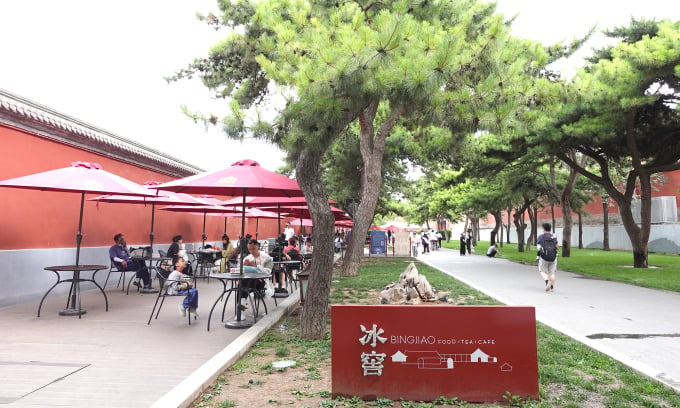
The outdoor seating area of Bingjiao restaurant.
Despite its strict security, the Forbidden City allows visitors to bring their own food and drinks inside, and there are numerous restaurants with varying price ranges within the grounds. Most palaces, castles, and historical sites around the world that we've visited don't allow this, both to protect the monuments and to ensure hygiene.
After a morning visiting the palace, we stopped at Bingjiao – a rather unpretentious restaurant that utilizes the former ice cellar of the Forbidden City. The restaurant's modest sign is placed directly on the ground, using the red of the palace walls as its main color scheme to avoid disrupting the overall landscape. The indoor and outdoor areas have dozens of tables and chairs, all fully occupied. If the weather is nice, you can dine outdoors while enjoying the view. Bingjiao's interior is Western-style with cool tones, reminiscent of the former ice cellar, including white chandeliers that create a luxurious and comfortable atmosphere.
At the restaurant, you can tour the royal ice and food storage area, which still retains its underground basement and thick, 2-meter-thick stone walls that are over three hundred years old. Built during the Qing Dynasty and originally intended to serve only a select few, the ice cellar now welcomes hundreds of diners every day.
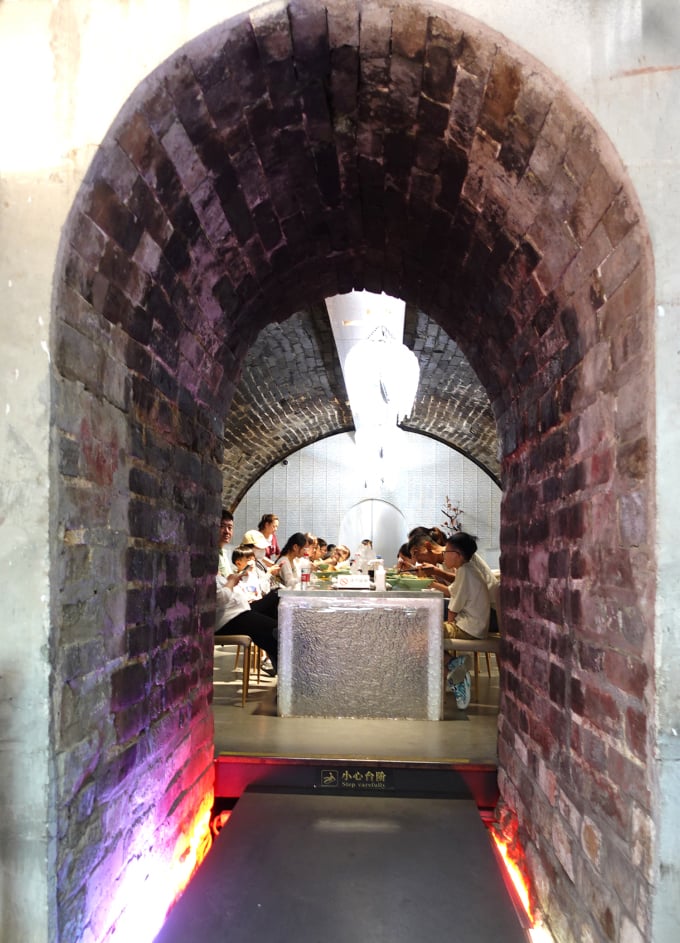
The ice cave and the rock wall are 2 meters thick.
Bingjiao was busy but the service was quite fast and professional. All the tables, chairs, floors, and walls were spotless, with no stains or dirt. Diners enjoyed their meals in comfort and tranquility, unlike the noisy atmosphere of other crowded restaurants.
Bingjiao's menu features traditional dishes like rice, noodles, and pastries. Designed for a diverse international clientele, the menu includes a well-balanced blend of Eastern and Western elements. We ordered a beef stew noodle set and a mushroom noodle set, both served with eggs, vegetables, and salad with Western-style dressing.
Noodles are a familiar dish to us, but back home we had never tasted the combination of braised beef and noodle soup like here. Unexpectedly, the dish offered a unique and delightful flavor. The braised beef was tender with white radish, seasoned generously but not greasy, and served with light noodles and blanched vegetables. The broth was clear and had an attractive brown color, rich but not overpowering. Lunch with two sets of noodles in the heart of China's most famous cultural heritage site cost a total of 104 yuan, equivalent to approximately 343,000 VND.
The next day, upon visiting the National Museum of China (also in Tiananmen Square), we learned that this is a quintessential Chinese dish. Braised pork noodles are presented in a model and displayed prominently in a museum room, highlighting the dish's importance to Chinese life. This is perhaps why the Forbidden City features this dish – an effective way to satisfy tourists' culinary needs while showcasing Chinese cuisine to visitors from all over the world, at a relatively affordable price.
The Forbidden City has been open to visitors for nearly 100 years. During peak months (April to October), the palace is open from 8:30 AM to 5:00 PM, with an entrance fee of 60 RMB. During the rest of the year, it is open from 8:30 AM to 4:30 PM, with an entrance fee of 40 RMB. It is closed every Monday. Visitors need to book tickets at least one day in advance. For more information about the exhibitions inside the Forbidden City, please refer to the official website.
To visit the Forbidden City, you can take subway Line 1 for 3 RMB (approximately 10,000 VND) to Tian'anmen Dong (E) Station, or take a bus or taxi to the Meridian Gate (Wu men). Like most historical sites in China, the Forbidden City is protected by multiple layers of security. Visitors need to present identification, have their photos taken, undergo facial recognition, and have their luggage screened. It's advisable to bring minimal belongings.
If you have plenty of time and are in good health, you can combine walking tours with visits to many nearby attractions such as the National Museum of China, the Monument to the People's Heroes, and Wangfujing Street.
Trinh Hang
Source link

































![[Image] National Conference on studying, understanding, and implementing Resolutions No. 79 and No. 80 of the Politburo](https://vphoto.vietnam.vn/thumb/402x226/vietnam/resource/IMAGE/2026/02/25/1771990845625_anh-man-hinh-2026-02-25-luc-10-40-34.png)













Comment (0)