The terrible disease of cancer ended his life at the age of 68, an age when he had just finished paying off his debts to his family and children, and could hopefully enjoy a few years of peaceful retirement. His dreams were countless: tending his garden, digging a pond for fish farming, building a thatched hut where his siblings, friends, and grandchildren could come to relax and have fun in the evenings.
The fruit trees he planted in the garden have borne fruit, and the next generation is just beginning to sprout new shoots and spread their branches. This year's cashew harvest seems to lack him, as there aren't as many fruits as when he was alive. The pond he dug now has big fish, but the whole place looks so desolate and sad!
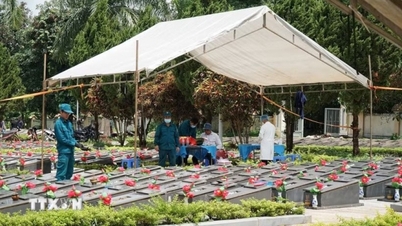
In the afternoon, I visited his grave, lighting three incense sticks to add warmth to the altar with their smoke. Looking at the plate of mangoes my sister had just picked from the garden to offer to him, I thought, "This is for you, brother. Come home and taste the first fruits of the season that you planted—are they sweet or sour?"
The afternoon turned rainy, the sky was murky, and a gloomy wind blew, sending chills down everyone's spine. The stone table under the plum tree, where my brothers and I and our friends from the neighborhood used to sit and chat, was now empty, with only dried plum leaves and a black cat curled up in a corner.
Brothers and sisters remember you, friends remember you, the village remembers you. We remember the name Bay Den, and every time he was tipsy, it was "My love from Quang Nam." We remember the boiled corn you brought from home to Doi Duong to give to your friends to eat and celebrate class reunions. We remember those late Tet celebrations by the Dinh River, the freshwater fish stewed with turmeric, the pickled melons you made. We remember the roasted peanuts you brought on the bus from Binh Thuan, and we sat munching on them all the way to Quang Nam without finishing them.
He didn't have much formal education, but he was very talented. Seeing people weaving baskets, he could do it after just a few glances; seeing an artist paint a portrait, he would buy paper, rulers, and ink to draw as well as a professional painter; and he could sew trousers and shirts, and do embroidery as well. He was also very good at writing prose and spoken language.
You may also like
Bringing love to our compatriots in the border region of Quang Tri.250 gift packages and many meaningful activities were distributed to the people and children of Huong Phung commune (Quang Tri province), contributing to sharing difficulties and spreading the spirit of compassion in this border region.
Lam Dong's coastal tourism is bustling in the early days of the new year.In the early days of the new year, coastal tourist areas in Lam Dong province welcomed a large number of visitors. The atmosphere of recreation and relaxation was vibrant, creating positive momentum for the tourism development goals in 2026.
A unique festival held only once every 10 years in Da Nang.Amidst the fast-paced urban life, Cam Ne village (Hoa Tien commune, Hoa Vang district, Da Nang city) still preserves a traditional festival deeply rooted in rural culture. The village festival is held once every 10 years.
But he only did it for fun, nothing professional. His main occupation was farming, the real kind of farming, without any pretense. He raised six children from infancy to adulthood, during the subsidy period, a time of great economic hardship, feeding them with a hoe, free-range chickens, a few pigs, potatoes, corn, beans, cashews... Now all six have their own families and stable lives.
Speaking of the hardships of raising children, I still vividly remember two anecdotes he used to tell me whenever he was slightly drunk. These stories were no less dramatic than the tales of Mrs. Dậu in Ngô Tất Tố's *Chả Dậu*.
Around 1978-1979, his family lived in the Ta Pao New Economic Zone in Huy Khiem commune, Tanh Linh district, Thuan Hai province (now Binh Thuan). This zone, established in 1976, was mostly populated by people from Quang Nam and Quang Tri provinces . During the subsidy period, with cooperative farming, performance-based pay, newly opened undeveloped land, and restricted trade routes, disease and food shortages were rampant, especially during the lean season and the Lunar New Year.
He recounted that during that Tet holiday, his family of five had nothing left to feed. By the 24th of Tet, they had no rice or sweet potatoes left. His wife had to go around the neighborhood borrowing money, but it only helped them get by, because everyone was struggling and poor; there wasn't much left to lend. They had to endure hardship and ration their food. But looking at their children, whose clothes were all tattered, it broke their hearts. On the evening of the 25th of Tet, the couple sat with their knees bent, thinking about what they could sell to buy their children new clothes so they could celebrate Tet with their friends.
After much thought, he decided to take his old pair of trousers, the khaki green ones he wore in high school before the liberation. Later, after getting married and moving to a new economic zone, spending his days working in the fields, the trousers became a cherished memento lying dormant in the corner of his closet. The trousers were worn at the back, but because he rarely wore them, they didn't look too bad. He cut off the two trouser legs, unstitched the seams, and turned them inside out – wow, they were still quite new! He lit a lamp, meticulously measured, cut, and diligently sewed them until morning. So, this Tet holiday, Ý Anh would have "new" trousers – what a relief, a huge weight lifted off his shoulders!
Regarding the clothes for his two daughters, he discussed with his wife the idea of selling the dog in Phuong Lam to get money for them to buy new clothes, and if there was any left over, they could buy some candy and snacks to make the children happy.
There was no other way; I felt sorry for the stray dog that had been so loyal to the family for so many years, but I had no choice!
Strengthening the friendship between Vietnam and the United States.On July 3rd, as part of the Pacific Partnership - Friends of the Pacific 2026 program, the U.S. Army Pacific delegation, led by Lieutenant General Joel Vowell, Deputy Commander of the U.S. Army Pacific, paid a courtesy visit to the Quang Tri Provincial Military Command.
At dawn on the 27th day of the lunar year, he called the dog to feed it, petted it one last time, then hugged it and put it in a cage, tying it to the back of his old bicycle. The road from Ta Pao to Phuong Lam was long and arduous; the mountain roads were deserted as Tet approached. He hunched over, pedaling hard to reach Phuong Lam in time for buyers. At noon, the sun blazed, and sweat drenched him. Just after passing through Duc Linh district, he suddenly felt a chill run down his spine. He hadn't anticipated that on the other side of the border, a checkpoint loomed large, with men in red armbands looming. He knew that if he carried the dog past the checkpoint, it would definitely be confiscated or taxed, and then what would he use to buy Tet gifts for his children? Should he take the dog back? After much thought, he exclaimed, "How stupid! It's my dog. I should let it out. It's far from home; it'll definitely run after me." Without hesitation, he parked his motorbike, untied the cage, released the dog, rolled a cigarette, and calmly rode the cage past the checkpoint, with the dog wagging its tail as it followed behind.
Having narrowly escaped danger, he cycled far from the station, then parked his bike by the roadside, waiting for the dog to arrive. The dog, relieved to see its owner, wagged its tail and nuzzled its head against its owner's lap. At this point, the feeling of relief at escaping danger had almost vanished, replaced by an indescribable feeling of remorse and sadness. Tears welled up in his eyes as he stroked the dog and gently put it back in its cage, just like he had done at home at dawn. On the way to Phuong Lam market with the dog, he was like a man possessed, grieving for his two children in their tattered clothes and for the loyal dog that had been with him for so many years. Only when someone offered to buy the dog did he decide to sell it immediately, to end this heartbreaking situation. The buyer took the dog away; the dog looked at him, he looked at the dog, and tears streamed down both their eyes.
That Lunar New Year, his children had new clothes and some gummy candies. But he carried his sadness until the day he died!