However, instead of viewing it merely as an environmental burden, many experts argue that construction waste can be transformed into a valuable resource for development if managed and recycled according to a circular economy model.
Pressure from large construction sites
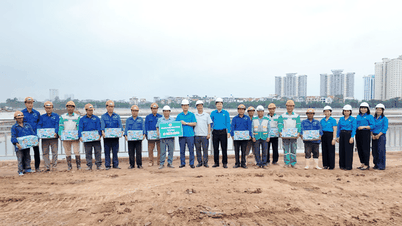
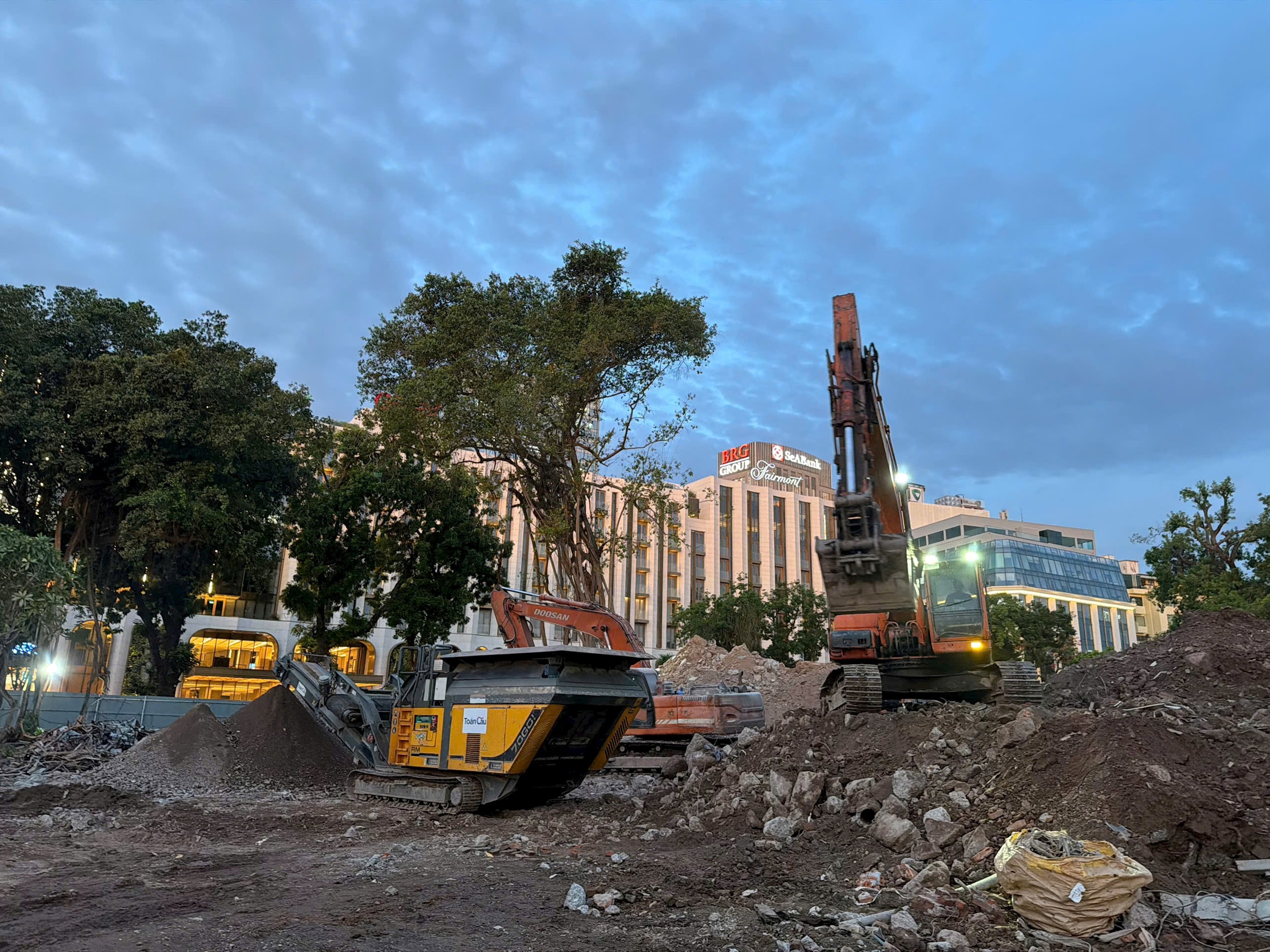
In the first few months of 2026, Hanoi witnessed a bustling construction atmosphere at many key construction sites. A series of transportation, technical infrastructure, and urban renovation projects were accelerated to meet the development requirements of the capital city. Simultaneously, a large volume of soil, rock, concrete, broken bricks, and demolition materials was generated daily.
According to Mr. Nguyen Van Quy, Head of the Solid Waste Management Department of the Hanoi Department of Agriculture and Environment, since the beginning of the year, along with the simultaneous implementation of many key construction investment projects such as flood control works, river bridges, and ring roads, the amount of construction solid waste generated in the city has increased sharply.
Meanwhile, existing construction waste treatment facilities in the area are operating at a total capacity of approximately 1,500 tons/day, which basically only meets the average daily waste generated, not including the waste generated from the large-scale construction sites currently underway.
According to Mr. Nguyen Van Quy, this situation is creating significant pressure on the city's construction waste management. First and foremost, it puts pressure on the collection and transportation system as the volume of waste increases dramatically, leading to a greater demand for vehicles and increased transportation frequency. Without strict control, the transportation process could generate dust and spill materials, affecting the environment and the lives of residents.
In addition, existing treatment facilities are also at risk of being overloaded. In many cases, the city has to arrange temporary collection points for storage before transporting the waste to designated treatment facilities.
More concerning is the risk of illegal dumping sites emerging. When processing capacity fails to keep pace with the rate of waste generation, the illegal dumping of construction waste in vacant lots, along roadsides, or in suburban areas can occur, causing urban blight, environmental pollution, and directly impacting the lives of residents.
As can be seen, along with the rapid urban development, the problem of construction waste is becoming one of the new challenges for Hanoi's urban environmental management.
From waste to resources
While construction waste was previously primarily viewed as a type of refuse to be collected and disposed of, many countries around the world are now approaching it from a completely different perspective: considering it a secondary resource that can be reused for development.
According to Dr. Nguyen The Thong from the Institute of Agricultural and Environmental Strategy and Policy, the core issue now is the need to shift from a waste treatment mindset to a circular economy mindset.



He stated that the circular economy has been legalized in Article 142 of the Law on Environmental Protection. This is an economic model aimed at reducing the use of raw materials, extending product lifecycles, limiting negative impacts on the environment, and minimizing waste generation.
In the construction industry, this model has been successfully implemented in many countries.
Since 2008, the European Union has issued a Waste Management Directive, requiring member states to recover and recycle up to 70% of the construction waste generated.
In Japan, the Construction Materials Recycling Act, enacted in 2000, has laid the foundation for the thriving recycling industry. By 2018, the amount of construction waste requiring disposal had decreased by approximately 85%.
Singapore, a country with limited land resources, also applies very strict regulations on the management of construction materials in order to minimize the amount of waste that needs to be landfilled.
"International experience shows that the transition from a traditional waste management model to a circular economy model in the field of construction waste is entirely appropriate and necessary for Vietnam," commented Dr. Nguyen The Thong.
In fact, many types of construction waste can now be reused. According to the 2020 Environmental Protection Law, soil, rocks, and solid waste from construction activities can be reused as building materials or for land leveling. Soil and sludge from excavation and dredging can also be used for land reclamation and filling in suitable areas.
In addition, the Ministry of Construction has issued many technical standards and regulations related to the recycling of construction waste, such as standards for recycled coarse aggregates for concrete, crushed sand for concrete and mortar, and recycled aggregates used as base layers for urban roads.
These regulations lay the groundwork for the wider use of recycled materials in construction, partially replacing increasingly scarce natural resources.
Completing the recycling ecosystem
To transform construction waste into a real resource, experts believe that not only processing technology but also the development of a complete circular economic ecosystem is crucial.
Mr. Nguyen Van Quy stated that Hanoi now has a complete legal framework and development orientation for this sector. The city has issued a comprehensive plan for the management of construction solid waste until 2030 and is continuing to refine mechanisms related to the development of construction material supply sources to serve key projects.
In particular, the city's Action Program on Environmental Pollution Control until 2030 has clearly identified the need to attract investment in facilities for treating and recycling construction waste, replacing the traditional landfill and dumping model.
According to the plan, many construction waste treatment projects will be implemented in areas such as Chuong Duong, Dong Anh, Tien Thang, and Tung Thien. These will be important links in the capital's construction waste treatment and recycling network.



Dr. Nguyen The Thong believes that one of the key factors for success is creating a sufficiently strong incentive for businesses to participate in this field.
According to him, investing in recycling technology requires significant costs, while the recycled materials market is still in its formative stages. Therefore, support and incentive mechanisms from the government will play a crucial role.
For Hanoi, the implementation of the Capital City Law with its specific mechanisms is seen as an opportunity for the city to develop appropriate policies to promote the development of the construction waste recycling industry in line with the circular economy.
When the systems for collecting, processing, recycling, and consuming construction waste are seamlessly integrated, the waste will no longer be an environmental burden but will become a source of raw materials for future construction projects.
As Hanoi enters a phase of increasingly large-scale infrastructure development, shifting the approach from "waste treatment" to "resource extraction from waste" not only helps reduce environmental pressure but also opens up a new direction for the construction industry. This is also a necessary step for the capital city to move closer to its goal of green, sustainable, and circular development in the future.
Source: https://hanoimoi.vn/ap-luc-tu-nhung-dai-cong-truong-1208157.html


![[Photo] "Hanoi Lotus Festival" honors the lotus flower that has been associated with Vietnam for thousands of years.](https://vphoto.vietnam.vn/thumb/1200x675/vietnam/resource/IMAGE/2026/06/27/1782516943048_sen-ha-noi-2026-minh-duy-1-jpg.webp)