To date, approximately 175,000 martyrs' remains have yet to be found nationwide, while the last surviving witnesses are gradually passing away, and traces of the old battlefields are fading. The "500-Day Campaign" is a race against time to avoid missing the opportunity to bring these martyrs back to their families and hometowns. At the campaign's launch ceremony, Deputy Prime Minister Pham Thi Thanh Tra, Head of the Steering Committee, emphasized the need for the campaign to be implemented with urgency and determination, because any delay would mean losing the opportunity; no matter how difficult, it must be carried out with all responsibility and heart...
Cross-border searches
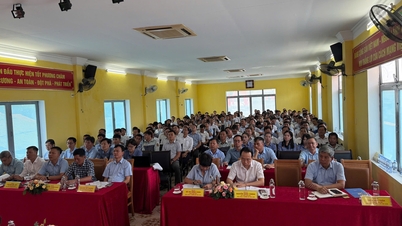
In response to the urgent need, on April 2nd, at the Quang Tri Ancient Citadel National Special Monument, the National Steering Committee for the Search, Collection, and Identification of Martyrs' Remains (the Steering Committee) launched the "500-Day Campaign to Intensify the Search, Collection, and Identification of Martyrs' Remains" (the 500-Day Campaign).
For the first time, this work was implemented as a nationwide campaign. Not only the military, police, interior ministry, science and technology, health, and diplomacy , but also local authorities, along with a large number of citizens and veterans, were mobilized to participate...
These days, in the forests of Champasak, Sekong, and Attapeu provinces (Laos) or Rattanakiri, Stung Treng, and Preah Vihear provinces (Cambodia), the teams collecting the remains of fallen soldiers from Military Region 5 are still tirelessly searching for their comrades. Some days, they have to walk dozens of kilometers, crossing streams and trekking through forests just to verify a credible piece of information.
Private Dinh Ngoc Hoa, a soldier from Team K53 (Quang Ngai), recounted that there were days when they left early in the morning and didn't return to their barracks until late at night. Many locations required digging meters deep into the earth and rocks. To date, the specialized teams have achieved many positive results: Team K53 has recovered 16 remains of fallen soldiers in Laos and Cambodia; Team K52 (Gia Lai) has found 18 remains of fallen soldiers in Cambodia; and Team K51 (Dak Lak) has recovered 22 remains of fallen soldiers in Mondulkiri province (Cambodia).
Colonel Le Cong Khoa, Team Leader of Team K53, said that each fallen soldier found is the result of a persistent verification process from multiple sources and close coordination of many forces. Many people from Laos and Cambodia have directly guided the recovery team to areas suspected of containing the graves of fallen soldiers.
Mr. Suksavanh Vilayvong, Chairman of the Government Committee of Champasak Province (Laos), shared: “Vietnamese soldiers always respect the law, local customs, and maintain close ties with the people, thereby building trust so that people actively provide information and participate in the search for fallen soldiers.”
Breaking through rocks, clearing a path to find teammates.
Starting on June 4th, the Quang Ngai Provincial Military Command, in coordination with experts from the University of Science (Vietnam National University Ho Chi Minh City), conducted a survey using ground-penetrating radar (GPR) technology in the Truong Chinh Street area, Dak Cam Ward, and Kon Tum Ward. The survey was carried out according to the plan of the Quang Ngai Provincial Steering Committee and Military Region 5, based on verifying information and documents provided by former US soldiers regarding the suspected mass grave of approximately 70 to 90 martyrs who died during the Tet Offensive of 1968.
The use of ground-penetrating radar helps to accurately pinpoint suspected locations, significantly reducing time and manpower compared to traditional search methods. After identifying suspected locations using geophysical equipment, the engineering corps and Team K53 conduct manual excavations, sifting through each layer of soil to ensure that no traces or artifacts of fallen soldiers are missed. The combination of modern technology with field experience is opening up more opportunities to find the remains of fallen soldiers, rekindling hope for many families after decades of waiting.
Combining modern technology with field experience is opening up more opportunities to search for the remains of fallen soldiers, rekindling hope for many families after decades of waiting.

In Military Region 2, one of the country's key areas for search and repatriation efforts, more than 4,800 martyrs remain undiscovered, including over 300 who died in Laos. In Tuyen Quang province, where fierce battles took place to defend the northern border, more than 1,200 martyrs are still missing.
The rugged terrain of Hill A5 in Thanh Thuy commune (Tuyen Quang province) makes the search for fallen soldiers a real battle against the rocky mountains. The suspected locations of remains are deep within caves that were destroyed by artillery fire decades ago. To access them, the recovery team has to use drills, sledgehammers, and expanding powder to break through the rocks and create a path.
Major Mac Van Can, an officer of the team searching for and collecting the remains of fallen soldiers (the Collection Team), said: "Many locations are in cramped spaces, lacking oxygen, and the risk of landslides is always present."
Lieutenant Colonel Hoang Vu Dung, Deputy Head of the Remains Recovery Team, recounted that on some scorching hot days, the team's clothes were drenched in sweat, and their hands bled from shoveling. But whenever they discovered a piece of canvas, a button, or a remaining belt under the ground, everyone had renewed hope. During the recent peak period, the team found a mass grave at Hill 211 and many remains of fallen soldiers at Hills 233 and A5.
Team leader, Lieutenant Colonel Tran Quang Huy, shared that in the current period, information from the people, veterans, and historical witnesses is a very valuable source of information. Since the beginning of the peak period, the unit has received 22 sources of information from veterans and the people, and has conducted surveys on 19 valuable sources.
Based on information provided by Mr. Vang Seo Tang from Minh Tan commune, the search team verified the information and organized an excavation. After nearly a week, they found the fallen soldiers along with many artifacts. Similarly, according to information from veteran Nguyen Van Quyen, former Deputy Political Officer of Battalion 5, Regiment 266, Division 313, a platoon perished in battle at Hill 1030…
The units implemented the "six clear principles": clear person, clear task, clear time, clear responsibility, clear output, and clear authority; linking the responsibility of the head of the unit to the results of implementation. The repatriation team was reinforced with personnel, divided into many sub-teams stationed at key high points such as 685, 772, A5, 1030, 1688, 1800A, 1800B... while coordinating with engineering forces to clear mines in areas suspected of containing the remains of fallen soldiers.
Regarding the implementation of the “500-Day Campaign,” Colonel Nguyen Minh Khoi, Deputy Political Commissar of the Tuyen Quang Provincial Military Command, stated: “The units are implementing the ‘6 clear’ principles: Clear person, clear task, clear time, clear responsibility, clear product, clear authority; linking the responsibility of the head of the unit with the results of implementation. The repatriation team has been reinforced with personnel, divided into many sub-teams stationed at key high points such as 685, 772, A5, 1030, 1688, 1800A, 1800B... while coordinating with engineering forces to clear mines in areas suspected of containing fallen soldiers.”
Major General Nguyen Ngoc Ngan, Deputy Head of Political Department of Military Region 2, shared that the biggest difficulty currently is the lack of accurate information about the original burial places of the martyrs, the drastically changing terrain, the elderly and frail witnesses, and the loss or incompleteness of many records and grave site maps. To support the search efforts, Military Region 2 and many related units of the Ministry of National Defense have mobilized 170 bomb and mine clearance teams, clearing more than 7,000 hectares of contaminated land.
In the Central Highlands region, one of the most noteworthy searches took place in Doch 1 village, Ia Ly commune (Gia Lai province). While hunting bats in a cave on Chu Pa mountain, Mr. A Hai, a local resident, accidentally discovered many items belonging to soldiers and reported it to the authorities. Immediately after receiving the information, the 34th Army Corps' search and recovery team promptly organized a survey of the site.
From April 6th to 9th, officers and soldiers continuously expanded the search area. As a result, 12 remains of fallen soldiers were discovered along with many artifacts such as hammocks, AK ammunition magazines, military insignia, communication wires, rubber sandal soles, iron bowls, medicine bottles, etc. According to archival documents, this was once an operational area of units belonging to the Central Highlands Front (B3) during the period 1966-1969.
The relentless race
According to statistics from the Ministry of National Defense, in the first five months of 2026, the forces searched for and collected nearly 1,000 remains of fallen soldiers. Since the launch of the "500-Day Campaign," 508 remains of fallen soldiers and two mass graves in Tuyen Quang province have been recovered. Of these, 33 remains were found domestically, 62 in Laos, and 413 in Cambodia.
According to statistics from the Ministry of National Defense, in the first five months of 2026, the forces searched for and collected nearly 1,000 remains of fallen soldiers. Since the launch of the "500-Day Campaign," 508 remains of fallen soldiers and two mass graves in Tuyen Quang province have been recovered. Of these, 33 remains were found domestically, 62 in Laos, and 413 in Cambodia.
In many areas, to find the remains of fallen soldiers, authorities have to clear paths through land still contaminated with bombs, mines, and unexploded ordnance. To date, units have cleared 3,234 hectares of land contaminated with bombs and mines to facilitate the search and collection of remains. In the core area of Vi Xuyen (Tuyen Quang province) alone, more than 1,529 hectares have been cleared, achieving over 34% of the target.
Each remains of a fallen soldier found gives another family the chance to know where their loved one lies. But for those working to recover the remains, finding them is only half the battle. Throughout the country, there are still hundreds of thousands of graves of "Unknown Soldiers." Therefore, alongside the field search, another front is being urgently deployed in the "500-Day Campaign": collecting biological samples, conducting DNA testing, building databases, and connecting war-related sources both domestically and internationally. This is an effort to ensure that the search, which has lasted over 50 years, can reach its final destination.
(To be continued)
Source: https://nhandan.vn/bai-2-menh-lenh-tu-trai-tim-post967529.html


![[Image] Schools organize meetings and introduce teaching models to students admitted to grade 10.](https://vphoto.vietnam.vn/thumb/1200x675/vietnam/resource/IMAGE/2026/06/25/1782368077271_ndo_br_z7970052192242-1ec8daeb77a6eed1a4e9f58c564ddd3e-jpg.webp)
![[Photo] General Secretary and President To Lam receives Palestinian Ambassador Saadi Salama](https://vphoto.vietnam.vn/thumb/1200x675/vietnam/resource/IMAGE/2026/06/25/1782365384740_a1-bnd-9423-8322-jpg.webp)

![[Image] Ho Chi Minh City: Ma Lang area, Chicken-Rice Market about to change its appearance](https://vphoto.vietnam.vn/thumb/1200x675/vietnam/resource/IMAGE/2026/06/25/1782377698627_ndo_br_m1-jpg.webp)


























![[Video] General Secretary and President To Lam: End the situation of fragmented, incompatible, and scattered data.](https://vphoto.vietnam.vn/thumb/402x226/vietnam/resource/IMAGE/2026/06/25/1782400197834_tbt-jpg.webp)