


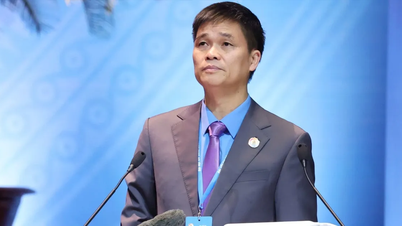
Representative Nguyen Thi Viet Nga ( Hai Phong ) answers questions from a VNA reporter. Photo courtesy of Hai Ngoc/VNA.
Given the geopolitical shifts in the Middle East that are significantly impacting energy prices and logistics costs, how do delegates assess Vietnam's ability to respond and achieve double-digit growth?
First and foremost, this issue needs to be viewed with both caution and confidence, because the current geopolitical shifts in the Middle East are clearly no longer distant external events, but are directly impacting many economies , including Vietnam.
When tensions increase the risk of energy supply disruptions, driving up oil prices, gas prices, freight rates, and cargo insurance costs, this will sooner or later affect production costs, distribution costs, product prices, and the competitiveness of businesses.
In today's rapidly changing, unpredictable world, and with increasing external risks, double-digit economic growth only has real meaning when it is of high quality, has a solid foundation, and is resilient. This means not only increasing the speed of growth but also growing on the basis of strengthening the economy's endogenous capacity, enhancing business competitiveness, maintaining overall balance, ensuring energy security, supply chain security, and reinforcing market confidence.
I believe the Vietnamese economy has the foundation to cope, having repeatedly overcome "headwinds" such as pandemics, supply chain disruptions, and imported inflation, thereby clearly demonstrating its adaptability and self-adjustment capabilities. However, complacency is unacceptable, as current pressures demand a shift in the growth model from one based on scale expansion to one based more on governance quality, productivity, technological innovation, the domestic market, and the resilience of businesses.
An economy can accelerate when conditions are favorable, but only those with sufficient internal strength can withstand external storms. The turmoil in the Middle East is a test showing that Vietnam's double-digit growth target cannot rely on old habits or simple expectations, but requires a more flexible, proactive, and resilient economy.
In other words, this fluctuation does not negate the potential for high growth, but it necessitates a deeper examination of the quality of growth, from governance capabilities and self-reliance to the ability to transform external pressures into a driving force for restructuring. If this can be achieved, the challenges will not only be obstacles but also opportunities for the economy to mature.
According to the delegates, in the context of increasing external risks, what are the urgent solutions that need to be prioritized to both stabilize the macroeconomic situation and maintain growth momentum?
In the current context, it is crucial not only to find solutions but also to prioritize, focus actions, and intervene at the right time. Because when external risks increase, a slow or scattered response will not only miss opportunities to mitigate adverse impacts but may also increase market anxiety.
First and foremost, maintaining macroeconomic stability and effectively controlling inflation expectations are crucial. When energy prices, transportation costs, and input materials increase, the pressure extends beyond business costs to the general price level, directly impacting purchasing power and consumer confidence. Failure to effectively control inflation expectations will make subsequent price management much more difficult. Therefore, price management must be transparent, with a clear roadmap, close coordination among various tools, and a firm stance against exploiting international fluctuations to raise domestic prices unreasonably.
The next priority is ensuring energy security and logistics security. In an increasingly uncertain world, the issue is not just about high or low prices, but more importantly, the stability of supply and the security of the transportation chain.
This requires a more proactive approach to diversifying fuel sources, enhancing reserve capacity for essential inputs, and gradually improving the logistics system to reduce dependence on transport routes vulnerable to geopolitical conflicts. From a broader perspective, energy security should be viewed as an integral part of national economic security.
Furthermore, special attention should be paid to ensuring that businesses maintain their production capacity, competitiveness, and confidence to continue investing, maintaining orders, and employment. When input costs rise, many businesses, especially small and medium-sized enterprises or those heavily dependent on imported raw materials, will face significant pressure on cash flow and their ability to cope. Therefore, supporting businesses during this period is not just about supporting individual entities, but about protecting the production capacity of the economy, safeguarding jobs, and preserving the foundation of social security in the long term.
In my opinion, targeted support measures with clear timelines should be implemented, such as extending or postponing taxes and fees, expediting tax refunds, reducing compliance costs, removing bureaucratic hurdles, and providing working capital support to sectors directly affected.
In the current climate, what businesses need is not necessarily large support packages in name, but rather quick and effective decisions to help them maintain cash flow, keep production running, and avoid running out of steam during difficult times.
Furthermore, it is necessary to leverage external pressures to promote the restructuring of growth drivers towards greater sustainability, and this must begin now, not wait. If the economy continues to be heavily dependent on the external sector, on imported raw materials, and on links it has not yet mastered, then each global shock will continue to create significant tremors.
Therefore, it is necessary to promote the development of the domestic business sector, enhance the capacity of the processing and manufacturing industry towards high added value, promote technological innovation, green transformation, efficient energy use, and at the same time develop the domestic market and improve the efficiency of public investment as a driving force.
I want to emphasize that, in the face of global upheaval, the appropriate response is not to retreat into a defensive posture, but to maintain stability in order to proactively adapt and decisively reform. Macroeconomic stability is a necessary but not sufficient condition; more importantly, that stability must be transformed into a foundation for reform, thereby creating new resilience for the economy. Only by doing so can we overcome immediate difficulties while maintaining sustainable development.

Lach Huyen International Port, Hai Phong City. Photo: Hoang Ngoc/TTXVN
What are the delegates' views on the role of fiscal and monetary policies in supporting businesses to overcome the current pressure of rising input costs?
I believe that in the current period, both fiscal and monetary policies play important roles, but the key is to coordinate them harmoniously, appropriately, and in the right proportions. If coordinated effectively, this will be a "duo" that helps the economy withstand cost shocks; conversely, a lack of synchronization can distort market signals and create instability.
In the context of pressure primarily stemming from rising input costs due to external factors, fiscal policy needs to be proactive and forward-thinking. This tool has the advantage of providing direct and timely support through measures such as reducing, deferring, and postponing taxes and fees; accelerating the disbursement of public investment to stimulate demand; and supporting businesses in technological innovation, energy saving, and market expansion. Fiscal policy not only helps alleviate the immediate cost burden but also contributes to strengthening confidence as businesses perceive timely support from the government.
Regarding monetary policy, flexibility is needed, but with utmost caution. The focus should be on maintaining liquidity stability and ensuring access to capital for production, exports, and supporting industries, rather than excessive easing to stimulate growth. Given the continued pressure of imported inflation, management should prioritize maintaining reasonable interest rates, supporting debt restructuring, directing credit towards production and business, while controlling risks related to exchange rates, inflation, and speculative capital flows.
In short, no single policy can be absolute. Fiscal policy needs to be proactive and focused; monetary policy needs to be flexible but disciplined. A harmonious combination of these two policies will help businesses overcome cost pressures while maintaining production capacity, employment, and a foundation for sustainable growth in the current volatile environment.
Thank you very much, delegates!
Lesson 3: Proactively Adapting to Sustain Growth
Uyen Huong - Thuy Duong/VNA (Reporters)
Source: https://baocantho.com.vn/bai-2-noi-luc-la-nen-tang-a202064.html






















![[INFOGRAPHICS] Sustainable Business Support Program (2026 – 2030)](https://vphoto.vietnam.vn/thumb/402x226/vietnam/resource/IMAGE/2026/06/04/1780552996067_1780552915.webp)


























![[Video] Sunset at Lap An Lagoon – Where the sun sets over the fishing nets](https://vphoto.vietnam.vn/thumb/1200x675/vietnam/resource/IMAGE/2026/05/31/1780192137701_beach-landscape-sea-water-nature-grass-745871-pxhere-com.jpeg)
































Comment (0)