From defensive to proactive, strategic, and leadership; from description and reflection to discovery, strategic planning, and creation through a coordinated, all-force combined arms operation.
The past 40 years have witnessed a great migration of the public from traditional print newspapers to the online space on global digital platforms. Faced with an information deluge, where fake news overwhelms the truth, revolutionary journalism has undertaken an internal revolution in its methodology.
Today, the enemy no longer wears the face of a gun but lurks behind algorithms, streams of "toxic information," and distorted viewpoints disguised under the guise of "democracy" and "human rights." The struggle to protect the Party's ideological foundation is a silent but extremely fierce battle against various "enemies": from "bees in the sleeve" and "internal enemies" to sophisticated and insidious external "opponents." Seven main forms of this can be summarized regarding the ideological foundation and political line:
First and foremost, they slander and undermine Marxism-Leninism and Ho Chi Minh Thought – the foundation for shaping Vietnam's political line and diverting its development from socialist Vietnam.
Secondly, they attack and deny the ideology and development of the socialist-oriented market economy; the socialist rule of law in Vietnam, which is of the people, by the people, and for the people; they slander multilateral and diversified diplomacy , labeling the Vietnamese bamboo as a form of "tightrope" diplomacy; and they falsely accuse the fight against corruption of "internal power struggles" and "factional purges"...
Thirdly, they attack the Party—the fundamental factor determining the victory of the Vietnamese revolution—promote, expand, and develop a multi-party system, and exaggerate the importance of civil society.
Fourth, they deepen and divide the Party from the State and the people, inflate the rhetoric of Party rule and totalitarianism, incite opposition between the Party and the people and the State; advocate for unlimited democratization, exaggerate and glorify those who oppose the State with the so-called "prisoners of conscience"; and depoliticize the armed forces...
Fifth, slandering leaders and dethroning "idols" to "shoot down flying birds," dividing generations of leaders, using the tactic of "killing two birds with one stone." This form of slander is very common and has been around for a long time.
Sixth, to entice, bribe, and control (economically, politically, morally, and in terms of lifestyle...) key elements of the strategic-level cadre, first and foremost those who formulate political policies and hold fundamental positions in the socio-economic, national security, and national defense sectors, in order to promote this group's "self-transformation," causing the nation to collapse through the "Trojan horse" tactic in ideology and the press.
Seventh, they criticize Vietnam's foreign policy, aiming to entice, bribe, and ultimately isolate and control Vietnam. They employ every means and conspiracy to subtly divide, fragment, and sabotage Vietnam's international relations: "feigning an attack in one direction while actually attacking in another," "encircling and isolating"... which is very dangerous.
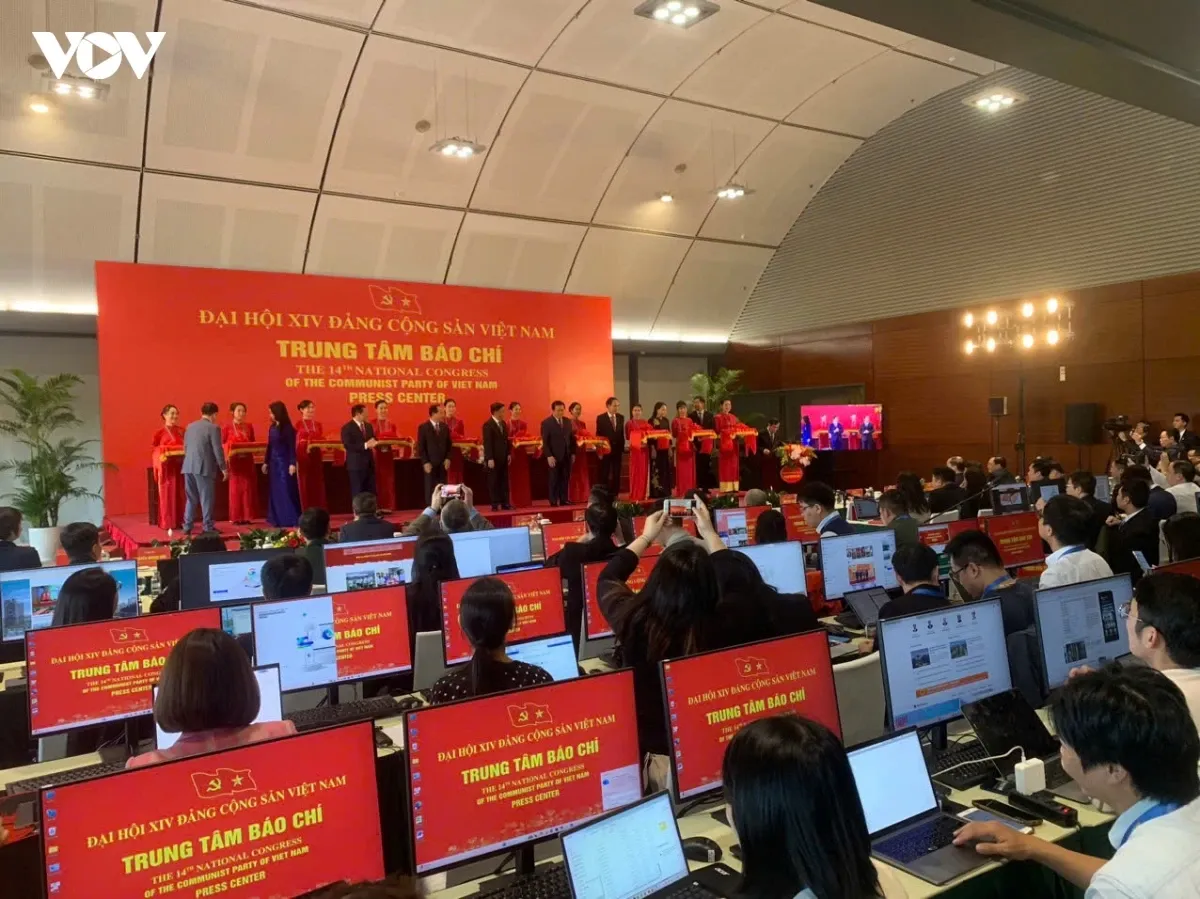
The Press Center for the 14th National Congress of the Communist Party of Vietnam is fully equipped with modern facilities and technical infrastructure, including high-speed internet access, meeting the operational requirements of journalists. Photo: VNA
In principle, the struggle should be proactive, avoiding passive defense. The press continues its shift from reacting to leading; at the same time, it firmly grasps the tactics of seizing the top spot. If ideological struggle in the press is confined to writing for each other to read, within the ivory tower of theory, then that struggle has deprived itself of its own weapon of mass appeal.
Why wait for them to distort the truth before correcting or countering it? Why can't the press take the initiative, anticipating sensitive issues of public concern and providing official information immediately, instead of lagging behind social media? Why can't we "eradicate" the breeding ground for fake news before it even has a chance to sprout? On the other hand, we must leverage the power of evidence. Our reasoning is the reasoning of development. Every new bridge built, every social welfare policy that resonates with the people, is the strongest evidence to protect our ideological foundation. The numbers speak for themselves and will silence all distortions.
Functionally, the shift is from orientation and defense to leadership and development. The era of growth demands that the press move beyond its role as a purely "faithful chronicler" to become a strategist and developer. Why do institutions still face obstacles? Why are national resources still being wasted? The press must organize forums for theoretical and practical discussion, bringing together the brightest minds to debate institutional democracy, how power can be controlled by law; how to liberate the people's potential, and how each citizen can feel like a subject in the country's development. Writing about the economy is not just about growth figures, but about courage, experience in independence, freedom, and creativity, including failures and even setbacks. Writing about culture is not just about preservation, but about transforming culture into an economic driving force, and more profoundly, into a system regulating national values.
Democracy and critical thinking, the art of winning hearts and minds, dividing opposing forces, all based on national righteousness and humanism.
Protecting ideological foundations does not mean monologue. In the new era, the press must create space for dialogue. Protection is not about "locking doors," but about intellectual superiority and freedom of activity. The enemy fears not censorship, but truth presented freely, scientifically, humanely, and persuasively.
Ten key tactics can be outlined:
One: People are using every means, especially new technologies, to attack the ideology and smear the vision and development decisions of Vietnam, claiming that they are "illusory fantasies," and that in reality, "socialist orientation is a transitional step from socialism to capitalism" (!) of the Vietnamese leadership, aiming to destroy the political foundation, create internal divisions, accelerate internal differentiation, promote "self-evolution," "self-transformation," and ultimately disrupt and plot to disrupt the country's internal affairs, in the style of "internal conflict," "fratricide," etc.
Two: People, alongside internal divisions, launch attacks from the outside; exploiting democratization, using human rights and religious freedom as pretexts to fuel, support, and promote separatism, pushing the regime towards self-disintegration and collapse through soft revolutions and color revolutions: "victory without fighting," especially in strategically important military areas, and places with complex religious, ethnic, and territorial disputes.
Three: Opportunistic elements, especially those who "turn the tables," are being planted and infiltrated to undermine the regime and the strategic leadership of the press and ideology from within, using tactics such as "inciting unrest," "feigning an attack in one direction to strike in another," and creating internal ideological divisions.
Four: People are hiding behind the guise of integration and cooperation in a "wolf-like" manner, employing a tactic of insidious sabotage aimed at directly or simultaneously undermining and blockading the country to isolate it, causing the nation to self-destruct, bleed, and deplete its economy, create political chaos, and lead to the disintegration of its ranks—a "self-bleeding wound," "war without gunfire," "negotiations under the table," etc.
Year: People are using every means to exert pressure aimed at isolating Vietnam economically and politically, even encroaching illegally on its land and sea borders, controlling its airspace... in order to pressure and threaten Vietnam on the international stage.
Six: People use others' hands to feign an attack in one direction while actually attacking in another, "using the enemy to destroy the ignorant," acting two-faced to manipulate, or overthrow, or "divide and conquer" key figures through their own strategies, causing cracks in the ideological and theoretical ranks, changing the direction of economic, social, and foreign policy development, in order to transform the political regime.
Seven: People are attacking, dividing, and creating conflict among the armed forces in order to neutralize the forces protecting the regime from within and defending the country from outside, plotting to "sit on the mountain and watch the dragon and tiger fight," with tactics to promote "rotten pumpkin from the inside," and "blooming within the regime."



Eight: People exploit the shortcomings of political practice, simultaneously slandering and denying it, while employing tactics of "internal and external attacks," and "flower-flower warfare" to disintegrate and transform the elite apparatus, aiming to seize control and destroy the nation.
Nine: People use every means to entice, bribe, neutralize with fabricated evidence, including slander, and even control those holding important positions in the press apparatus, key national intellectual and theoretical figures, manipulating politicians, strategists, technocrats, scientists... causing disruption from within the institutional brain.
Ten: People exploit contradictions among the people, contradictions between the government and the people, bribe and deceive the people, incite the people to riot, attack the government, attempt to disrupt society, promote cracks and disintegration from the grassroots level... with methods of disorientation and directing the attack to cause ideological chaos.
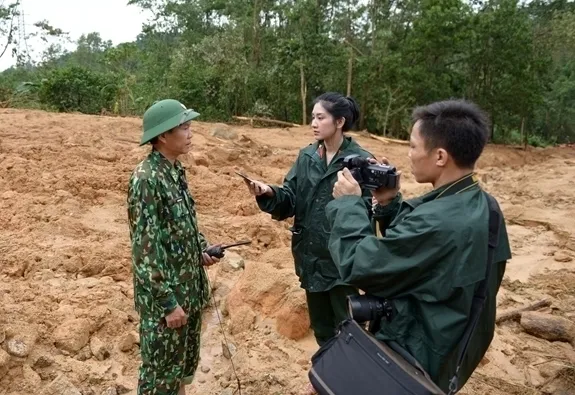
Reporters from the People's Army Newspaper are working in the landslide-affected area. (Illustrative photo: qdnd.vn)
Therefore, now more than ever, the press needs to remain calm:
Criticism with erudition: When criticizing a false viewpoint, a journalist must have a multifaceted perspective, understanding what the opponent is saying in order to dismantle their logic at its root. Writing in defense of the Party must reach a cultural level, earning the respect of the enemy and the trust of the people.
The direct struggle against internal enemies, alongside the fight against external enemies, is the mission of the press to cleanse the nation's bloodstream. The most dangerous destructive force does not come from guns on the border, but from the decay, "self-evolution," and "self-transformation" within the very bloodstream of the system. The press does not shy away, has no forbidden zones, and bravely plays the role of a sword controlling power. The struggle to protect the Party's ideological foundation at this time is about cleansing and self-cleansing. The press exposing corruption, waste, and negative practices; criticizing the apathy and intellectual laziness of a segment of Party members and officials is the most proactive and humane way to protect the Party. The press effectively acts as a bridge connecting the people's hearts, removing institutional bottlenecks, and helping the Party to self-reflect so that it becomes increasingly clean, strong, and worthy of the people's ultimate trust.
Pioneering by innovating methods of action requires courage to cast aside rigid thinking, prejudices, dogmatism, and bookishness; simultaneously, it requires innovation and development of institutional democracy to create a legal space and institutionalize democracy to maximize the creative capacity of all social strata. On the other hand, the press contributes to overcoming all impasses, narrow-mindedness, isolation, and closed-mindedness through democratic debate and respect for genuine scientific criticism. Political science can only develop in an environment of freedom of thought and respect for truth. Differing opinions, but those with a constructive spirit, should be respected and published by the press. Frank, multi-faceted debates in a constructive spirit should be encouraged.
Leaders and managers at all levels must maintain their integrity, be truly open-minded, respect and listen to criticism, and consider scientific criticism as a valuable intellectual resource for perfecting policies and guidelines... starting from the press. When the press bravely reflects constructive social criticism, it is not an "attack" on the Party, as some have mocked, but rather helps the Party to self-reflect and self-correct, becoming increasingly clean. This is the vision, the program, and the roadmap for combating false narratives and protecting the Party's ideological foundation proactively from an early stage and from afar.
Struggle and humanity, upholding justice and eradicating evil, go hand in hand with using beauty to overcome ugliness and encouraging new elements.
The most frightening thing is failure. But even more frightening than failure is the unwillingness to change when circumstances and conditions have changed.
As a propagandist, architect, and leader, the press's defense of the Party is not about forced glorification, but about using objective and transparent truth to affirm the righteousness of the regime and the nation. Defending the Party is defending the interests of the nation. Theoretical struggle is not about vilification, but about persuasion through truth and morality. The poetics of this struggle must reach an artistic level. It cannot use a style of writing that blinds the enemy or brutal imposition. Persuasion is needed to divide the enemy, and humanism is needed to transform the enemy. This must be the necessary ideology in this just and humane, yet extremely difficult and complex, struggle.
Firmly upholding the principle of "building to counter": Ultimately, protecting the Party's ideological foundation means protecting the people's trust – the lifeblood that determines the rise and fall of a nation. To prevent the people from believing fake news, the press must report the news as quickly and thoroughly as possible to build and develop a strong foundation of public support. Simultaneously, reforming the principle of "countering to build": When criticizing erroneous viewpoints, the pen must be like a surgical knife, precise and accurate. Theory and evidence must be used to dismantle distorted arguments. Actively organize democratic debates and defend from within, using collective intelligence and practical experience to persuade, and when necessary, break down all opposition and eliminate dark schemes and the dangers of internal self-transformation leading to disintegration and collapse from within.
Continue the comprehensive transformation of methodology and multi-platform expression. Break away from the "resolution-style" writing of journalism. Focus on political commentary that is artistic, concise, and inspiring, so that each newspaper becomes a gathering place for the collective wisdom of the people, unifying the actions of the people as masters, and unconditionally protecting the lives, interests, and aspirations of the entire nation. Instead of chasing explanations and "smoothing over" events, journalism should proactively provide multi-faceted, transparent information and contribute to addressing the root causes of ideological and practical bottlenecks, leaving no room for hostile forces to operate. Each article exposing a corruption case or removing a morally corrupt official is a step forward in protecting the ideological and practical foundations, carrying more weight than thousands of pages of empty news.
The struggle against erroneous viewpoints is not passive defense, but a conscious offensive powered by truth and morality. The soul of journalism lies in the people's hearts. When journalism speaks the voice of the people, addressing the nation's concerns correctly, no false narrative can shake or mislead them. This is the poetics, the strength of journalism in the struggle to protect and develop the Party's ideological foundation in this prosperous era.
Therefore, journalism should be written with the poetics of constructive engagement. It cannot stop at merely describing the world; it must propose solutions, offering suggestions to the Party and State to overcome bottlenecks in the development process. In every forum, journalistic criticism must reach a level of political culture. Criticism should be constructive, not nitpicking or "killing," but rather a force for enlightenment. The language should be sharp yet imbued with the compassion of those involved, the concern for the nation's destiny. With a mindset of openness and transparency, journalism truly serves as a mirror for every Party member and official to reflect on themselves. And, when journalism creates a strong public opinion, it becomes a legal and moral "shackle" to prevent, isolate, and push back against thoughts and behaviors that deviate from the nation and humanity.
Amidst the complex and chaotic jungle of information, the press deserves to be both a "harbinger of storms" and a guide. Without this guiding role, the press loses its own essence and spirit. Therefore, protecting the ideological foundation is not about repeating outdated dogmas, but about creatively applying them to solve pressing and strategic problems. Each media outlet is a fortress protecting the truth; each article must be like alluvial soil building up the people's trust with concise, multi-layered, and fiery language, with political rhetoric imbued with reality and a contemporary vision, and with modern and professional techniques.
Building a system of courageous and creative media organizations and a team of intelligent and dedicated journalists using modern multimedia.
In the era of striving towards 2045, revolutionary journalism must have an international stature, carrying the mission of transforming theoretical strength into a burning aspiration for prosperity in the hearts of 100 million compatriots.
It is necessary to reiterate that one of the purposes of journalism is to serve the prosperous future of the nation, and the guiding principle of journalism is to protect the regime on the ideological foundation of the Party and the will of the people. Therefore, the era of a prosperous Vietnam does not accept media outlets that are not up to par, not only in terms of vision and courage, but also those whose writers are weak-willed, opportunistic, and pragmatic, who challenge the forms and methods of struggle in a completely new ideological space.
In particular, in 2012, VNG launched Zalo – the "national" domestic digital messaging platform with the largest number of regular users in Vietnam. And, seven years later, in 2019, the short-video platform TikTok entered the market and exploded in popularity, making the online ideological struggle truly intense in terms of scale, speed, and sophistication. Social media, with its advantages of speed, intelligent algorithms, and high interactivity, is creating fierce competition, vying for public attention with mainstream media.
The development of artificial intelligence (AI), capable of automatically generating content and creating incredibly sophisticated deepfakes of images and audio, poses a existential challenge to journalism. If we maintain a conservative, rigid mindset regarding form, a lack of substance, and technological backwardness, we will "hand over" the information battlefield to other forces, plunging the public into a labyrinth of harmful and uncontrolled information. Therefore, the ultimate weapon of journalism against fake news and false narratives on social media is not prohibition, but the scientific accuracy and persuasiveness of information. To create a "spiritual vaccine" for the people against distorted monologues, journalism must take a proactive approach, controlling information and not simply reacting to events in a fragmented or short-sighted manner.
Accordingly, the restructuring and rectification of the press system should be oriented towards a comprehensive, multi-functional, systematic, interconnected, elite, and modern approach. Each media organization and agency must be an ideological fortress, a forum for free, creative, and democratic political science within a synchronized, elite, streamlined, and unified system. The relationship between ideals and reality, responsibilities and interests among media organizations within the system, between media organizations and journalists, and between modern technology and tools must be harmoniously resolved. Without addressing this comprehensively, the strategic and fundamental success expected will be impossible. Each leading agency must truly be a pioneering, intellectual, democratic, professional, and modern apparatus within the Vietnamese press system.
More than anyone else, the position of a journalist holding a leadership or management role in the press is one of standing at the pinnacle of truth, wielding the pen not for personal gain but with the hope of contributing to shaping the stature, spirit, strength, and prestige of a self-reliant and strategically independent nation in world history. The team in charge cannot simply possess "sharp pens, pure hearts, and brilliant minds," but must also be theorists with a global vision, role models of integrity and diligence, and experts in new technologies who can organize and lead the newsroom not through subjective imposition or willful ideology, but through incisive reasoning, dedication, humanity, scientific evidence, impartiality, and powerful, modern technology.
And, more than anywhere else, there must be journalists with the vision of a strategist, the courage of an ideological fighter, and the soul of a humane Vietnamese. Their pens must be sharp enough to dissect negative tumors, but also warm with humanism to rekindle the people's faith. A political commentator defending the Party who only knows how to quote resolutions in a dry, dogmatic way demonstrates linguistic incompetence, intellectual laziness, and professional inadequacy. It is unacceptable for some individuals to lack integrity, waver in their ideals, succumb to the bribery of interest groups, and readily distort the truth. The phenomenon of "journalists counting crabs," "counting floors," writing articles that impose their will, and extorting businesses... not only violates the law but also tarnishes the honor of genuine journalists and seriously erodes the people's trust in the credibility of revolutionary journalism.

Alongside the restructuring of the press system, there is a need to develop a team of journalists worthy of their responsibilities. This includes theoretical experts and strategic cadres, alongside journalists and media professionals with intellectual stature, political acumen, and a willingness to sacrifice for the nation's destiny. They must dare to think, dare to act, and dare to take responsibility before history and the development of revolutionary journalism, whether on airwaves or in cyberspace. They must utilize modern technology to disseminate positive information, and to counter, from the outset and remotely, distorted narratives and actions that undermine the regime, the people, and the Party's ideological foundation.
In short, history needs courageous media outlets and journalists who dare to go to the root of all conflicts, possessing the integrity to remain unmoved by money, unsubdued by unjust power, and unlost in the maze of modern media.
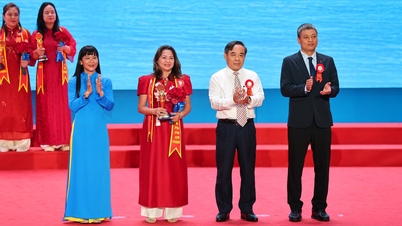
And, to put it figuratively, journalists must see with the eyes of a thousand miles, think like sages, write like "gentlemen," act like soldiers in the fortresses of theory and ideology, behave with integrity and humanity, befitting the nation and keeping pace with the ideology of the times. With sufficient internal strength and a ripe opportunity to elevate this struggle, it is essential to launch the National Journalism Award on Protecting and Developing the Ideological Foundation of the Party.
Only with this minimum level of support can the press continue to develop as a collective propagandist, a collective promoter, and a collective organizer in protecting and developing the Party's ideological foundation, worthy of being on par with the times.
The nation, in its vision for 2045, places an unprecedented and sacred mission on the shoulders of those who wield the pen. The nation enters this new era with the confidence to weather the storms of history and proactively stand firm on its own two feet.
Together with the nation, Vietnamese journalism enters a new era through the proactive efforts of those who uphold, protect, and develop the truth of national independence and socialism, with innovative thinking, political vision, strategic autonomy, scientific methods, and artistic poetics on the ideological and theoretical battlefield, all within the sacred love of the Fatherland.
With the mission of being the voice of the Party and the State, a forum for the people, and a pioneer in protecting and developing the Party's ideological foundation, the press must not hesitate, and even less can it fall behind, regress, sink into the mire of regression, and sink itself. With an open-minded vision, with a determination to innovate thinking, with the courage to look directly at and contribute to resolving contradictions – the press continues to lead public opinion and maintain the flame of the aspiration for national development. Let each issue of the newspaper, each television program, each status update from print to online space carry new strength, preserving and developing the Party's ideological foundation and realizing the nation's aspiration to become a dragon.
That is the mission, the honor, and the path of self-development for journalism, worthy of the trust of the Party and the People, and worthy of the affection of international journalistic friends.
Dr. Nhi Le, former Deputy Editor-in-Chief of the Communist Magazine
According to the People's Army Newspaper
Source: https://baocantho.com.vn/bai-4-doi-moi-phuong-thuc-hanh-dong-a207190.html
![[Image] Ho Chi Minh City: Ma Lang area, Chicken-Rice Market about to change its appearance](https://vphoto.vietnam.vn/thumb/1200x675/vietnam/resource/IMAGE/2026/06/25/1782377698627_ndo_br_m1-jpg.webp)

![[Image] Schools organize meetings and introduce teaching models to students admitted to grade 10.](https://vphoto.vietnam.vn/thumb/1200x675/vietnam/resource/IMAGE/2026/06/25/1782368077271_ndo_br_z7970052192242-1ec8daeb77a6eed1a4e9f58c564ddd3e-jpg.webp)

![[Photo] General Secretary and President To Lam receives Palestinian Ambassador Saadi Salama](https://vphoto.vietnam.vn/thumb/1200x675/vietnam/resource/IMAGE/2026/06/25/1782365384740_a1-bnd-9423-8322-jpg.webp)