

Ta Quoc Ky Nam (born in 1990) is a designer with over 15 years of experience in the publishing industry. After years of being behind thousands of book covers, this is Ta Quoc Ky Nam's first appearance as a writer. Calling it a "turning point" is perhaps an understatement. "Following in his mother's footsteps" isn't a sudden shift, but the result of a long process of accumulation – years of quiet writing stemming from the uncertainties that young people are forced to navigate. In this process, writing is no longer a creative act but a method of dialogue; writing is no longer about storytelling, but about understanding; writing is not about expressing feelings, but about confronting them.
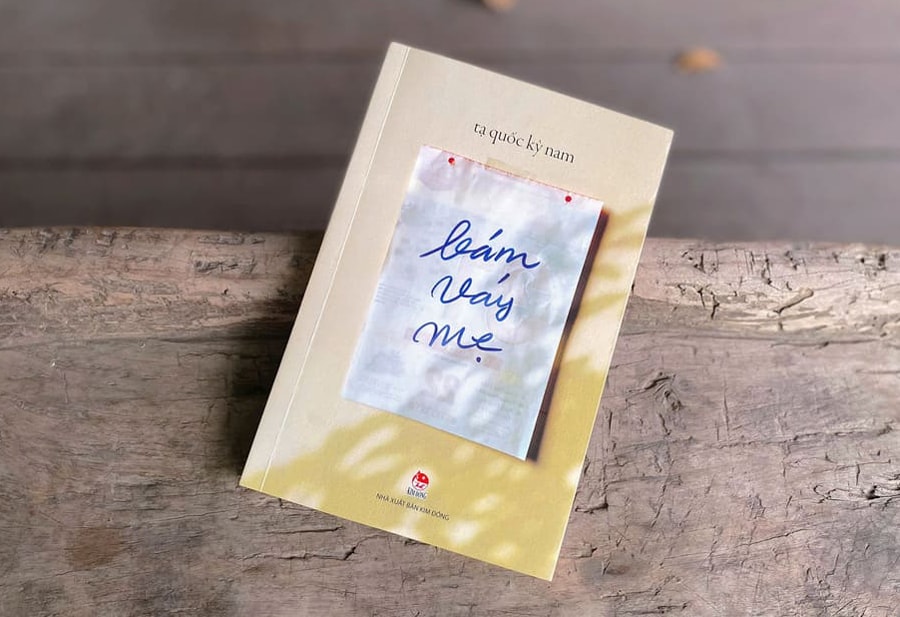
The book is divided into three parts: "Clinging to Mother's Skirt," "Clinging to the Way," and "Staying with Yourself." This structure seems simple, but it is actually a conscious movement: from recognizing inner disharmony, to practicing adjustment, and then pausing to look directly at oneself. This is not a journey out into the world , but a journey inward—a movement fraught with difficulties, because it has no map and no one to guide it except oneself.
Even the title, "Clinging to Mother's Skirt," easily evokes feelings of weakness and dependence. However, in the author's approach, the image is symbolic: a spiritual anchor. "Clinging" is not about refusing to grow up, but about knowing how to hold onto a place to return to.
Young people often live between two versions of themselves: the strong, adaptable, and competitive "I outside," and the vulnerable, fragile "I at home." The issue isn't about abandoning one side, but about learning to support both. Ta Quoc Ky Nam writes from very specific experiences. After moving house, he recognizes the "smell of home"—something seemingly ordinary but offering a primal sense of security, a place where one doesn't need to prove who they are. Amidst the clashes, a question arises: "Does Mom love me?"—it sounds childish, but it touches the deepest part of humanity: the need to be understood, accepted, and loved. "Mom" here symbolizes place, memory, and the safe haven that everyone needs. Only by daring to "cling" to that anchor point can we avoid drifting away.
If the first part was about identification, then "Sticking to the Way" is the transition to action, to self-adjustment. A thought-provoking point of the book is the disconnect between material and spiritual life. Young people may be very good at "making a living," but are confused about "being alive." The author doesn't offer advice. He only recounts his own experiences and the price he has paid. Some prices cannot be measured in money, but in the depletion of inner strength, in the silent signals from the body, in an emptiness that is difficult to name. And then, the time comes to stop and ask: "What am I trading for?"
"Don't just focus on making a living and forget about living." That's not advice, but a conclusion reached after hitting rock bottom.
While the first two parts are still manageable, the final section – “Staying True to Yourself” – leaves no room for retreat. Because “a person’s battle is sometimes with their own inner self.” Here, the author’s tone becomes more direct. The questions are posed frankly: How well do we understand others when we don’t understand ourselves? Are we living for ourselves, or trying to please others? Where do the choices we make truly come from?
The value of "Clinging to Mother's Skirt" lies in its honesty. The book doesn't try to soothe the reader with comforting words, nor does it offer solutions or healing. Instead, it forces us to look back at ourselves. It can be seen as a form of "internal autobiography"—where the story isn't told through events, but through a process of self-awareness. What remains isn't what happened, but how the writer understands those things after repeatedly daring to "rewrite" themselves. It's a book that doesn't pander to the reader, yet makes them feel compelled to read it to the end.
Concluding "Clinging to Mother's Skirt," what remains isn't a specific message, but a feeling: People can go far, but they still need a place to return to. They can be strong in the face of the world, but they still need understanding when they are vulnerable. And sometimes, "clinging" isn't weakness, but a way to avoid losing ourselves and to help us stand firm in life's journey.
Source: https://hanoimoi.vn/bam-vay-me-976476.html


![[Photo] General Secretary and President To Lam and the President of the Philippines hold talks.](https://vphoto.vietnam.vn/thumb/1200x675/vietnam/resource/IMAGE/2026/06/01/1780286997787_anh-man-hinh-2026-06-01-luc-11-09-43.png)





















































































Comment (0)