

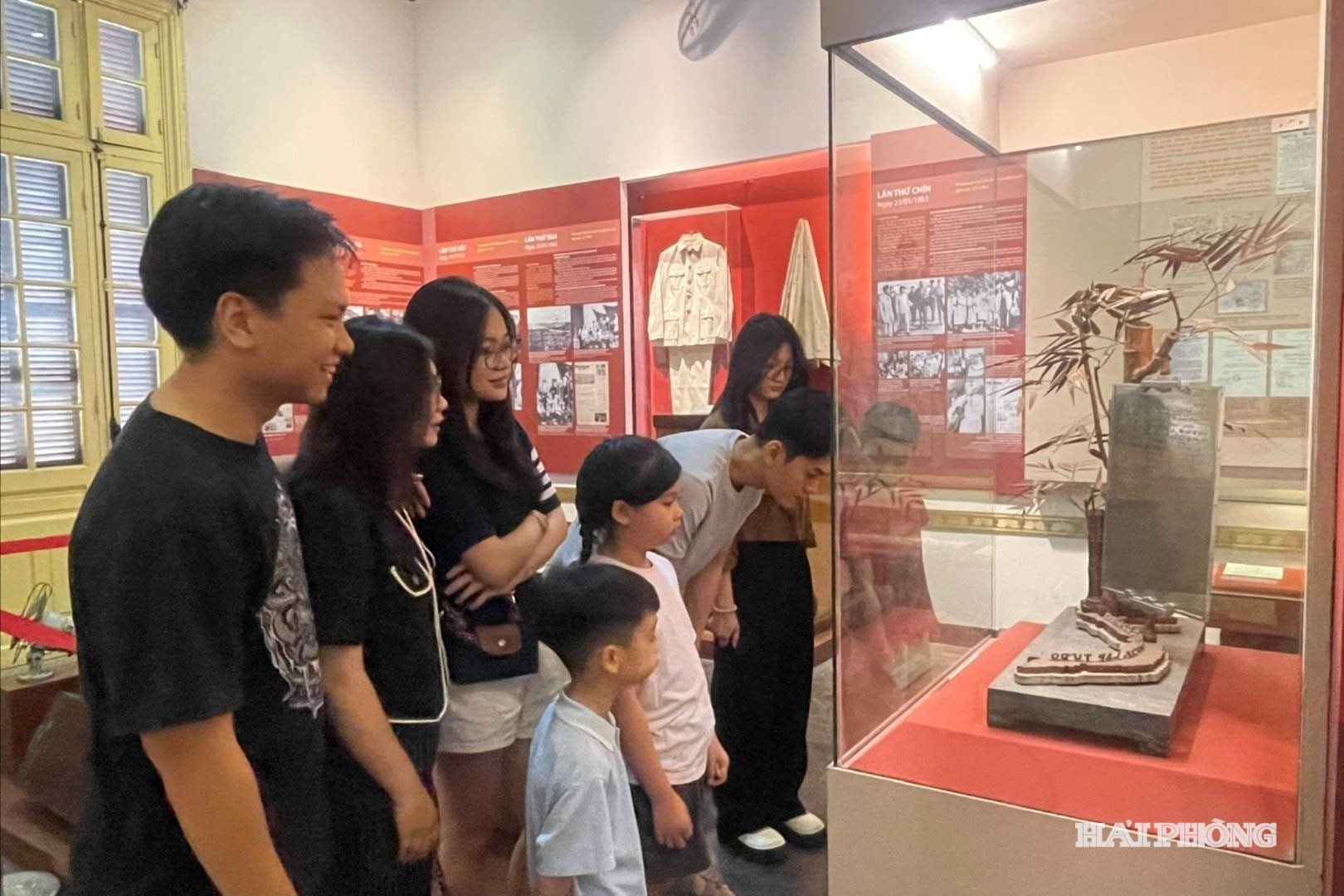
Recreating President Ho Chi Minh's handwriting on steel.
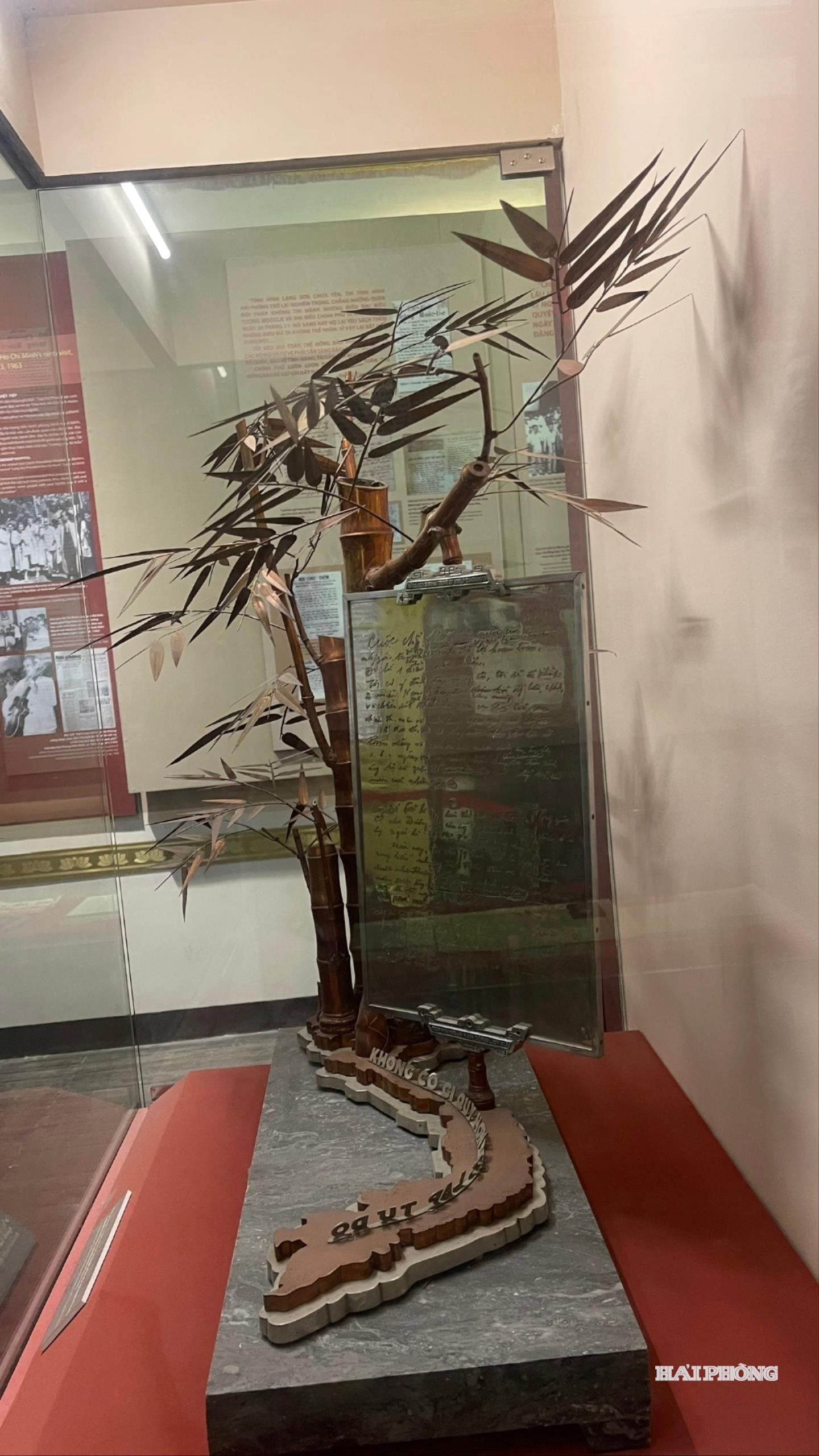
Amidst the solemn exhibition space at the Hai Phong Museum, Branch 1, the sculpture "The Testament of President Ho Chi Minh" stands out for its harmonious combination of metal and Vietnamese cultural imagery. The work was created by artist Nguyen Van Thi from Hai Phong. With respect and admiration for the national leader, artist Nguyen Van Thi drew inspiration from Vietnamese bamboo and President Ho Chi Minh's historic testament to create this artwork.
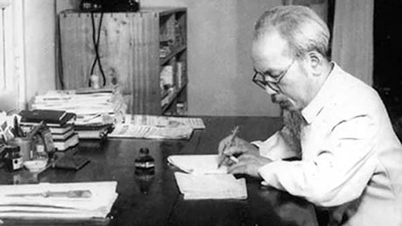
Viewers are captivated by the image of the bamboo tree reaching upwards, serving as a support for the Testament as a symbol of national spirit and Vietnamese vitality. The Testament is engraved on a stainless steel plate attached to a bamboo branch, suggesting it is the "sweet fruit" crystallized from President Ho Chi Minh's thoughts, ethics, and aspirations for the country. The front of the steel plate faithfully reproduces President Ho Chi Minh's handwritten notes, consisting of 290 characters. The delicate strokes and familiar slant of his handwriting are meticulously engraved down to the smallest detail. Even the crossed-out and corrected sections in the original are reproduced almost perfectly. The back of the steel plate continues to display the complete Testament, written on May 10, 1969.
Mr. Nguyen Van Hoa, a tourist from Le Chan ward, emotionally shared: “I had read Uncle Ho's will in books and newspapers before, but seeing this artifact in person feels very different. The crossed-out lines make me feel closer to Uncle Ho. It's not just a historical document, but also the thoughts and concerns of a great leader.”
The space surrounding the artwork is further enhanced by the base, which is shaped like a map of Vietnam made of brass. On the S-shaped strip of land, the prominent steel inscription reads: "Nothing is more precious than independence and freedom"—an immortal quote associated with the revolutionary career of President Ho Chi Minh.
In particular, the bamboo imagery in the artwork is meticulously crafted. The bamboo stalks have natural rough patches, and each leaf vein appears delicately against the metal background. At the base of the bamboo, vigorous shoots emerge, symbolizing the continuation of Vietnamese tradition across generations.
According to narrator Do Thi Mai Anh, what makes the artwork special is that it not only faithfully recreates President Ho Chi Minh's Last Will and Testament but also incorporates many national cultural symbols. From bamboo and the map of Vietnam to President Ho Chi Minh's famous saying, everything creates a meaningful artistic whole.
A space preserving memories of Uncle Ho.
Besides the "Testament of President Ho Chi Minh," the thematic exhibition on President Ho Chi Minh at the Hai Phong Museum also preserves many valuable images, artifacts, and documents related to his life and career.
The space is uniquely arranged with muted colors, soft lighting, and an emotionally evocative layout. From the entrance, a simple, approachable portrait of President Ho Chi Minh appears. Documentary photographs and artifacts such as his clothing, chair, and podium are associated with his visits to Hai Phong. The exhibition's special feature is its storytelling through artifacts. Instead of being overly cluttered with documents, each artifact has its own space for viewers to pause, observe, and reflect.
Among the visitors were many students. Many of them attentively took notes while listening to the explanation about President Ho Chi Minh's Last Will and Testament. Pham Minh Anh, a student from the Vietnam Maritime University, shared: “I had studied President Ho Chi Minh's Last Will and Testament in textbooks, but seeing the artifact recreating his handwritten version today moved me deeply. I found President Ho Chi Minh very approachable and simple.”
According to Ms. Nguyen Thi Hong Ha, Deputy Director of the Hai Phong Museum, the exhibition area dedicated to President Ho Chi Minh is always the most popular attraction, especially during major holidays. Many people come not only to see the artifacts but also to rediscover the sacred feeling of standing before the relics associated with Uncle Ho.
From simple materials, with deep respect for Uncle Ho and the talent of the artisans of Hai Phong, a work of art rich in national spirit was created. Uncle Ho's brushstrokes, the simple corrections, and the spirit of "Nothing is more precious than independence and freedom" thus continue to live vividly in the hearts of viewers today.
LINH HUYSource: https://baohaiphong.vn/ban-di-chuc-dac-biet-o-bao-tang-hai-phong-542945.html






























































Comment (0)