

The close relationship between the leaders of the two countries, along with many shared interests, is a powerful driving force propelling US-India relations forward.
Indian Prime Minister Narendra Modi paid an official visit to the United States from February 12-13, at the invitation of President Donald Trump. What was included in this trip?
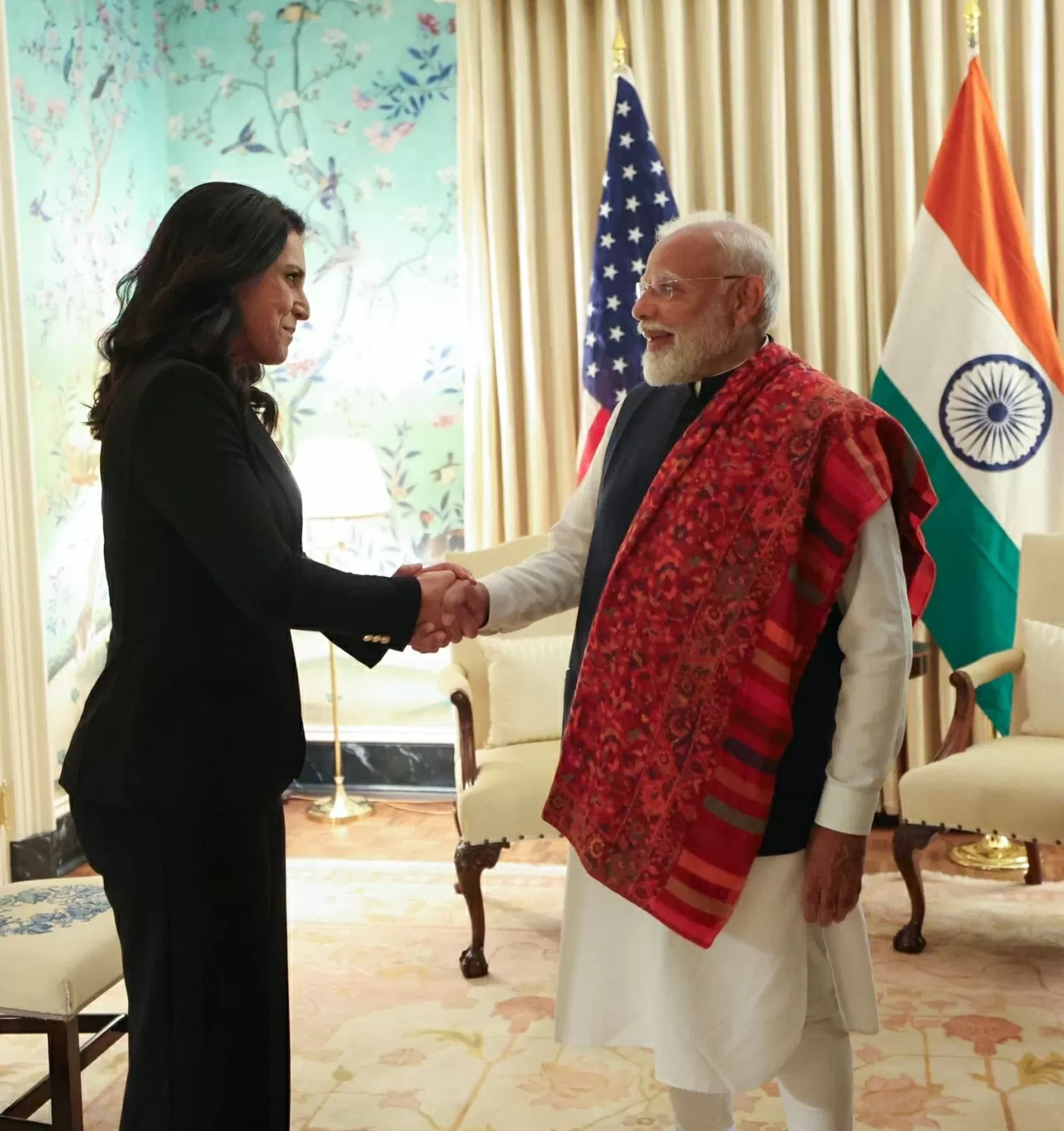 |
| Indian Prime Minister Narendra Modi kicked off his visit with a meeting with the newly appointed Director of National Intelligence, Tulsi Gabbard, on February 12. (Source: X) |
Reconnecting family ties
First, Modi will be one of the first leaders to visit the White House during Trump's second term, following Israeli Prime Minister Benjamin Netanyahu, Japanese Prime Minister Ishiba Shigeru, and King Abdullah of Jordan.
More importantly, the fact that the new US President invited the Indian Prime Minister to visit in his first month in office reflects Washington's priority for New Delhi, a relationship that, in the words of US Secretary of State Marco Rubio, "will shape the 21st century." Rubio himself had an early meeting with his Indian counterpart, S. Jaishankar, on January 26th, discussing important issues such as tariffs, economic cooperation, and preparations for Modi's upcoming visit.
In fact, the US-India relationship has flourished since Trump's first term. The leader revived the Quad cooperation between Washington, New Delhi, Tokyo, and Canberra, thereby strengthening India's security position. He also promoted US-India defense cooperation, including launching the 2+2 Ministerial Dialogue in 2018.
This forum provided an opportunity for the Defense and Foreign Ministers of both countries to exchange views on security and foreign policy issues of mutual concern. That same year, the US government also gave India the "green light" for Strategic Trade Status Tier 1 (STA-1), granting New Delhi access to advanced US technologies and military intelligence.
In particular, Washington played a crucial role in the 2020 Sino-Indian border clashes by providing New Delhi with significant intelligence, logistical support including winter clothing, and several unmanned reconnaissance aircraft.
The personal relationship between the two leaders has also attracted considerable attention. A highlight was the symbolic event in Houston, Texas, in September 2019, when Modi and Trump addressed a crowd of 50,000 Indian Americans. A year later, they did something similar, this time in Ahmedabad, the birthplace of Narendra Modi's political career.
Under Joe Biden, US-India relations have continued to be maintained and developed, notably through initiatives aimed at promoting cooperation in key and emerging technologies such as artificial intelligence (AI), quantum computing, semiconductors, and space exploration.
On that basis, in a statement ahead of the visit, Prime Minister Narendra Modi said that the upcoming meeting at the White House is an opportunity to further promote and develop the achievements of bilateral cooperation during President Donald Trump's first term.
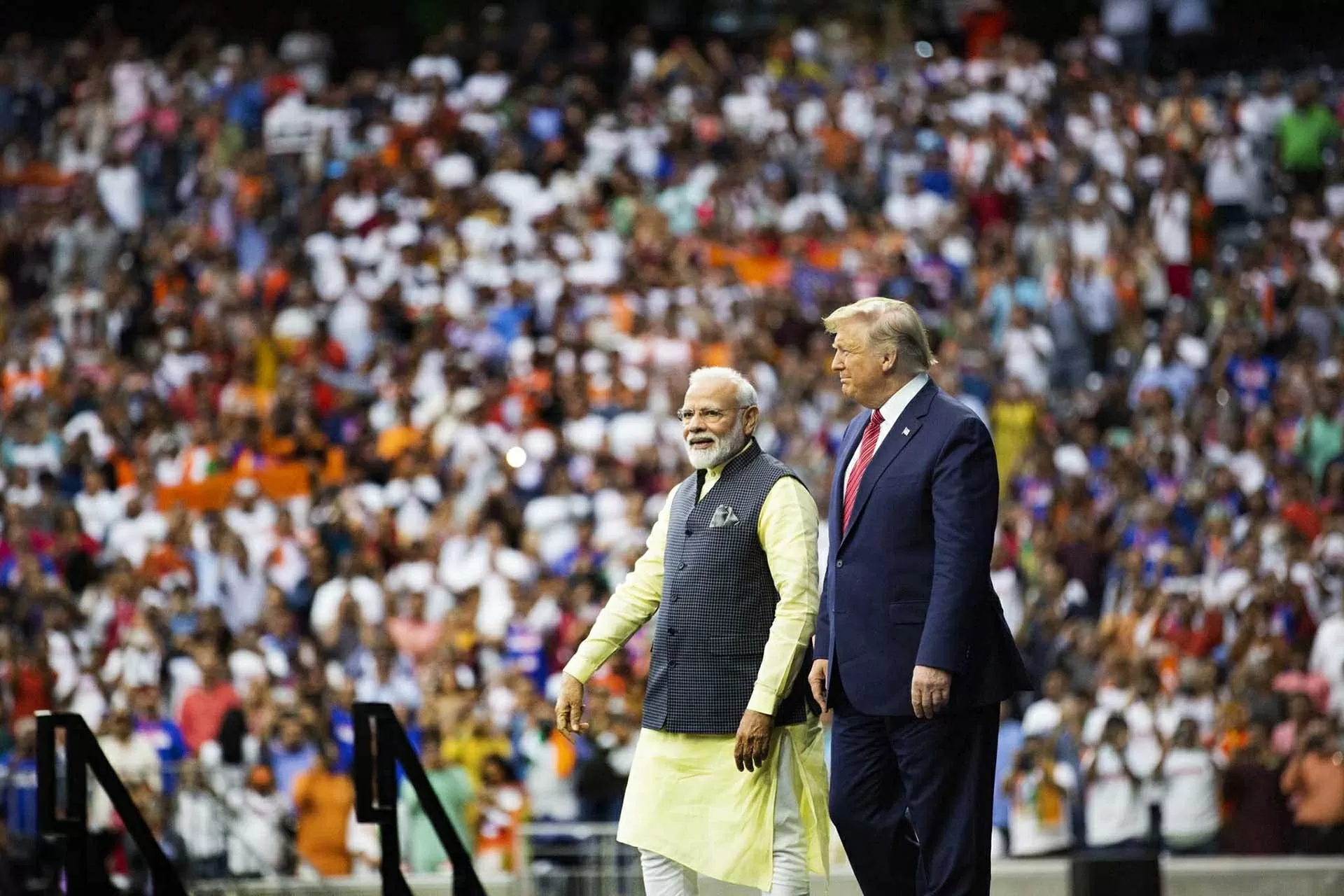 |
| Prime Minister Narendra Modi and President Donald Trump at the Howdy, Modi event in Houston, Texas, on September 22, 2019. (Source: Houston Chronicle) |
There are still storms ahead.
However, it would be a mistake to conclude that under President Trump, the US-India relationship was all "rainbow and sunshine." During his first term, this very leader criticized India's trade surplus with the US, labeled New Delhi the "king of tariffs," and imposed tariffs on steel and aluminum imports from the Ganges. The White House also eliminated many provisions of the Generalized System of Preferences (GSP), which allowed many Indian goods, such as textiles and footwear, to enter the US market without tariffs.
In 2018, the US also threatened sanctions against India after it purchased the S-400 air defense missile system from Russia. A year later, Trump's controversial comments on Kashmir, along with efforts to strengthen relations with Pakistan, further hampered bilateral ties.
Most recently, Trump continued to criticize the H-1B visa system, which allows American companies to recruit skilled workers from abroad, with Indians making up the highest proportion. The situation culminated when the US government deported over 100 Indian citizens earlier this month, sparking protests and concerns in India.
Self-interest comes first.
However, this is unlikely to hinder the current trajectory of US-India relations. Vineet Prakash, Professor of International Relations at Jawaharlal Nehru University (India), assessed: “The expulsion of Indian citizens will not change the nature of US-India relations. The two sides have many areas of shared interests and will continue to promote cooperation, especially in trade, technology, and defense.”
In addition, India is now planning to review tariffs on more than 30 imported items from the US, including luxury cars and solar panels, in order to reduce its trade surplus. Previously, New Delhi also reduced tariffs on bicycles, luxury cars, and chemicals from Washington.
From India's perspective, the US remains a key ally, being its largest investor and leading trading partner. The US is also home to five million Indian Americans – the world's largest Indian diaspora. Based on this, the Mint (India) predicts that the two leaders will discuss the trade balance, H1-B visas, and arms sales during their upcoming meeting.
Conversely, the Turkish news agency Anadolu assessed that strategic competition with China, particularly in the Indo-Pacific, is forcing the US to seek closer relationships with countries like India. Sharing this view, veteran Indian diplomat G. Parthasarthy stated that the White House "does not want a policy of confrontation with India" and that "although there are still some minor issues, I believe India is perfectly capable of managing them."
Source: https://baoquocte.vn/thu-tuong-an-do-tham-my-ban-cu-loi-ich-moi-304119.html
![[Photo] Commemorating the unwavering friendship between Vietnam and Laos](/_next/image?url=https%3A%2F%2Fvphoto.vietnam.vn%2Fthumb%2F1200x675%2Fvietnam%2Fresource%2FIMAGE%2F2026%2F01%2F27%2F1769518372051_ndo_br_1-jpg.webp&w=3840&q=75)
![[Photo] The General Secretary attends the groundbreaking ceremony for the construction of the Truong Ha Primary and Secondary Boarding School.](/_next/image?url=https%3A%2F%2Fvphoto.vietnam.vn%2Fthumb%2F1200x675%2Fvietnam%2Fresource%2FIMAGE%2F2026%2F01%2F28%2F1769604498277_vna-potal-tong-bi-thu-du-le-khoi-cong-xay-dung-cong-trinh-truong-pho-thong-noi-tru-tieu-hoc-va-trung-hoc-co-so-truong-ha-8556822-jpg.webp&w=3840&q=75)


![[Photo] National Assembly Chairman Tran Thanh Man meets with former leaders of the National Assembly from various periods.](/_next/image?url=https%3A%2F%2Fvphoto.vietnam.vn%2Fthumb%2F402x226%2Fvietnam%2Fresource%2FIMAGE%2F2026%2F01%2F28%2F1769601014034_anh-man-hinh-2026-01-28-luc-18-50-04.png&w=3840&q=75)


![OCOP during Tet season: [Part 3] Ultra-thin rice paper takes off.](/_next/image?url=https%3A%2F%2Fvphoto.vietnam.vn%2Fthumb%2F402x226%2Fvietnam%2Fresource%2FIMAGE%2F2026%2F01%2F28%2F1769562783429_004-194121_651-081010.jpeg&w=3840&q=75)


![OCOP during Tet season: [Part 2] Hoa Thanh incense village glows red.](/_next/image?url=https%3A%2F%2Fvphoto.vietnam.vn%2Fthumb%2F402x226%2Fvietnam%2Fresource%2FIMAGE%2F2026%2F01%2F27%2F1769480573807_505139049_683408031333867_2820052735775418136_n-180643_808-092229.jpeg&w=3840&q=75)
![OCOP during Tet season: [Part 1] Ba Den custard apples in their 'golden season'](/_next/image?url=https%3A%2F%2Fvphoto.vietnam.vn%2Fthumb%2F402x226%2Fvietnam%2Fresource%2FIMAGE%2F2026%2F01%2F26%2F1769417540049_03-174213_554-154843.jpeg&w=3840&q=75)


Comment (0)