

Chris, a British partner working in Vietnam, had the opportunity to visit and work with me at the University of Bristol (UK). Knowing that I was born and raised in Ho Chi Minh City and have many relatives living in Binh Duong , he asked me two questions: "What do you think about the merger of Ho Chi Minh City?" and "What are your prospects for becoming an international financial center?".
To me, those two questions are actually very closely related because Ho Chi Minh City has long been the leading economic and financial center of Vietnam. This merger is perfectly in line with the city's development orientation: strengthening regional linkages, elevating its status, and striving to transform from a regional financial center into an international financial center. Ho Chi Minh City's identity lies in its openness, its daring spirit, its willingness to experiment with new things, embrace new opportunities, and constantly innovate. What Ho Chi Minh City needs is to more strongly assert this "brand" on the international stage.
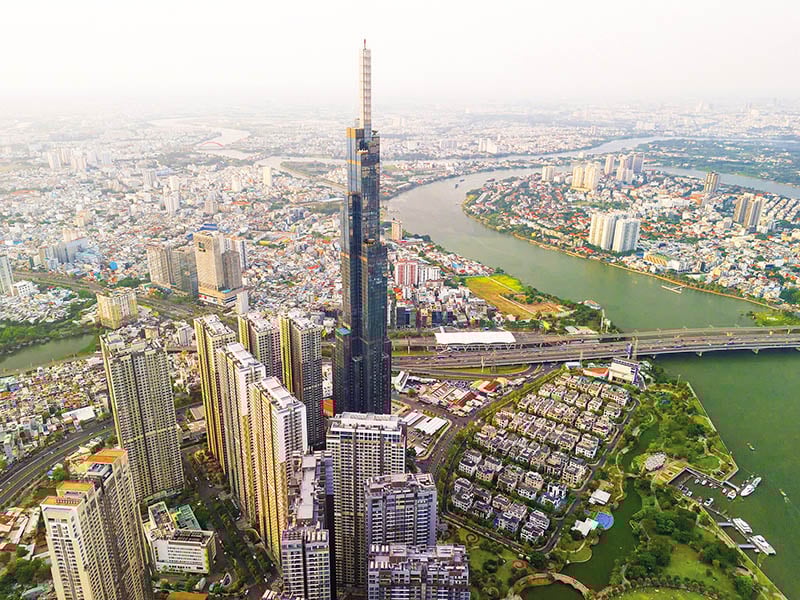
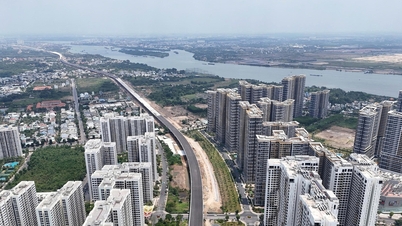
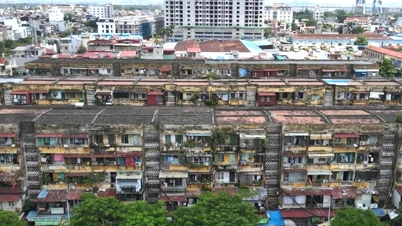
Ho Chi Minh City is considered to have all the favorable conditions to develop into an international financial center and become a megacity. Photo: Le Toan |
The brand of a "megacity"
"Megacity" is a term I've seen frequently lately when discussing the merger of Ho Chi Minh City with Binh Duong and Ba Ria - Vung Tau provinces.
Ho Chi Minh City previously accounted for 15.5% of the country's gross domestic product (GDP). After merging with Binh Duong and Ba Ria - Vung Tau, its influence increased even further, contributing nearly 24% to the national GDP. The merged city's GRDP (Gross Regional Product) is almost double that of Hanoi. The city's economic scale is also double that of the six newly merged localities in the Southwest region combined.
"When asked about the size of Ho Chi Minh City, the artificial intelligence responded: after the merger, Ho Chi Minh City's size is now comparable to Shanghai in China. Now we must strive to develop like Shanghai, with such a scale, creating remarkable progress," General Secretary To Lam stated at a meeting with veteran revolutionary cadres, meritorious individuals, and exemplary policy beneficiary families in the Southern region, held on April 21st in Ho Chi Minh City.
If we ask what Shanghai's "trademark" is, we'll easily get the answer that it's a major economic and financial center of China, and that it's associated with the film "The Bund".
Regarding the position of an international financial center, according to the Global Financial Centers Index (GFCI 37) ranking, published by Z/Yen Partners (UK) and the China Development Institute on March 20, 2025, Vietnam ranks 98th, considered a regional financial center; while Shanghai ranks 8th, in the top group of global financial centers – meaning the highest group, on par with London, New York, and Tokyo.
On the one hand, it shows a significant gap between us and Shanghai. On the other hand, it shows the potential for us to catch up with other countries. This is not a far-fetched idea. In the GFCI 29 report published in 2021, Dubai was just a narrow specialized market, ranked 19th globally. Now, they have naturally joined the global leadership group, diversifying their services and threatening the position of Top 10 centers with hundreds of years of history. Another example is that in March 2023, Ho Chi Minh City was more than 40 ranks behind Bangkok; now the gap has narrowed to just 2 ranks.
However, we shouldn't focus too much on these rankings, but rather on the "brand" story. We need to ensure that when people think of Ho Chi Minh City, they immediately think of it as a vibrant economic and financial center, full of opportunities, with sustainable development, a place where they can conduct financial transactions and explore a city full of life, constantly changing.
This is what Ho Chi Minh City's brand identity should be like, so that it can develop like Shanghai, as envisioned by General Secretary To Lam.
The question is, how can we achieve that?
What does Ho Chi Minh City need most?
The vision of regional integration, becoming an international financial center, and sustainable development has existed for a long time, but why hasn't Ho Chi Minh City achieved the expected results?
Some say the first crucial element is the lack of "money," or investment capital. To continue the regional linkage strategy with Binh Duong, Ba Ria - Vung Tau, and Dong Nai as before, infrastructure investment is needed to increase connectivity between these areas, such as the metro project connecting Binh Duong with Ho Chi Minh City before the merger, and the construction of ring roads.
Industrial-maritime economic clusters and commercial/financial centers also require investment in synchronized and modernized logistics infrastructure. And now, there's added pressure to adopt artificial intelligence (AI) and sustainable development.


Those things require money, and Ho Chi Minh City can raise that money itself, through the very international financial center it is currently developing. The problem is that it needs a superior mechanism.
This superior mechanism allows businesses in Ho Chi Minh City in general, and the financial center in particular, to experiment with new ideas, easily attract international capital, resolve economic disputes smoothly, and attract strategic partners to help develop Ho Chi Minh City.
Besides the open and flexible mechanisms from the central government, those things also require two more conditions.
Firstly, there needs to be a mechanism that allows leaders to experiment and make mistakes, without being "punished" for creative, risky decisions—in other words, overcoming obstacles without being held back.
Secondly, there is a need for a less restrictive urban governance model that allows for quick, innovative decisions, but also ensures clear and transparent accountability. This means delegating power and responsibility, as well as ensuring the highest possible standards of oversight and transparency.
One example of this is the need for independent governing bodies for key projects. International financial centers or high-tech hubs will require independent regulatory bodies. Dubai's financial center is a case in point.
The Dubai Financial Centre is governed by the DIFC (Dubai International Financial Centre), an independent body responsible for strategic planning and operational oversight of the Centre. This body, along with the Dubai Financial Services Authority (DFSA), acts as the regulatory body, closely monitoring financial activities and ensuring financial security, including preventing money laundering.
This independent body will have multiple roles, including selecting strategic partners, prioritizing those who will test new products, and issuing sets of operating standards under the superior mechanism assigned to the financial center.
Who will be appointed to this body? To what extent will they be independent? What are the mechanisms for operation, supervision, and accountability? These are questions that need to be answered regarding the governance mechanisms of key areas in Ho Chi Minh City, whether it's a financial center, a technology center, an innovation center, or something else.
The most crucial link in the aforementioned model and mechanism is the leader. Because even with the mechanism and model, if the leader lacks the ability to connect, lacks the courage to act, and lacks the willingness to experiment, everything will remain stagnant.
Therefore, Ho Chi Minh City needs money, superior mechanisms, a flexible management model that is sufficiently independent but also accountable. It also needs a leader with vision, dedication, and the ability to connect these pieces, navigating through difficulties and uncertainties.
But perhaps most importantly, we need consistent direction, from policy to the vision of the leadership team. If we simply provide mechanisms, directions, and vision, but they change frequently, even every few years, it will create numerous problems. In today's uncertain global context, stability, consistency in development direction and vision, and predictable policies are considered a luxury. However, if we can achieve this, international investors will appreciate it and feel secure.
Consistency and stability, simply put, means "keeping your promises," "doing what you say you will do," and not "changing your mind" midway.
The people of Ho Chi Minh City have always been known for their open-mindedness and straightforwardness. If they can maintain that stability and consistency, I believe it will be a strong brand.
"This place is reliable, easy to cooperate with, easy to do business, so you should come and invest." That simple message is enough to attract investors.
The foundation for an international megacity also stems from trust in that brand, and we should strive to build a trustworthy and friendly megacity to attract investment.
Source: https://baodautu.vn/ban-sac-cua-mot-sieu-do-thi-d275258.html
![[Image] Close-up view of the 10-lane road connecting to Long Thanh Airport](https://vphoto.vietnam.vn/thumb/1200x675/vietnam/resource/IMAGE/2026/04/04/1775291871988_ndo_br_1-resize-5690-jpg.webp)













































Comment (0)