


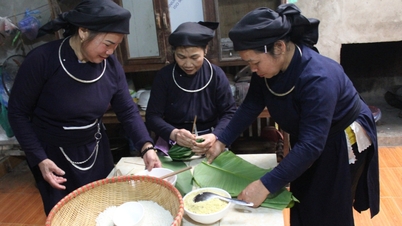
Making banh chung (traditional Vietnamese rice cakes) for Tet (Vietnamese New Year).
Fortunately, after putting down his plow, he had a peaceful and dreamy sleep that night. He dreamt that a fairy came and taught him how to make two kinds of cakes: banh chung and banh giay. The fairy also instructed him to say that when offering them to King Hung VI, banh chung represented the earth, and banh giay represented the sky. At that time, astronomy was only at the concept of a round sky and a square earth.
King Hung Vuong VI received the cakes and pondered for a long time. He thought about the products made by his people, and realized that nothing was more precious than rice, peanuts, and pigs and chickens. The banh chung (square sticky rice cake) contained all those products in its shape, symbolizing the earth. The banh giay (round, pure white sticky rice cake) symbolized the sky. He also saw the hard work of Prince Lang Lieu and thought that he deserved to inherit the throne.
For us today, sticky rice cakes (bánh chưng and bánh giầy) are no longer part of the imagination of a world with a round sky and a square earth. However, they are compelling evidence of a human civilization: the rice-farming civilization, which has a history of over four thousand years.
Of course, the rice-based civilization also has much physical evidence from thousands of years of history. These include Chu Dau pottery and Dong Son bronze artifacts. The uses and decorations on these objects often depict images of rice plants. And their function is closely linked to cooking rice and soup. It's not difficult to deduce that rice was already cultivated and processed skillfully at that time.
One of the pinnacles of rice processing is the making of various cakes and pastries, especially banh chung and banh giay. Besides the complex preparation process, banh chung is also a long-standing tradition of rice-farming communities. Vietnamese people usually make banh chung during the Lunar New Year. This is a time when children and grandchildren who work far away return home to reunite in their homes, where three or four generations live together. It's also a time when the children and grandchildren are taught the basic techniques of making banh chung by their parents, without needing any fairy godmother to guide them in their dreams.
The youngest children sit with basins full of water, washing the banana leaves. Older children can pick out pebbles and grains from the sticky rice basket. Even older children can be taught to split bamboo strips and sort beans. The adults in the house spread mats and arrange the rice, meat, mung bean baskets, banana leaves, and bamboo strips in the most convenient places. Rural people wrap the cakes very precisely in terms of weight and size. City dwellers have the added tool of a wooden mold. Many families don't even need a mold; they have children sit and fold the leaves and cut off the ends to a size determined by the adults cutting a banana leaf stem as a guide. The wrapping process is usually supervised by an elderly woman. She doesn't wrap each cake herself but only ties them together in pairs. This process seems easy, but it's not. Cakes wrapped by many people have varying degrees of tightness. The person in charge will adjust the corners and tie the hundred pairs together securely.
Typically, larger families start wrapping bánh chưng (traditional Vietnamese rice cakes) around the 26th of the lunar month. Few families wait until the afternoon of the 30th because that afternoon they also have to prepare the New Year's Eve offering meal, which requires a lot of skilled and strong people.
Boiling the sticky rice cakes (bánh chưng) is the most time-consuming step. It usually takes about 12 hours of continuous firewood. People take turns staying up all night by the fire, adding water and firewood. The basin of cold water placed on top of the boiling pot must always be refilled. When the water in the pot runs low, the water in the basin is hot enough to add more. Many children stay up all night by the pot just waiting for the cakes to be taken out. They get to enjoy the small, hot sticky rice cakes, scraping the last bit from the rice bowl reserved specifically for them.
Even after taking the pot of sticky rice cakes out, the adults still have work to do. They have to arrange them neatly on a wooden board. Another wooden board of the same size is placed on top to press them down. Above that board will be a bucket of water or a stone mortar. Houses on the street front have folding doors, which are very convenient for lifting and pressing the sticky rice cakes. In the countryside, sometimes a simple wooden platform is used. Sticky rice cakes must be pressed while hot to become firm. The rice grains must blend together tightly. When cut with a string, the cake pieces must be square and sharp-edged.
The cakes placed on the altar on the afternoon of the 30th of Tet are wrapped again in fresh, vibrant green dong leaves by the women. They are then tied with several strands of red-dyed bamboo, adding a touch of solemnity. At this point, the cake has begun to become a ritual on the altar.
The rice cake is taken down from the pot, peeled, and arranged on the Tet (Lunar New Year) feast table. People use thin strips of bamboo to create an eight-petal flower shape on a large plate. They peel off one side of the cake and place it face down on the plate of bamboo strips. Then they peel off the other side of the cake. Using the bamboo strips, they cut the cake into eight equal parts. Two such parts are called a corner of the banh chung. Not many people can eat an entire corner of a banh chung.
Even during times of hardship, sticky rice cakes (bánh chưng) were rarely eaten to fill one's stomach. In fact, eating a full meal of sticky rice cakes can be quite filling. They also need side dishes. One of the most common is pickled onions and cucumbers. In rural areas, a pot of fish stewed over three fires, along with pork belly and sugarcane, is a wonderful accompaniment to sticky rice cakes.
In modern times, banh chung (Vietnamese sticky rice cake) is now considered just like any other cake. Very few families in the city still make their own banh chung by hand. The tasks involved in preparing the banh chung have also disappeared. Without the old wood-burning stove to place the pot of fragrant herbal water, no one uses that fragrant herbal bath anymore. And banh chung is eaten at any time of year. Naturally, the elaborate rituals of family gatherings have also become less common. Few young people under 40 know how to make banh chung. Some don't even eat it anymore. The traditional banh chung now faces competition from countless other industrially produced cakes, and it always ends up losing.
However, in a certain sense, banh chung (Vietnamese sticky rice cake) embodies the spirit of a cultural heritage. This spirit is most clearly manifested in the reunion and gathering within a large family. Without it, the foundation and structure of a large family seem to waver and become unstable. Siblings living in the city have also missed a rare opportunity to meet and chat. Therefore, remembering or forgetting has become a question for life today.
Source: https://baovanhoa.vn/van-hoa/banh-chung-de-nho-hay-quen-205118.html











































Comment (0)