

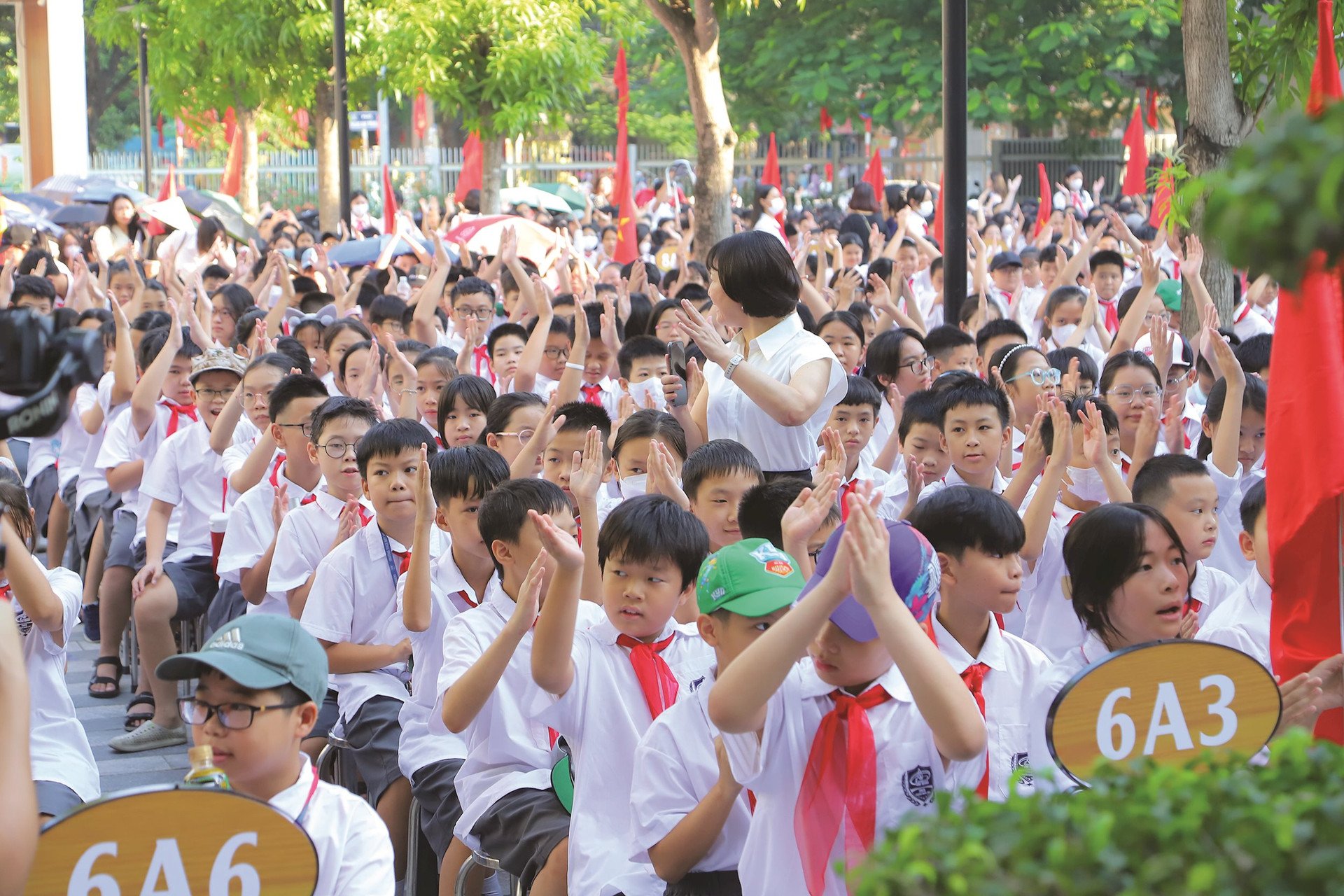
Critical feedback is essential for developing and improving policies.
Associate Professor Tran Xuan Nhi, former Deputy Minister of Education and Training, observed that in recent times, the press has not only reflected current events in the education sector such as the opening of the school year, high school graduation exams, entrance exams for grade 10, and enrollment at the primary level, but has also focused on publicizing policies and initiatives for educational reform, attracting significant public attention.
Early and remote policy communication.
To improve policy quality and build social consensus, it is crucial to communicate policies early and proactively. This means communicating from the policy drafting stage and mobilizing social resources to participate in the drafting process.
"Policy communication is not just about illustrating policies, but also about providing constructive criticism to build and refine them. A series of important policy decisions by the Government and various ministries, including the Ministry of Education and Training, have benefited significantly from the contributions of the press and media from the very beginning, even when they were still drafts," said Associate Professor Dr. Tran Xuan Nhi.
Most recently, at a seminar organized by the Ministry of Education and Training to gather opinions from the press on the draft Law on Teachers, teachers' salaries and professional certifications were the two issues that received the most attention from reporters and journalists. Prior to this, this topic had also been explored by the press from diverse perspectives, through real-life stories and statistics from relevant agencies regarding the number of teachers resigning recently. This is not a new issue; for many years, concerns have been raised about inadequate remuneration, salaries, and allowances for teachers, making it difficult for them to fully dedicate themselves to teaching and improving their knowledge and skills for career development. Many teachers even quit due to low salaries, having to seek other jobs, making the teaching profession less attractive to talented individuals.
The Law on Teachers, currently being drafted by the Ministry of Education and Training, is expected to contribute to raising the status of teachers in today's society. However, much work remains to be done between now and the National Assembly 's consideration at its 8th session (October 2024) and its adoption at its 9th session (May 2025). Among these tasks, the press continues to be considered a powerful channel for dissemination, serving as a forum for positive exchange and recording feedback and criticism from the public, experts, and educators.
According to Vu Minh Duc, Director of the Department of Teachers and Educational Management Staff (Ministry of Education and Training), from now until then, the Ministry of Education and Training and the drafting committee will continue to widely solicit public opinion through various channels and forms, with the participation of the press and media being indispensable. The Director also emphasized that special attention will be paid to gathering opinions from all teachers – the group directly affected by the draft law.
To communicate effectively and effectively.
In the current flow of information, the press not only accompanies the education sector in informing all levels of society about new policies and guidelines, but also contributes to highlighting and discovering exemplary teachers, students, and advanced role models in the field of education. At the same time, it focuses on reflecting and exposing negative incidents… Acknowledging the support and cooperation from press and media agencies, Deputy Minister of Education and Training Hoang Minh Son affirmed: The press has made a significant contribution to ensuring that the education sector's policies and guidelines are implemented effectively, bringing positive values to students, parents, and society as a whole.
Many journalistic works have delved into analyzing "hot" issues in the education sector; documenting the practical implementation or social critique of the sector's policies and decisions; and recording the thoughts and aspirations of parents and students.
Many works spread beautiful stories of the education sector; examples of good people and good deeds; the noble hearts and selfless dedication of teachers… Among them are teachers who live and work in remote areas, volunteering to “plant the seeds of knowledge” in the farthest corners of the country.
"Through journalistic works, we see the commitment of reporters to ensure that exemplary teachers and the positive values that education brings are widely disseminated in society," Deputy Minister Hoang Minh Son stated.
Special Topic: Journalism and Policy Communication
In policy communication, the concept of policy refers to public policies encompassing measures implemented by the Party and Government to address social issues or promote social development.
Policy communication is the process of conveying information about the Party and State's policies on specific areas through various communication channels, with mainstream media playing a key role, to bring policies to the public. This aims to ensure smooth communication between the policy-making entity and the groups affected by those policies in society.
This contributes to changing perceptions and ultimately adjusting the behavior and attitudes of policy beneficiaries to align with the interests of each individual, the community, and society as a whole, while remaining consistent with the common interests of the nation, the people, and all citizens.
However, in the current context, policy communication is not limited to mainstream media; the role of social media in policy communication is becoming quite significant.
Undeniably, social media has made positive contributions to policy communication, particularly in participating in the critical review process from the policy drafting stage, helping to make policies more relevant to people's lives. However, at the same time, social media has also led to the spread of inaccurate, unverified, or misinterpreted information that does not reflect the views of those who drafted the policies.
Therefore, the legitimacy and accuracy of the press remain the guarantee of its leading role in policy communication. This is clearly demonstrated in the Prime Minister's Directive "On Strengthening Policy Communication" issued in March 2023, which identified "the press as the main channel".
So how can the press "maintain its rhythm" as the "mainstream" in policy communication?
These are the concerns we raised in this year's issue commemorating the 99th anniversary of Vietnam's Revolutionary Press Day, with the hope that: the press needs to be given more resources to effectively communicate policies, contributing to the creation of policies that are in line with the people's will and helping to create social consensus.
D.D.K
Source: https://daidoanket.vn/bao-chi-dong-hanh-with-nganh-giao-duc-10284452.html














































![[Photo] Closing Ceremony of the 15th Conference of the Central Committee of the 13th Party Congress](https://vphoto.vietnam.vn/thumb/402x226/vietnam/resource/IMAGE/2025/12/23/1766462841764_a1-bnd-3731-1647-jpg.webp)




















Comment (0)