

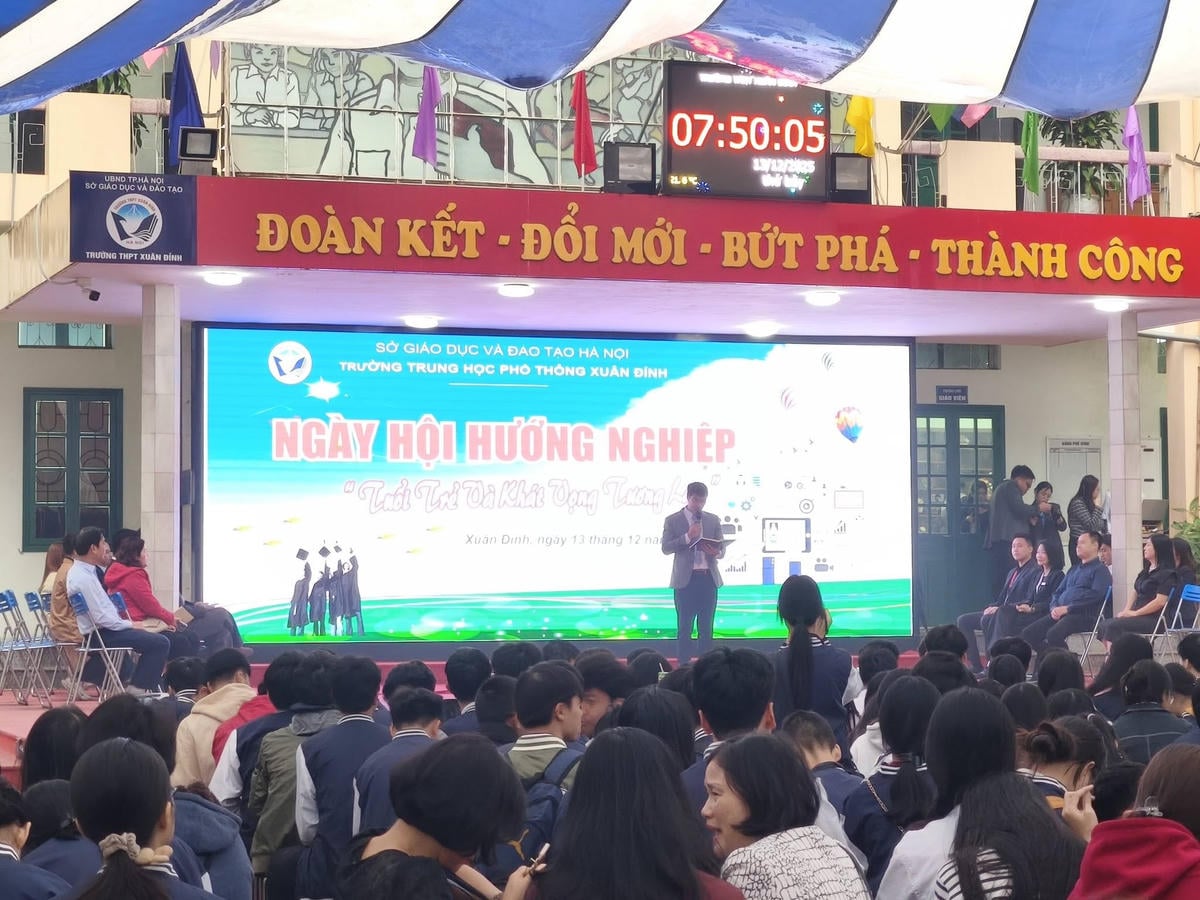
From 2026, junior high school graduates will have a new educational option, equivalent to high school, opening up a more flexible and practical path in career guidance and human resource development.
Vocational high school – a legally recognized level of education.
According to the new regulations, vocational high school is a level of education within the field of vocational education and training, and is considered on par with high school. It is no longer a pilot model or a "detour" for disadvantaged students, but a formal educational path, fully legalized, with an independent diploma included in the national education diploma catalog.
The amended Education Law clearly stipulates that vocational secondary education is for those who have completed the lower secondary education program or equivalent; graduates of vocational secondary education can continue their studies at the intermediate, college, or university level according to the articulation regulations of the Ministry of Education and Training (MOET). The addition of vocational secondary education diplomas to the national diploma system affirms the equal legal value of this type of training compared to the high school diploma.
According to the Ministry of Education and Training, vocational high schools are established to fundamentally address the issue of career guidance after lower secondary education, while simultaneously creating a skilled workforce that can quickly enter the labor market in the context of an economy facing a shortage of qualified technical labor.
The core of vocational high school education lies in its integrated training model. The program ensures both core general education knowledge and significantly increases the duration of vocational training, helping learners develop clear professional competencies right from the secondary school level.
According to the design guidelines, the total duration of the vocational high school program is expected to be approximately 3,300 hours, of which about 1,500 hours are dedicated to core high school cultural knowledge; 300 hours to compulsory general subjects such as politics, law, and national defense and security; and about 1,500 hours to vocational subjects and modules. Cultural subjects are designed to be integrated with vocational specialization, helping students see the practical significance of their learning.
Notably, the program integrates cultural and vocational learning into each semester, avoiding the situation where all cultural subjects are concentrated in the first year – a common cause of student discouragement and dropout in previous vocational training models.
"An open roadmap" for human resource allocation and development.
According to the plan, during the 2025-2026 period, the Ministry of Education and Training will focus on developing the legal framework, standard curriculum, and criteria for vocational high schools. From 2026 to 2030, the program will be implemented and the first cohort will be officially enrolled nationwide, applicable to eligible institutions; a comprehensive evaluation will be conducted in 2030 to further refine the program.
The institutions permitted to provide vocational secondary education include: vocational high schools; qualified secondary and college-level schools; and some higher education institutions in specialized fields such as arts and sports. For universities, vocational secondary education is only permitted for majors and professions within the specialized fields offered by the university.
Professor Dr. Le Quan, Deputy Minister of Education and Training, stated that the Ministry is finalizing regulations on standards for vocational high schools. According to him, vocational education institutions are fully capable of providing high school-level general education with guaranteed quality, even comparable to many current high schools, if they are allocated a stable teaching staff and have autonomy in curriculum development.
One of the major concerns of parents and students is: Is a vocational high school diploma equivalent to a regular high school diploma? According to the law, vocational high school and regular high school are two different paths but are at the same educational level, both falling within the lower secondary education stage and are considered equal within the Vietnamese National Qualifications Framework.
Dr. Hoang Ngoc Vinh, former Director of the Vocational Education and Training Department (Ministry of Education and Training), argues that "equivalence" should be understood as equivalence in legal value, opportunities for further education and employment, rather than complete similarity in learning content. Vocational high school graduates still have the right to pursue higher education at colleges and universities or participate in the domestic and international labor markets, just like high school graduates. Therefore, vocational high school graduates possess both an equivalent high school diploma and a specific skill to start working early, while still having the opportunity to continue their education at higher levels if they meet the admission requirements.
However, for this model to be effective, experts suggest focusing on industries with high scientific and technological content, aligned with the development needs of the economy. In addition, clear regulations are needed regarding implementation conditions. It should only be implemented in facilities that meet the requirements in terms of personnel, infrastructure, programs, and output standards. If implemented in a scattered manner, prioritizing quantity over quality, the model risks distortion and failure to achieve its objectives.
The amended Vocational Education Law has opened up an important legal framework. The remaining issue is to organize its implementation in a systematic, selective, and consistent manner. If done well, vocational high schools will not only be a new path for students after lower secondary education, but also a new pillar of the national education system, contributing to the formation of a skilled workforce capable of adapting and developing sustainably in the future.
Source: https://daidoanket.vn/trung-hoc-nghe-huong-di-moi-cho-hoc-sinh-sau-thcs.html


![[Photo] General Secretary and President To Lam presides over a meeting on preparations for the review of one year of operation of the three-tiered government system.](https://vphoto.vietnam.vn/thumb/1200x675/vietnam/resource/IMAGE/2026/06/02/1780391821195_a1-bnd-4595-9717-jpg.webp)






















































Comment (0)