

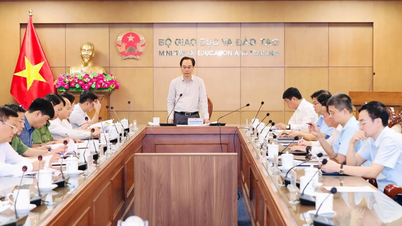
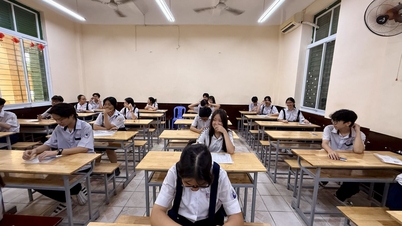
On June 2nd, the Ministry of Education and Training (MOET) held a nationwide online conference on the preparation for the 2026 High School Graduation Examination.
The conference was attended by leaders from provinces and centrally-administered cities, departments of education and training, higher education institutions involved in organizing the exam, and other relevant units.
Besides reviewing exam preparations, the Ministry of Education and Training analyzed data on registrations for the 2026 high school graduation exam to assess the initial changes in the implementation of the 2018 General Education Program in teaching, assessment, career guidance, STEM education, and digital transformation.

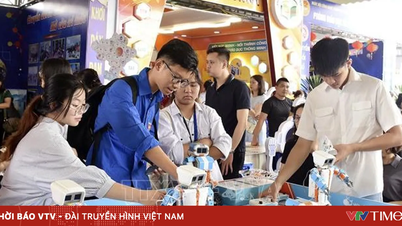
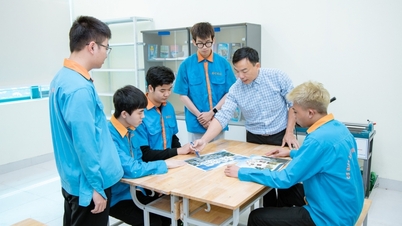
STEM education continues to evolve and shift in line with technology.
One of the key objectives of the 2018 General Education Program is to shift strongly from a content-based approach to developing students' qualities and competencies; while simultaneously strengthening differentiation and career orientation at the high school level. Data from the 2026 exam registration shows that this objective is gradually being realized.
Compared to 2025, the number of students in Physics is expected to increase by 35,332; History by 71,443; Economics and Law Education by 32,671; Informatics by 10,975; Industrial Technology by 4,974; and Agricultural Technology by 9,129.
The Ministry of Education and Training assesses that the simultaneous increase in many different subject groups shows that students are increasingly choosing subjects based on career orientation, rather than focusing on a few fixed combinations as before. This also shows that the 2018 General Education Program has been creating a substantial impact on students' learning activities.

According to statistics from the Ministry of Education and Training, in 2026, the total number of choices for STEM subjects, including Physics, Chemistry, Biology, Informatics, Industrial Technology, and Agricultural Technology, will increase from 705,773 in 2025 to 771,083 in 2026, an increase of 65,310, or 9.25%.
In particular, Informatics increased by 142%; Industrial Technology by 205%; and Agricultural Technology by 41.6%. These are the subjects with the highest growth rates among all the elective subjects in this year's exam.
The increase of 32,671 students in the Economics and Law Education subject in just one year shows that the content of economics, finance, and law education in the new curriculum has initially had a positive impact on students' career awareness.
The Social Sciences continue to assert their important role.
Alongside the growth of STEM fields, social science subjects continue to receive significant interest from students.
History had 570,800 students registering to take the exam, an increase of 71,443 students compared to 2025, making it the subject with the highest number of choices among the elective subjects. Economics and Law Education reached 284,754 students, an increase of 32,671 students.
This result shows that the 2018 General Education Program not only promotes STEM education but also contributes to enhancing the status of social sciences, civics, economics, and law; thereby contributing to the formation of essential qualities and competencies of citizens in modern society.
The Ministry of Education and Training assesses that the significant increase in the number of students choosing Informatics and Technology subjects shows a clear change in the awareness of students and parents about the role of digital technology.
Positive changes in subject selection, STEM education, career guidance, civic education, and digital transformation demonstrate that the 2018 General Education Program is gradually being implemented and creating tangible impacts on learners.
The data also highlights the need for even stronger innovation in STEM education, foreign languages, career guidance, streaming, digital transformation, and the application of artificial intelligence, narrowing the gap in access to STEM education and digital transformation between regions to meet the country's requirements for developing high-quality human resources in the new era.
Source: https://daidoanket.vn/hoc-sinh-doi-cach-chon-mon-thi-tot-nghiep-thpt-nam-2026.html




![[Photo] Delegation attending the 14th Congress of the Vietnam Trade Union visits the Mausoleum of President Ho Chi Minh.](https://vphoto.vietnam.vn/thumb/1200x675/vietnam/resource/IMAGE/2026/06/03/1780451842301_ndo_br_img-3824-jpg.webp)

























































































Comment (0)