

Regulations are necessary to protect patients' rights.
Currently, many health insurance-covered medical facilities are experiencing shortages of medicines and medical supplies, forcing patients to purchase medications themselves based on their doctor's prescriptions. However, regulations regarding the responsibility for reimbursing patients for these costs are unclear.
Representative Tran Van Tuan (Bac Giang) emphasized the need for specific regulations requiring medical facilities to reimburse patients for the money they have paid for medication and medical supplies before discharge. This would ensure the legitimate rights of people with health insurance cards, while also reducing complex administrative procedures and giving patients more peace of mind when using medical services.
Mr. Tuan also suggested that medical facilities should be responsible for payments to the Social Insurance agency and ensure that payment records are complete and transparent. This would not only protect the rights of patients but also help prevent potential irregularities during the medical examination and treatment process.
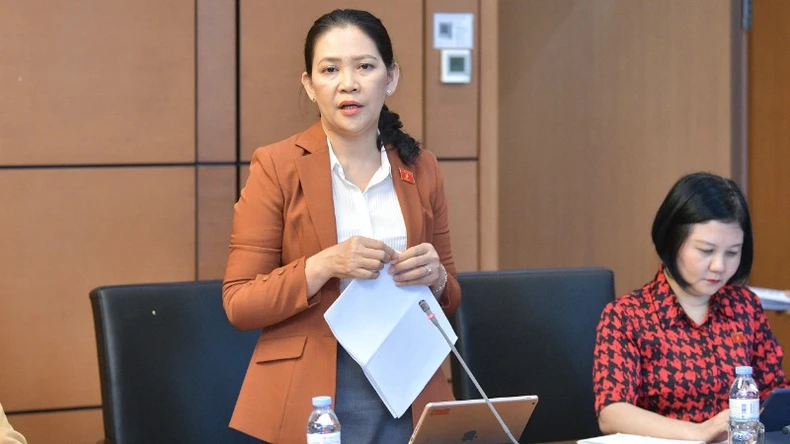 |
Representative Huynh Thi Anh Suong – Delegation of the National Assembly of Quang Ngai province. |
Representative Huynh Thi Anh Suong (Quang Ngai) argued that expanding the scope of health insurance coverage is necessary to ensure universal health insurance coverage. According to Ms. Suong, currently over 93.6 million people participate in health insurance, equivalent to 93.35% of the population. However, further review and inclusion of groups not yet covered by health insurance is needed to ensure that all citizens have access to healthcare services.
Ms. Suong also proposed expanding health insurance coverage to include medical services such as telemedicine, referrals based on professional requirements, the use of blood and blood products, and other medical equipment used in treatment.
Addressing shortcomings in the management and assessment of health insurance.
Representative Quàng Thị Nguyệt ( Điện Biên ) stated that revising the concept and content of health insurance assessment is necessary to overcome difficulties in organizing and implementing the current health insurance policy. Clarifying the process of paying for medical examination and treatment costs will contribute to improving the accountability of agencies managing the Health Insurance Fund, ensuring efficient fund utilization, and preventing waste and corruption.
Furthermore, delegate Tran Duc Thuan (Nghe An) also suggested that the draft amendment to the law should focus on addressing the obstacles encountered in the implementation of the Health Insurance Law, in order to clarify the rights of health insurance participants and the responsibilities of relevant agencies.
 |
Representative Tran Thi Hong Thanh (Ninh Binh) delivered a speech. |
In addition, delegates also agreed with expanding the scope of benefits for health insurance participants. Delegate Tran Thi Hong Thanh (Ninh Binh) highly appreciated the draft law for expanding the scope and benefits in the transfer between different levels of medical examination and treatment.
However, Ms. Thanh suggested that additional benefits regarding pre-hospital emergency services and nutritional treatment services should be added to ensure that the rights of health insurance participants are more fully protected.
In addition, delegate Nguyen Thi Thuy (Bac Kan delegation) also proposed reviewing and supplementing regulations on health insurance coverage across all healthcare facilities, in order to thoroughly resolve current obstacles, help people easily access medical examination and treatment services, and avoid administrative hassles.
Referral slips should be kept to ensure the effectiveness of the healthcare system.
During the group discussion, Deputy Minister of Health Nguyen Tri Thuc (Ho Chi Minh City) raised concerns regarding the organization of medical examination and treatment at various levels and the maintenance of the grassroots healthcare system. One of the issues he was particularly interested in was retaining referral slips for health insurance-covered medical examinations and treatments, aiming to protect and develop a comprehensive healthcare system.
 |
Representative Nguyen Tri Thuc – Member of the National Assembly delegation from Ho Chi Minh City. |
According to Deputy Minister Nguyen Tri Thuc, previously the Vietnamese healthcare system was divided into four levels: commune, district, province, and central. However, this revised law will redefine it into three levels: the initial level (roughly understood as commune health stations), the basic level (district hospitals and some provincial hospitals), and the specialized level (central hospitals, specialized general hospitals, and some provincial hospitals with the necessary technical qualifications).
He argued that organizing the healthcare system into these three levels would be more suitable for its current development, optimizing patient flow and treatment, and improving service quality for the public.
At the same time, the new direction for the healthcare sector is to eliminate administrative geographical barriers in health insurance-covered medical examinations and treatments. This will allow people to receive medical care anywhere without being limited by their initial registration location.
Regarding the proposal by some National Assembly deputies to abolish referral forms in health insurance-covered medical examinations and treatments, Deputy Minister Nguyen Tri Thuc clarified that referral forms should only be abolished for cases moving from the initial level to the basic level. However, referral forms should be maintained for cases moving from the initial or basic level to the advanced level (central hospitals and specialized hospitals).
He argued that referral letters are not just administrative procedures but also documents summarizing the patient's medical history, helping doctors at higher-level hospitals understand the patient's health condition and thus develop more accurate and effective treatment plans.
If referral forms are abolished, many patients will no longer seek treatment at district health centers and hospitals, but will instead flock to central-level hospitals. This will not only overload higher-level hospitals but also cripple the grassroots healthcare system.
"Referral letters are very important. If they are abolished, patients will no longer seek treatment at health centers or district hospitals but will go straight to central-level hospitals such as Cho Ray, Bach Mai, Viet Duc… In that case, the grassroots healthcare system will be eliminated in just 1-2 years," Mr. Nguyen Tri Thuc stated.
According to the Deputy Minister of Health, if referral forms are abolished, the pressure on patients at central-level hospitals will increase dramatically. He cited the example of skilled doctors at Cho Ray, Viet Duc, or Bach Mai hospitals, who can only perform one specialized surgery per day because these surgeries last 6-8 hours. If patients from all over the country flock to specialized hospitals, the doctors will not be able to cope with the large number of patients, leading to an overload at these hospitals.
The Deputy Minister also shared concerns about the negative impact on the quality of medical examination and treatment if referral slips are not maintained. "Previously, a doctor examined about 20 patients per day, but if referral slips are abolished, the number of patients waiting to be examined could reach 200 per day. At that point, no doctor would be able to examine them all," he warned.
Deputy Minister Nguyen Tri Thuc also emphasized the important role of the grassroots healthcare system, especially in the context of the Covid-19 pandemic. The grassroots healthcare system is the frontline in disease prevention and control, and developing grassroots healthcare will help people receive medical care locally without having to go to higher-level facilities.
He also affirmed that, currently, regulations on patient referrals have been relaxed, and there are no longer financial barriers between lower-level and higher-level hospitals. This has made it easier for medical facilities to refer patients, bringing many benefits to patients.




![[Image] Shipbuilders exposed to steel and record-breaking heat.](https://vphoto.vietnam.vn/thumb/1200x675/vietnam/resource/IMAGE/2026/06/04/1780545781745_ndo_br_img-5402-4683-jpg.webp)






















































![[Video] Sunset at Lap An Lagoon – Where the sun sets over the fishing nets](https://vphoto.vietnam.vn/thumb/1200x675/vietnam/resource/IMAGE/2026/05/31/1780192137701_beach-landscape-sea-water-nature-grass-745871-pxhere-com.jpeg)





































Comment (0)