

The Fusarium fungus that causes Panama wilt disease in bananas persists in the soil and is difficult to control with single measures. According to lecturer Vo Dinh Long from Ho Chi Minh City University of Industry, effective disease prevention requires focusing on the soil environment – where the fungus resides and develops – instead of just treating symptoms on the plant or placing too much emphasis on the role of the variety.
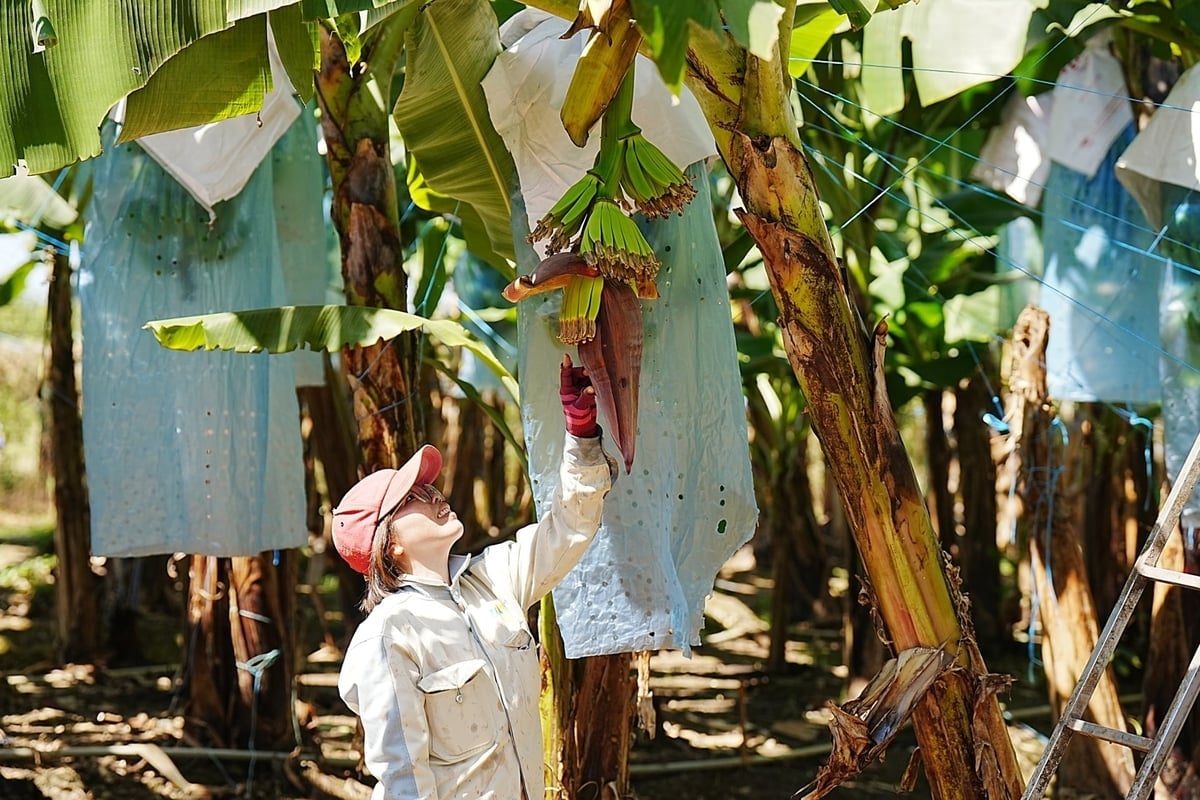
Workers inspect the growth of banana plants at Unifarm's banana plantation. Photo: Phuc Lap.
According to field surveys, Mr. Long stated that the fungus causing banana wilt disease does not usually spread too deep, rarely exceeding 80cm. The highest density is concentrated in the 30-40cm soil layer, coinciding with the active root zone of the banana plant. This soil layer should be prioritized when applying soil improvement measures, from soil structure treatment to nutrient and microbial adjustments.
Research and disease monitoring data show that Fusarium TR4 thrives in hot, humid conditions with poor drainage and nutrient imbalance. These three factors often occur simultaneously in many intensive banana cultivation areas, especially in areas with continuous cultivation, little crop rotation, and heavy reliance on inorganic fertilizers. When the soil environment deteriorates, the banana plant's reduced resistance creates favorable conditions for fungal outbreaks.
Many current measures, such as destroying diseased plants, controlling entry and exit to the orchard, sanitizing tools, or selecting resistant varieties, all play a certain role. However, according to Mr. Vo Dinh Long, if the underlying cause—the soil environment—is not addressed, the effectiveness of these measures will be difficult to maintain in the long term. As long as the soil remains infected, the risk of recurrence will always exist, even after changing varieties.
Field results from several farms show that even with the simultaneous application of chemical and biological methods, the effectiveness of controlling Panama disease in infected soil remains very limited. Expert reports note that in severely affected areas, direct treatments are almost ineffective in eliminating the fungal source in the soil, forcing producers to restructure their farming practices and choose a more long-term approach.
Another point emphasized by Mr. Long was the mechanical properties and overall "health" of the soil. Porosity, drainage, buffering capacity, and soil structure directly determine root function and disease resistance in plants. Compact, waterlogged soil not only creates a favorable environment for fungal growth but also weakens roots, reducing their ability to absorb nutrients.
Furthermore, soil microorganisms are considered key in sustainable disease control strategies. When Fusarium has become deeply ingrained and persistent, mechanical measures such as restricting movement or sanitizing equipment only help reduce spread, not eliminate the source of the disease.

Mr. Vo Dinh Long, lecturer at Ho Chi Minh City University of Industry. Photo: Phuc Lap.
A more fundamental solution is to enhance the beneficial microbial community, creating biological competition and naturally inhibiting fungal diseases. The goal is not to completely eradicate Fusarium – which is almost impossible – but to build a balanced soil ecosystem so that plants can grow in conditions where they can "coexist with the fungus".
According to Mr. Long, among the causes of the severe disease outbreak, the issue of weakened banana plants due to nutritional imbalances should be carefully monitored. In many large farms, fertilization still follows fixed formulas, lacking adjustments to weather and soil conditions. When heavy rains alter the root environment, nutrients are still supplied "automatically," leading to localized excesses or deficiencies, reducing the plants' resistance and making them more susceptible to disease.
In this context, research on breeding resistant varieties is considered a necessary direction, especially in areas that have been severely infected and are difficult to recover from. However, from practical production and research, experts believe that varieties are only effective when placed in a suitable farming system with healthy soil, good drainage, and balanced nutrition. If the variety is separated from its soil context and integrated management, its disease control effectiveness will be difficult to sustain.
The soil-based approach is therefore being recommended by many scientists as a cornerstone of strategies for preventing and controlling Panama wilt disease in bananas. This is not a short-term solution, but a viable path to reduce long-term risks for the banana industry, given the presence of Fusarium TR4 in many growing regions.
According to Ms. To Thi Nha Tram, M.Sc. - U&I Agricultural Joint Stock Company (Unifarm), the process of selecting and breeding banana varieties resistant to Panama disease at Unifarm is implemented according to a long-term plan, combining laboratory research and field trials.
During the period 2018-2020, banana plants still growing in heavily infected areas were selected, subjected to tissue culture, and controlled mutation treatment. Promising lines were further screened through artificial inoculation with the TR4 fungal strain in greenhouses before being planted for field trials.
The results of multiple evaluation rounds showed that some lines achieved high resistance rates under disease conditions, and were then scaled up for large-scale testing. The entire process was designed with risk control in mind, closely monitoring from seed to cultivation to assess the adaptability and stability of the variety under real-world production conditions.
Source: https://nongnghiepmoitruong.vn/bat-benh-heo-vang-chuoi-tu-dat-trong-d789394.html












![OCOP during Tet season: [Article 4] Elevating local products](https://vphoto.vietnam.vn/thumb/402x226/vietnam/resource/IMAGE/2026/01/29/1769652810578_2935-z6982071462129_649e82db06fb2f2ea701388b1f5f5b0b-173322_176-185229-202804_457.jpeg)






























































Comment (0)