Change old habits
In the early mornings of the Quang Ngai highlands, mist blankets the hillsides, the sound of babbling streams echoes from rocky crevices, and here and there, herds of free-ranging buffaloes leisurely graze on tender grass. Here, the buffalo is not just livestock; it's a source of pride, a valuable asset, and a way for each family to gauge their prosperity. It's no coincidence that the province currently has 83,000 buffaloes, mostly concentrated in the mountainous districts.

Buffaloes are an important livestock animal for people in the mountainous areas of Quang Ngai province. Photo: Le Khanh.
However, behind that familiar image lies a long story about the difficulties of raising buffaloes according to old customs. For decades, the villagers have maintained the habit of letting their buffaloes roam freely, foraging for food on their own, and sleeping in open fields without shelter at night. During the dry season, the buffaloes can tolerate it, but during the rainy and cold seasons, each cold spell becomes a shared worry for the entire village. Many households have witnessed their buffaloes become exhausted, infected with disease, or die from the cold without knowing what to do.
Many households raise a large number of buffaloes, but the adult weight is small and their growth is slow. Lack of care and nutrition weakens their immune system, making them susceptible to disease outbreaks whenever the weather changes erratically. Furthermore, prolonged inbreeding leads to genetic degeneration, resulting in weak calves with low survival rates. The survival rate of calves is only 60-70%, and at times even lower.
People often say, "We can raise them the way our ancestors did." But after many seasons of buffalo dying from the cold, many households have fallen into hardship, losing their most valuable asset. Poverty in mountainous areas stems not only from a lack of arable land or harsh natural conditions, but also from a lack of information, knowledge, and understanding of how to properly care for their buffalo herds. This gap prevents many households, despite their hard work, from escaping poverty.
Recognizing the long-standing shortcomings, Quang Ngai province decided to implement a program to support livestock farming techniques and improve the size and stature of buffalo herds, with a clear objective: to bring knowledge to every household, preventing people in mountainous areas from continuing to "learn on their own" in increasingly difficult conditions.

People in Quang Ngai are being guided on more scientific livestock farming techniques to gradually change their old practices. Photo: Le Khanh.
To ensure that knowledge truly reaches the people, agricultural extension officers must go deep into the villages, visit each household, and sit down with the villagers to explain and guide them step by step. There are days when they have to cross streams, and days when it rains heavily, but the officers still regularly visit each family to monitor the condition of the buffalo herd and provide guidance on how to care for them.
In Minh Long commune, Mr. Dinh Van Ui is one of the households that boldly made the earliest changes. Mr. Ui led us to see his newly built buffalo shed on the slope, with a sturdy roof and surrounded by lush green elephant grass. He recounted: "Before, I let the buffaloes roam freely, and if they got sick, I had to endure it, or if they got cold, I had to suffer. But the officials came down and guided me step by step, and after following their instructions, I saw a difference. The buffaloes are healthier and no longer emaciated every rainy season."
From learning how to build shelters and make silage for feed to how to prevent diseases before each cold season, Mr. Úi gradually adopted completely new methods compared to before. Thanks to access to larger buffalo breeds and a scientific breeding process, economic efficiency has increased significantly. "Now, income from buffalo farming has increased by one and a half times compared to the old way of raising them. If you are willing to learn, you will see immediate benefits," he said.
Buffaloes are no longer thin and emaciated thanks to new knowledge.
In Son Mai commune, Mr. Dinh Tien Dung, an official at the Public Service Center, said that changing the breed and limiting inbreeding is a crucial turning point. “Previously, calves were very weak, with a survival rate of only about 60-70%. Farmers would let the buffaloes in the herd mate naturally, which led to a decline in the breed over time. Now, with the new breed, the survival rate of calves has increased to 80-90%,” he shared.
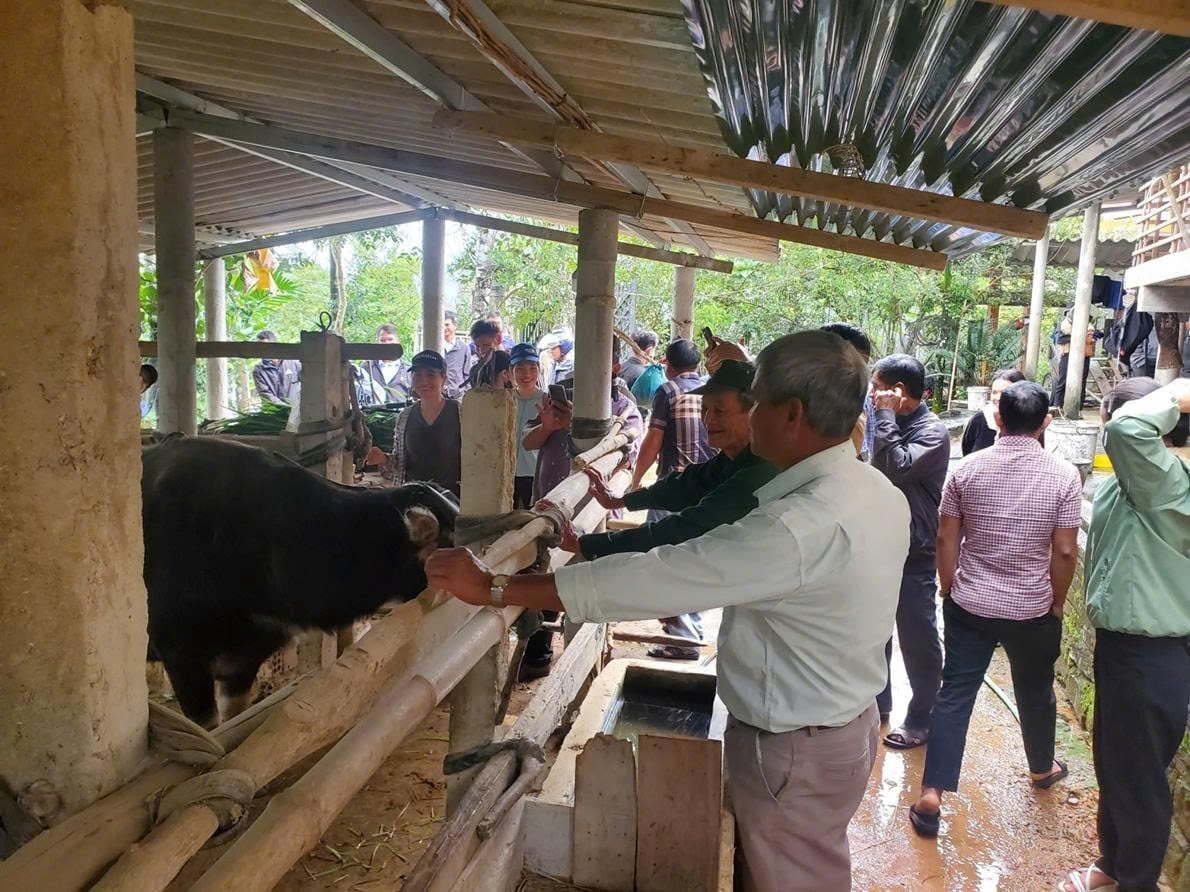
With this knowledge, people in the mountainous areas of Quang Ngai have applied it to their local livestock farming practices. Photo: Le Khanh.
Each training session and conversation around the campfire helped the villagers better understand the rules of livestock farming and the importance of knowledge. Some households, after the training, bought wire mesh to fence off their barns, while others dedicated plots of land on the hillside to growing grass. Some even started keeping livestock logs: every vaccination and every breeding was carefully recorded. The change wasn't sudden, but it was clear that the villagers had become more open to new knowledge. They no longer thought of buffalo farming as simply a matter of "letting them roam free," but began to see it as a profession requiring learning and investment.
According to the Quang Ngai Provincial Agricultural Extension Center, the buffalo herd improvement program is part of the agricultural restructuring strategy until 2030, aiming to build a healthy, large-sized, high-productivity buffalo herd that meets market demands. The long-term goal is not only to increase production but also to help people acquire the knowledge to improve their livelihoods.

Thanks to new technical knowledge, the efficiency of buffalo farming in the mountainous areas of Quang Ngai province is gradually increasing. Photo: Le Khanh.
Mr. Nguyen Quang Trung, Deputy Director of the Department of Agriculture and Environment of Quang Ngai province, shared: “This plan aims to change the traditional buffalo farming practices in the highlands, increase meat and draft power, create jobs, and improve income. This is an important step towards sustainable poverty reduction and stable security in mountainous regions.” Initial results show that the program is on the right track. Buffalo herds in many areas are healthier, the number of surviving calves has increased, and meat production is also higher. Farmers are no longer completely dependent on nature, but are proactively stockpiling feed, monitoring the health of their buffalo herds, and preventing diseases according to the seasons.
Most importantly, people's mindsets are changing every day. They are beginning to realize that knowledge is the way to preserve the greatest asset in their homes and open up a more stable future. Local officials are also improving their capacity, enabling them to provide long-term support to each household.
As evening falls over the highlands of Quang Ngai, herds of buffalo return to their pens, bringing peace of mind to each family. Sturdy shelters, bundles of stored grass on the porch, healthy calves running freely… All of this is proof of the power of knowledge when it is given to the right place at the right time. Therefore, poverty reduction in mountainous areas is not just about providing livestock or capital, but a journey towards informational poverty reduction, helping people access knowledge, understand correctly, and act accordingly to create their own path out of poverty.
Source: https://nongnghiepmoitruong.vn/anh-sang-tri-thuc-ve-voi-nhung-ban-lang-nuoi-trau-d787446.html


![[Photo] First session of the 14th Congress of the Vietnam Trade Union](https://vphoto.vietnam.vn/thumb/1200x675/vietnam/resource/IMAGE/2026/06/03/1780465947883_ndo_br_img-3852-jpg.webp)
![[Photo] General Secretary and President To Lam presides over a meeting with the Central Organizing Committee.](https://vphoto.vietnam.vn/thumb/1200x675/vietnam/resource/IMAGE/2026/06/03/1780482764658_a1-bnd-4741-3342-jpg.webp)
![[Photo] Secretary of the National Assembly Party Committee, Chairman of the National Assembly presides over the meeting of the Standing Committee and Executive Committee of the National Assembly Party Committee.](https://vphoto.vietnam.vn/thumb/1200x675/vietnam/resource/IMAGE/2026/06/03/1780480353201_ndo_br_bnd-2585-jpg.webp)









![Transforming from Resolution 57: [Part 3] High-tech agricultural center](https://vphoto.vietnam.vn/thumb/402x226/vietnam/resource/IMAGE/2026/06/03/1780491765550_2928-4922-img_7193-010813_454-010814.jpeg)






![The Essence of Viet Bac Villages: [Part 3] The Precious Fragrance of Nghinh Tuong](https://vphoto.vietnam.vn/thumb/402x226/vietnam/resource/IMAGE/2026/05/29/1780020600366_5237-tinh-tuy-ban-lang-viet-bac-bai-3-chuyen-o-nghinh-tuong-050626_700.jpeg)
![The Quintessence of Northern Vietnam's Villages: [Part 2] The Famous Cassava Noodles of Kunming](https://vphoto.vietnam.vn/thumb/402x226/vietnam/resource/IMAGE/2026/05/28/1779937455892_3929-3144-mien-dong-15-nongnghiep-023138.jpeg)
![The Essence of the Village: [Part 1] Wine on the mountain, tea in the clouds - Bang Phuc](https://vphoto.vietnam.vn/thumb/402x226/vietnam/resource/IMAGE/2026/05/27/1779841729178_3821-1jpg-nongnghiep-103814.jpeg)






















![[Video] Sunset at Lap An Lagoon – Where the sun sets over the fishing nets](https://vphoto.vietnam.vn/thumb/1200x675/vietnam/resource/IMAGE/2026/05/31/1780192137701_beach-landscape-sea-water-nature-grass-745871-pxhere-com.jpeg)

































Comment (0)