

The disease is becoming increasingly difficult to identify.
On May 30th, Bac Giang University of Agriculture and Forestry organized a scientific workshop on the diagnosis of some emerging and re-emerging diseases in livestock.

The emergence and re-emergence of new pathogens are changing the epidemiological landscape in livestock. Photo: Trung Hieu.
Based on practical experience in production, Mr. Nguyen Huu Tho, Head of the Department of Livestock, Veterinary and Fisheries of Bac Ninh province, said that African swine fever remains a major challenge for the local livestock industry. Changes in genetic characteristics can alter epidemiological patterns, increasing difficulties in diagnosis and directly affecting the effectiveness of disease control.
“Not only are infectious diseases more difficult to control, but many now do not manifest with typical signs as before. African swine fever can be mistaken for porcine reproductive and respiratory syndrome (PRRS), while avian influenza has symptoms similar to Newcastle disease. The increasing prevalence of co-infection with multiple pathogens within the same herd also makes accurately identifying the cause of the disease more complicated,” said Mr. Nguyen Huu Tho.
According to Dr. Nguyen Tuan Duong, Vice Rector of Bac Giang University of Agriculture and Forestry, in recent years, numerous outbreaks of disease on a large scale have caused significant damage to the livestock industry. This highlights the urgent need to improve the capacity for monitoring, forecasting, early detection, and especially accurate diagnosis of emerging and re-emerging diseases in livestock.

Dr. Nguyen Tuan Duong speaks at the scientific workshop on diagnosing some emerging and re-emerging diseases in livestock, organized by Bac Giang University of Agriculture and Forestry on May 30. Photo: BAFU.
"This is not only a task for the veterinary sector but also a strategically important issue for sustainable agricultural development, ensuring food security, public health, and socio- economic stability," emphasized Dr. Nguyen Tuan Duong.
The diagnostic strategy needs to change.
According to Associate Professor Dr. Le Van Phan, lecturer at the Faculty of Veterinary Medicine - Vietnam Academy of Agriculture, the emergence of new virus strains, recombinant viruses, and constantly changing variants is making disease diagnosis in livestock more difficult than ever.
"Previously, disease diagnosis relied primarily on clinical symptoms, but this approach is no longer reliable. Many infectious diseases no longer present typical symptoms, while co-infection with multiple pathogens in the same livestock herd is becoming increasingly common," Dr. Phan analyzed.
In this context, laboratory diagnostic methods such as PCR, Realtime PCR, and ELISA are becoming indispensable tools. These techniques allow for the direct detection of the genetic material of pathogens or the determination of the immune response in animals, helping to detect and contain outbreaks more effectively at an early stage.

Mr. Pham Kim Dang emphasized the importance of improving disease surveillance capacity, early diagnosis, and data management. Photo: BAFU.
Simultaneously, diagnostic strategies need to adapt to the characteristics of the epidemic. For acute cases, Realtime PCR is an effective tool for rapid virus detection. Meanwhile, for prolonged or chronic infections, combining PCR with ELISA will improve the ability to detect the pathogen. Accurately identifying the circulating virus strain is particularly important in selecting the appropriate vaccine and developing effective disease prevention programs.
“Today, laboratory diagnostics are not only used for disease detection but also as a tool to monitor the evolution of pathogens, evaluate vaccine effectiveness, conduct epidemiological surveillance, and control antibiotic resistance in livestock. This is the foundation for the veterinary industry to shift from passive response to proactive disease forecasting and control,” Associate Professor Dr. Le Van Phan noted.
Shifting from epidemic control to epidemic surveillance.
With Vietnam's livestock industry producing over 6 million tons of meat annually and moving towards modern, biosecure development, disease challenges are no longer simply veterinary issues but have become a factor directly affecting the competitiveness of the entire industry.

According to Professor Pham Bao Duong, the veterinary sector can gradually shift to a model of proactive surveillance, early warning, and risk prediction of disease outbreaks. Photo: BAFU.
According to Mr. Pham Kim Dang, Deputy Director of the Department of Animal Husbandry and Veterinary Medicine, science and technology and digital transformation will play a key role in the restructuring of the livestock industry. Many achievements have been put into practice, such as the African swine fever vaccine, disease diagnostic techniques, genetic engineering technology, the Animal Disease Information Management System (VAHIS), and the national livestock database.
"According to the development orientation until 2030, the livestock industry will continue to shift strongly towards modernization, application of high technology, and sustainable development. In particular, improving disease surveillance capacity, early diagnosis, data management, and the application of scientific and technological advancements are identified as key factors ensuring stable growth," Mr. Dang emphasized.
To realize that goal, according to Professor Pham Bao Duong, Rector of Bac Giang University of Agriculture and Forestry, universities, research institutes, and science and technology enterprises need to more strongly promote their role as centers of knowledge, innovation, and technology transfer for the livestock and veterinary industries.
According to him, the emergence and re-emergence of new diseases, along with the rapid mutation of pathogens, require the veterinary industry to continuously update its scientific knowledge, apply new technologies, and enhance its monitoring and diagnostic capabilities. In the field of veterinary medicine, achievements in biotechnology, genetic engineering, molecular diagnostics, artificial intelligence, and big data analytics are opening up entirely new approaches.
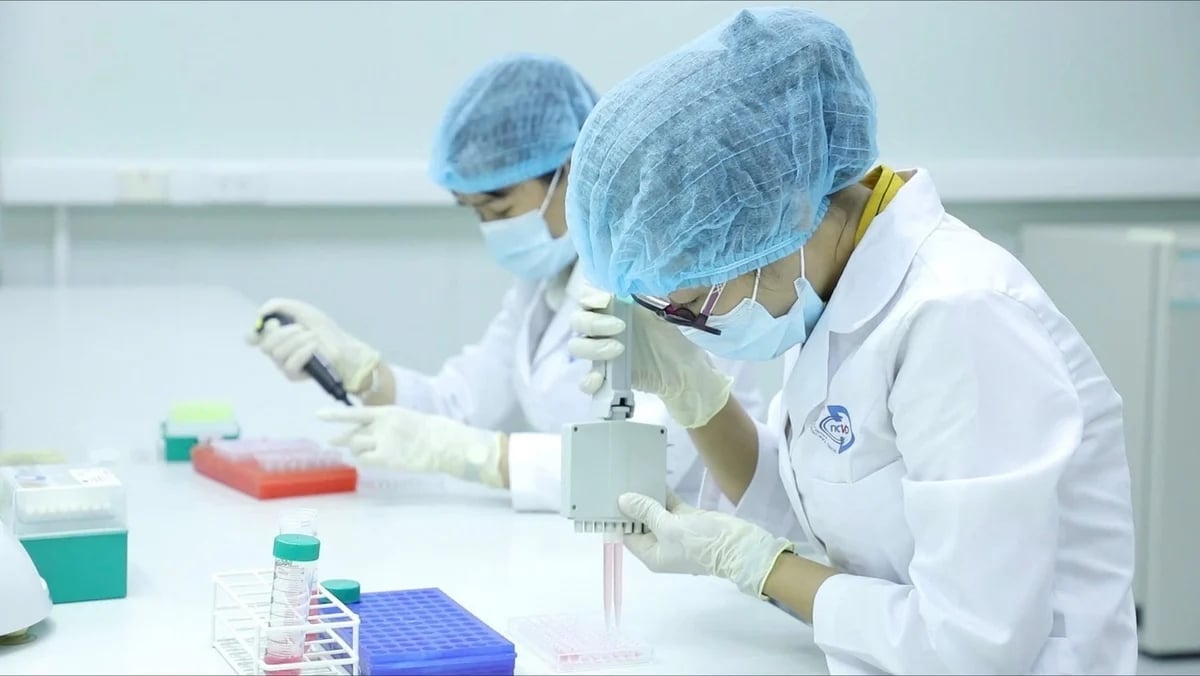
The reality of the pandemic necessitates a change in diagnostic strategies tailored to the specific characteristics of the disease. Photo: Linh Linh.
“Instead of just detecting and treating diseases after they have broken out, the veterinary industry can gradually shift to a model of proactive surveillance, early warning, and disease risk forecasting. However, for these scientific advancements to truly translate into practical production, active participation from universities, research institutes, and businesses is needed in research, testing, technology development, and technology transfer to management agencies and livestock farmers,” Mr. Duong expressed.
According to Dr. Duong, the gap between laboratory and production practice remains a major challenge. Many valuable research results have not been widely applied, while livestock farmers still face difficulties in accessing advanced diagnostic, monitoring, and disease prevention technologies.
Therefore, it is necessary to further strengthen the links between schools, scientists, businesses, and regulatory agencies to form an innovation ecosystem in the fields of agriculture and veterinary medicine.
"In the race against ever-changing pathogens, the greatest advantage of the livestock industry lies not only in the scale of production but also in its ability to transform scientific knowledge into tools to protect livestock even before diseases appear," emphasized the Rector of Bac Giang University of Agriculture and Forestry.
Source: https://nongnghiepmoitruong.vn/dich-benh-vat-nuoi-dang-thay-doi-nhanh-hon-phuong-thuc-chong-dich-d814282.html
![[Photo] First session of the 14th Congress of the Vietnam Trade Union](https://vphoto.vietnam.vn/thumb/1200x675/vietnam/resource/IMAGE/2026/06/03/1780465947883_ndo_br_img-3852-jpg.webp)
![[Photo] General Secretary and President To Lam presides over a meeting with the Central Organizing Committee.](https://vphoto.vietnam.vn/thumb/1200x675/vietnam/resource/IMAGE/2026/06/03/1780482764658_a1-bnd-4741-3342-jpg.webp)

![[Photo] Secretary of the National Assembly Party Committee, Chairman of the National Assembly presides over the meeting of the Standing Committee and Executive Committee of the National Assembly Party Committee.](https://vphoto.vietnam.vn/thumb/1200x675/vietnam/resource/IMAGE/2026/06/03/1780480353201_ndo_br_bnd-2585-jpg.webp)









![Transforming from Resolution 57: [Part 3] High-tech agricultural center](https://vphoto.vietnam.vn/thumb/402x226/vietnam/resource/IMAGE/2026/06/03/1780491765550_2928-4922-img_7193-010813_454-010814.jpeg)



























![[Video] Sunset at Lap An Lagoon – Where the sun sets over the fishing nets](https://vphoto.vietnam.vn/thumb/1200x675/vietnam/resource/IMAGE/2026/05/31/1780192137701_beach-landscape-sea-water-nature-grass-745871-pxhere-com.jpeg)































Comment (0)