

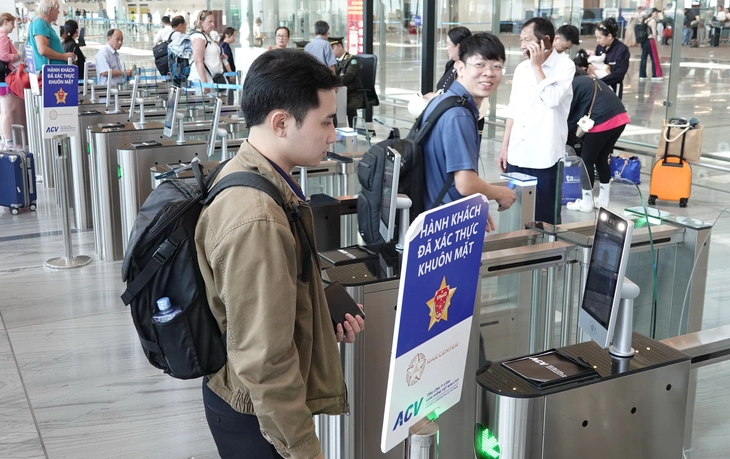
Passengers pass through security checkpoints using face ID (facial recognition) at Terminal 3 of Tan Son Nhat Airport on the morning of December 1st - Photo: TTD
All remaining passengers must manage their entire journey, from check-in and security checks to boarding, through VNeID or kiosks at the airport.
The new procedures applied by Vietnam Airlines and Vietjet are in accordance with Directive No. 24 dated September 13th by Prime Minister Pham Minh Chinh on promoting the deployment of technological solutions to serve people and businesses associated with population data, identification and electronic authentication.
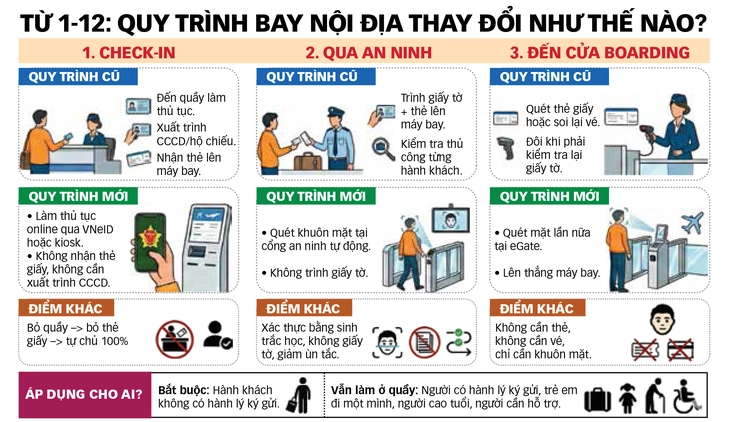
Graphics: TUAN ANH
The early days of struggling with biometrics.
In fact, as observed by Tuoi Tre newspaper at Terminal 3 of Tan Son Nhat Airport (Ho Chi Minh City), the atmosphere in the first few days of implementation had both the feel of a "digitalized" airport and a hint of bewilderment from many people experiencing it for the first time.
Besides passengers who are already familiar with using VNeID to complete procedures in just a few seconds, many are still confused and revert to relying on traditional counters when encountering problems.
At Vietnam Airlines' check-in area, ground staff constantly step out of the counter holding instruction boards, pointing out the correct location, and even using their phones to guide passengers through the biometric check-in process right at the counter before proceeding to the screening area. However, in many cases, the facial recognition machine doesn't match the face, spinning for a few seconds before reporting an error, forcing passengers to start over.
Vietnam Airlines stated that the reasons could be due to the photo on the ID card differing from the passenger's current appearance, the passenger having undergone cosmetic surgery, significant weight loss or gain, or inconsistencies in identification data.
"Initially, passengers who don't check in luggage will still be assisted with biometric authentication at the counter. Later, when things stabilize, they will do it online, no longer needing to go to the counter as before," an employee explained.
In the security screening area, which was previously considered a "bottleneck," the new technology has revealed both its strengths and weaknesses.
Mr. An, flying from Ho Chi Minh City to Da Nang , spent over 5 minutes fumbling in front of the biometric scanner just to get through an automated security gate. Even though he had checked in via VNeID beforehand, he still had to change machines 3-4 times, moving closer and further away, shifting back and forth to get his face into the correct frame as required by the machine.
"Some days it's very quick, just a few seconds. Today, the machine kept spinning and reporting an error every 5 seconds, so I had to start over. I tried several machines before I finally got through. Strangely, the person behind me scanned their device and went through immediately at the same machine that had malfunctioned. It seems the system isn't synchronized or the data for each customer doesn't match," said Mr. An.
According to observations, Tan Son Nhat Airport has installed nearly 15 facial recognition machines in both the security area and the Vietnam Airlines counter. Passengers familiar with technology and able to operate the machines quickly passed through smoothly. Meanwhile, some were unable to complete the process due to mismatched information and had to return to queue in the traditional manner.
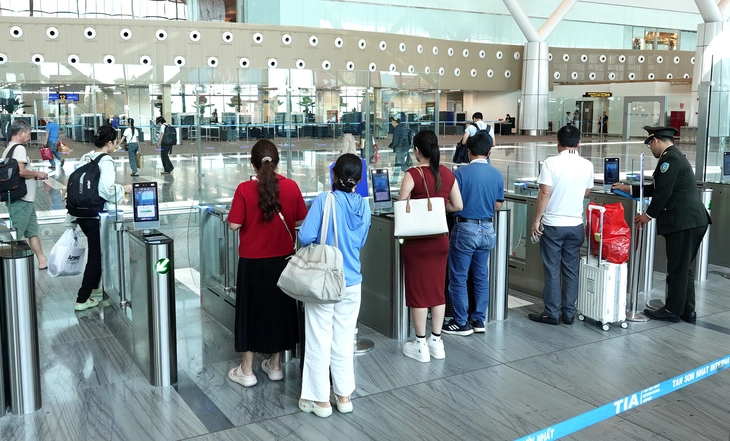
A female passenger (left) walks through the security checkpoint using Face ID (facial recognition), while other passengers linger for a long time at the automated security gate (photo taken at Terminal 3, Tan Son Nhat Airport, morning of December 1st) - Photo: TTD
The number of people passing through automated checkpoints is increasing.
Airlines say they have prepared multiple layers of solutions to be ready for December 1st, when "paperless flights" become the norm.
Mr. Dang Anh Tuan, Deputy General Director of Vietnam Airlines, affirmed that the airline has established a multi-channel support system from check-in counters, website, social media to hotline, and has also released detailed instructions on how to register for VNeID level 2, link tickets and use biometrics.
According to Mr. Tuan, the pilot results show that the system fully meets security and safety standards and is perfectly suitable for widespread deployment at all domestic airports.
Vietjet also announced that it has prepared equipment and personnel to guide passengers through the VNeID check-in process to reduce congestion at the counters. Vietjet has not yet implemented this at Tan Son Nhat Terminal 1 due to a lack of automatic gates, while other airlines still maintain the traditional procedure.
Currently, only Vietnam Airlines and Vietjet allow online check-in via VNeID. Other airlines such as Bamboo Airways, Vietravel Airlines, and Sun Phu Quoc Airways have not yet implemented VNeID check-in.
Speaking to Tuoi Tre newspaper , Ms. Pham Thuy Trang, Director of Can Tho International Airport, said that from August 1st, the airport had completed the infrastructure deployment and put the ACV-ID and VNeID biometric systems into operation, ensuring stable operation and readiness for the December 1st milestone.
Ms. Trang stated that from August until now, the percentage of passengers using VNeID has only reached about 2%, but the percentage of passengers eligible for biometric data collection has been almost 100%, and the percentage passing through special automated checkpoints at security gates has consistently remained high.
The implementation of biometrics in Can Tho has yielded significant results: reduced waiting times, increased processing speed, improved identification accuracy, and positive passenger feedback regarding its modernity and convenience, thereby contributing to enhanced service quality and the airport's image.
The Vietnam Airports Corporation (ACV) reports that biometric information used for check-in via VNeID at all airports has shown positive growth, clearly reflecting a change in passenger habits and the effectiveness of the new infrastructure.
At security checkpoints, strong growth indicates that passengers have become accustomed to facial recognition during screening, contributing to shorter processing times and reduced congestion. ACV stated that it will continue to expand its infrastructure and enhance passenger guidance.
ACV assesses that passengers have begun to form the habit of using biometrics at "touch points" throughout their flight journey, with a growing trend at check-in counters, security gates, and departure gates.
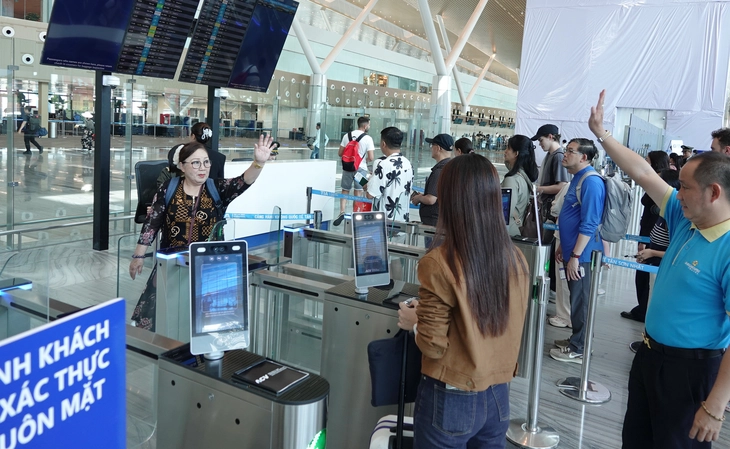
On the morning of December 1st, after changing the facial recognition scanner for the second time, the passenger (left) passed through security and waved to her family. The other female passenger (with her back turned) tried Face ID several times unsuccessfully and proceeded to queue for regular check-in at Terminal 3 of Tan Son Nhat Airport - Photo: TTD
The customer wants an app.
ACV acknowledges that there have been some delays or mismatches at the automated security gates recently due to two main reasons: malfunctions in the ACV biometric system and delays in data transmission by airlines.
ACV is coordinating with airlines to address issues and maintaining a fault reporting team and a 24/7 technical hotline to monitor, analyze causes, and resolve problems immediately.
Many argue that for this digital transformation to be truly convenient and consistent for the people, the issue is not just about a few facial recognition devices or a new app on a phone.
Many believe that the Ministry of Public Security and the Ministry of Construction, along with other relevant sectors, should coordinate to integrate all flight operations, from ticket purchase and check-in to security checks and boarding, into a single platform called VNeID, instead of forcing passengers to download additional airline apps and log in and out repeatedly.
Currently, although the process is modern, it is still fragmented. For example, tickets can be purchased on the airline's website or through an agent, and then at the airport, you have to download the airline's app to check in, even though VNeID is already a national identification application that integrates many types of personal documents.
Therefore, there is a need for a unified platform that can allow passengers to go from the entrance to the boarding gate with just a single facial scan, without having to go through any other procedures.
Many passengers surveyed shared a common expectation: they would be willing to experience new technology if it reduced the number of steps, saved time, and eliminated the need to "struggle" with multiple apps and passwords.
Reduce waiting time, increase accuracy.
Airlines have praised the new process for reducing waiting times, increasing accuracy, and eliminating the risk of passengers missing their flights due to forgotten documents. For passengers with checked baggage, the process is also streamlined to simply drop off their luggage at the counter, then proceed through the automated system as usual.
Vietnam Airlines stated that it will deploy support personnel at the airport during this period, from ground staff to technical support teams, to prevent passengers from missing their flights due to minor technology-related issues.
Passengers will not need to remove their shoes or belts.
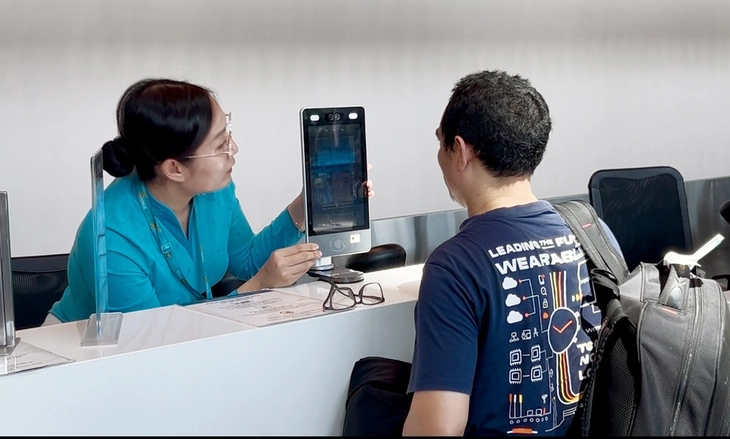
Airline staff guide passengers to have their photos taken at the check-in counter in Terminal 3 of Tan Son Nhat Airport on the morning of December 1st - Photo: TTD
Mr. Pham Quang Hieu, Deputy Head of ACV's Environmental Technology Department, said that ACV is applying more technologies in check-in procedures, security checks, and boarding. Notably, the new generation of screening equipment allows passengers to avoid removing their shoes, belts, or electronic devices from their carry-on luggage.
This technology will be implemented first at Long Thanh International Airport, with trial operations expected to begin on December 19th.
According to Mr. Hieu, the old scanning machines have low resolution, making it difficult to detect complex objects; the metal detectors also fail to detect non-metallic objects in rubber shoe soles, resulting in the shoe removal and tray placement process taking 3-4 minutes per customer, equivalent to 7 million hours of wasted labor per year.
The US lifted the shoe-removal requirement three months ago, and many experts suggest Vietnam should do the same to reduce pressure at security checkpoints. ACV considers smart screening a crucial step in perfecting the "paperless airport" model.
Regarding Long Thanh Airport, Mr. Hieu said that ACV aims to build a smart, green airport, optimizing operations, reducing carbon emissions, striving for Net Zero standards, and being competitive with major transit hubs like Changi or Suvarnabhumi.
Aviation experts consider the implementation of VNeID a significant step forward. This helps the Vietnamese aviation industry move closer to the "digital airport" model.
Associate Professor Dr. Nguyen Thien Tong, former Head of the Department of Aeronautical Engineering at Ho Chi Minh City University of Technology, believes that standardizing identification data will shorten the time spent checking documents. This will reduce pressure on check-in counters and security personnel.
He said, "During peak hours, simply reducing the number of seconds per passenger by a few dozen seconds can help speed up the flow of passengers and reduce congestion." Experts also emphasized that the transition process needs to be communicated early on.
Instructions should be provided right from the moment passengers book their tickets. As the number of VNeID users increases rapidly, the technological infrastructure must be robust enough to avoid disruptions. Simultaneously, contingency plans are needed to ensure passengers don't miss their flights if the application malfunctions or loses connectivity.
What do passengers need to prepare?
To ensure a smooth flight, passengers should proactively register for VNeID level 2 and complete the facial verification process before arriving at the airport.
Although the new process makes travel faster, passengers should still carry their national identity card or other valid documents as a backup in case the system malfunctions or the app freezes and spins.
Passengers should also pay attention to the necessary documents for elderly people and children before the flight to avoid confusion if they cannot access the app. Additionally, they should familiarize themselves with the online check-in process on the VNeID app by going to the "Airline Services" section, selecting the airline, and following the verification instructions.
Passengers should also arrive at the airport earlier than usual, pay attention to signs, or ask staff for assistance to navigate the automated lines correctly, avoiding last-minute confusion.
According to airline staff, passengers should also download the Vietnam Airlines or Vietjet app to speed up data synchronization between VNeID and the airline's system.
Source: https://tuoitre.vn/bay-thoi-cong-nghe-20251202083654449.htm































































































Comment (0)