

The culmination of creative labor and a life close to nature, the diverse handcrafted woven products of the Muong people not only serve the needs of daily life but also embody many traditional cultural aspects. However, with the flow of modern life, traditional woven products are gradually disappearing, and there are now very few Muong people skilled in weaving...
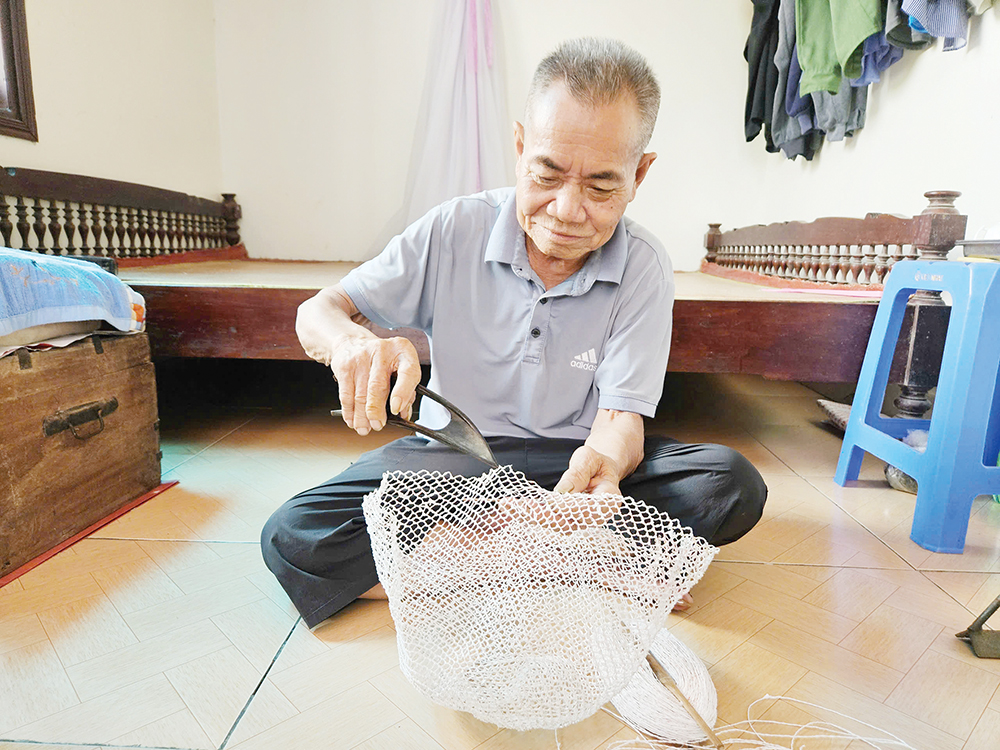
Mr. Mai used needles and thread to weave the net part of the fishing net.
Since ancient times, when the Muong people's lives were primarily dependent on the mountains, forests, and fields for self-sufficiency, the craft of weaving emerged and gradually became widespread. Utilizing natural materials from bamboo, rattan, and other similar plants, and employing traditional hand-weaving techniques passed down from generation to generation—from simple to complex and elaborate designs—the Muong people were able to produce a wide variety of items, from household goods and decorations to production tools such as baskets, containers for sticky rice, mats, woven baskets, trays, and other woven items. Finished items were often hung in the kitchen attic to dry, accumulating smoke and soot until they turned black and shiny. Though simple, the Muong people's woven products were practical, durable, water-resistant, termite-proof, environmentally friendly, and could last for many years without breaking. They served not only household purposes but could also be sold or exchanged for other products, helping to increase family income.
Having inherited the craft of weaving from his ancestors since he was young, at the age of 84, Mr. Hoang Xuan Mai in Ban 1 area, Vo Mieu commune, Thanh Son district, still diligently preserves the traditional craft of his ethnic group. He often sits and meticulously weaves fishing nets – tools commonly used by the Muong people in the past and even today to catch shrimp and fish in ponds, lakes, rivers, and streams to supplement their food supply and improve their family meals. The fishing net has a small-mesh, bag-shaped net with a round bottom and a wide mouth, attached to a long, oval-shaped handle. This handle is made from the trunk of the "heo" tree – a type of palm tree with a flexible trunk. After being cut, it is heated over a fire to bend it into the frame of the fishing net.
Mr. Mai's wrinkled, calloused but skillful hands held the small strands of string, placing them on his feet and twisting them into thicker strands. As he twisted each strand, he coiled it into bundles for later use in weaving. Previously, the Muong people used the fibers from tree bark growing in the forest for weaving fishing nets. Now, they often utilize the fibers extracted from good quality rice sacks, which are durable, flexible, and won't deteriorate even after prolonged soaking in water. Holding a needle made from buffalo horn, Mr. Mai meticulously and swiftly weaves the twisted strands into a net with perfectly even, fine mesh.
"To create a durable and beautiful handcrafted product, the weaver must have good technique, especially the mesh must be even. Weaving, regardless of the material, requires meticulousness, care, and diligence. Those who lack perseverance will find it difficult to do the job and will find it hard to stay in the weaving craft for long," Mr. Mai confided.
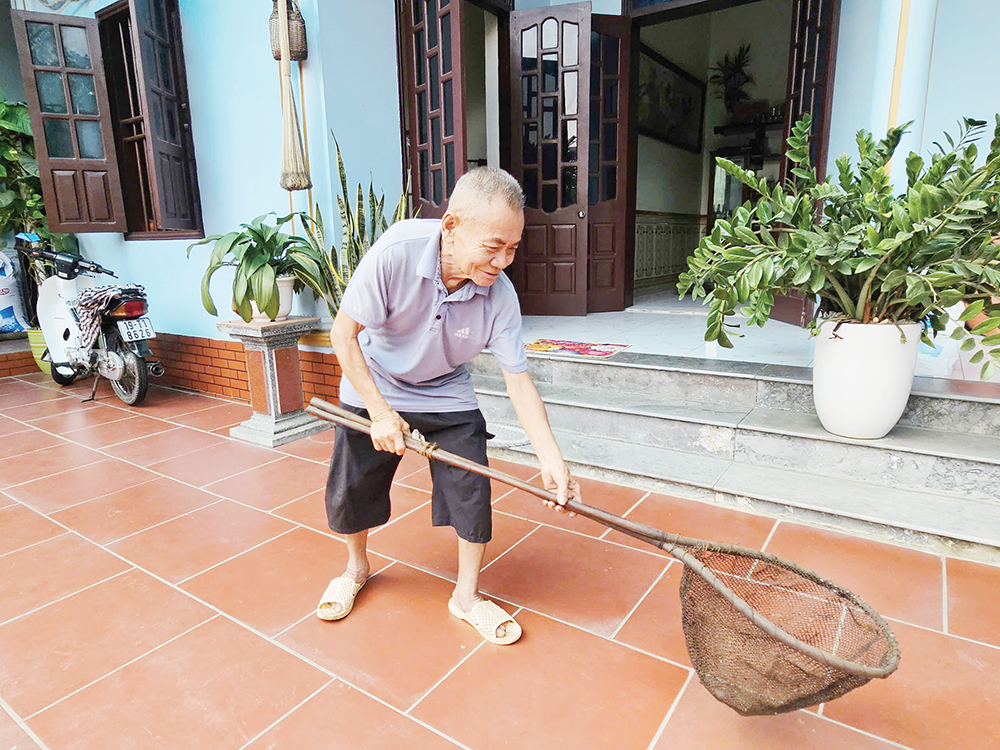
The completed fishing net is used by the Muong people to catch shrimp and fish in ponds, lakes, rivers, and streams...
Despite his extensive experience and mastery of weaving techniques, Mr. Mai still takes 2-3 days to complete one fish scoop. Each month, he makes about 15 scoops, all durable and sturdy, making them popular with locals. They sell out as soon as they're finished. Nowadays, the lives of the Muong people are increasingly prosperous, with readily available industrial products constantly entering their kitchens and homes. Furthermore, despite his advanced age, declining health, and low income from the craft, Mr. Hoang Xuan Mai remains deeply devoted to his ancestral weaving tradition, diligently preserving and developing this beautiful craft to continue the tradition from ancient times to the present day.
Cam Nhung
Source: https://baophutho.vn/ben-bi-giu-nghe-220292.htm





















































































Comment (0)