

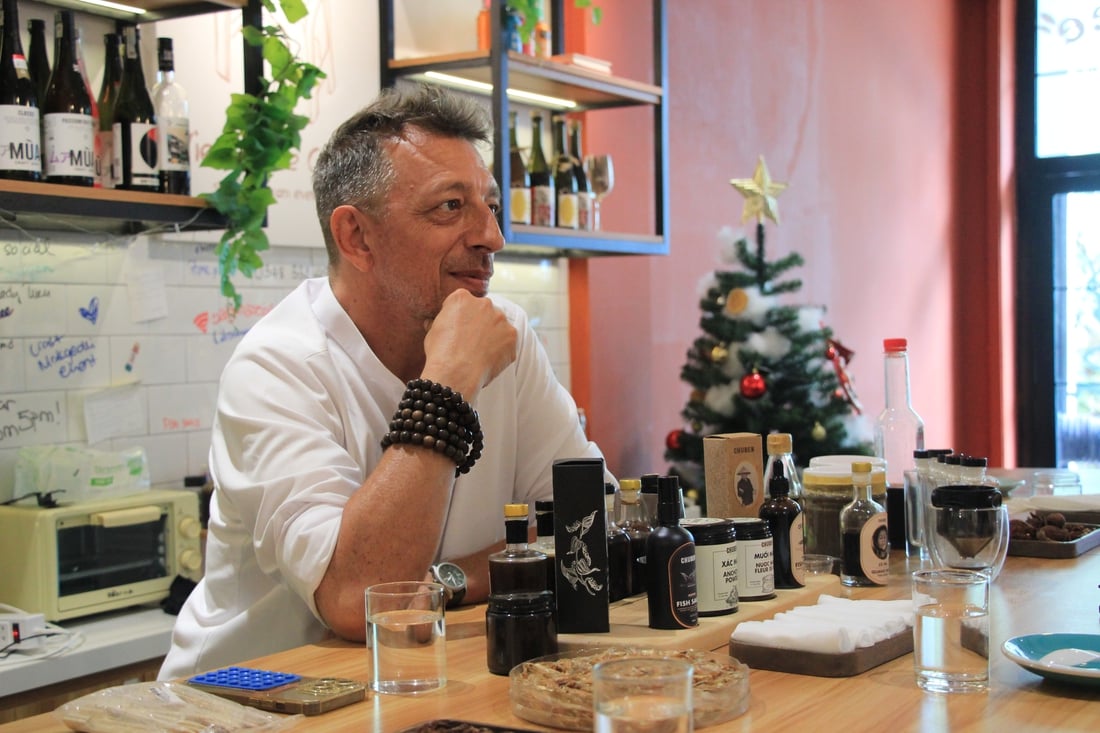
Benoît Chaigneau "learns the ropes" of making Vietnamese fish sauce.
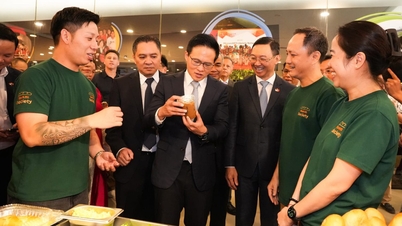
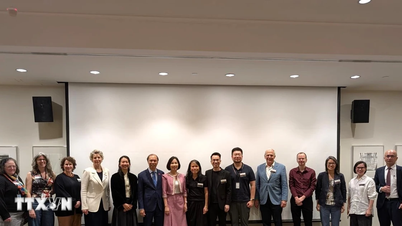
Benoît Chaigneau kicked off a workshop and tasting session on the theme of fish sauce at the Saigon Social culinary exchange space in Ho Chi Minh City.
He was surrounded by a group of foreign visitors from various countries such as the United States, New Zealand… and also Vietnamese people.
They listened attentively as Benoît explained the traditional fish sauce making process in Vietnam, its nutritional content, and how to enjoy dishes paired with fish sauce in a novel way. Benoît even went so far as to bring along a jar of fermenting fish sauce for them to smell and taste.
"Staying put" while begging to learn how to make fish sauce.
Benoît Chaigneau is not an unfamiliar name in the Vietnamese culinary world. He is the founder of ChuBen Fish Sauce in Hoi An, known for its fish sauces that are priced significantly higher than the average.
A Frenchman coming to Vietnam to make fish sauce and then selling it for over 200,000 dong for a 100ml bottle might sound unbelievable, even unacceptable, to many.
Benoît Chaigneau's story has also been told in newspapers and on television. In 2020, Benoît Chaigneau – who has 20 years of experience as a television presenter and food critic – traveled to Vietnam and got stranded in Quang Nam due to COVID-19. In Vietnam, he discovered his passion for making fish sauce and decided to stay to pursue his career.
A famous anecdote about Benoît is that he once hung a hammock and "lingered" in front of a house in Quang Nam for three days just to beg the homeowner to let him learn the art of making fish sauce.
Benoît's persistence earned him the owner's approval, but on the condition that he work 12 hours a day, 6 days a week, for a salary of 5 million VND. He was thus hired to work and learn simultaneously, while also contacting chefs he knew to learn more about the scientific basis of the fish sauce fermentation process.
Then, a visit to a fish sauce production facility in Nam O (Da Nang) unexpectedly opened a door for Benoît. "Fish sauce is made from anchovies. I come from the Mediterranean region, where anchovies are used extensively."
"There are flavors and products that I'm already familiar with. Making fish sauce fascinates me; it feels like I'm touching my roots. But what's truly new is the way Vietnamese people use fish sauce, the way they make it, the way they cook with it," Benoît recounted.
That thought seemed to become Benoît Chaigneau's guiding principle on his journey with fish sauce. He traveled from North to South, seeking out famous fish sauce-producing regions such as Phu Quoc and Phan Thiet, and sought entry to fish sauce factories and workshops to observe and learn firsthand. Benoît also dedicated much time to reading and researching the history of fish sauce. He stated that he has read and preserved approximately 5,000 pages of documents related to fish sauce.
"When people found out there was a foreigner making fish sauce in Vietnam, many laughed at me, saying things like, 'What do you know about Vietnamese fish sauce?' But they were wrong," Benoît said with the confidence of someone who knows exactly what he's pursuing. "I've actually put a lot of time and effort into learning."
With determination, in 2023 Benoît launched his unique fish sauce product. He didn't choose the traditional path but instead pursued a modern direction with multi-flavored fish sauces such as smoked fish sauce and pepper fish sauce.
"The foundation for my product is still traditional Vietnamese fish sauce. First, I make fish sauce from anchovies and salt, entirely using traditional methods, produced in wooden barrels. After obtaining the fish sauce, I transfer it to stainless steel tanks, then add spices and let it ferment for another 6 to 8 months. In total, it takes almost two years before bottling," Benoît shared about his fish sauce making process.
When asked what gave him the confidence to sell at that price, Benoît said that many factors determine the quality of fish sauce - from the freshness of the fish, the quality of the salt and spices, to the time, effort, and energy put into making the product, not to mention the packaging.
"Each ingredient is carefully selected. For example, I only use anchovies about 6cm long, caught between 11 PM and 4 AM. That's the time before the fish feed, so their stomachs are empty when processing begins."
"The spices used to marinate the fish sauce are all organic. I pay special attention to the origin of each ingredient," Benoît shared. He said he is so meticulous that he sometimes even goes fishing with the fishermen to ensure he gets fresh, high-quality fish that meets his standards.
Talking to Benoît, it's easy to see that he's always enthusiastic and full of energy when talking about his variations on fish sauce.
At the tasting event at Saigon Social, Benoît intrigued and surprised attendees as they sampled his multi-flavored fish sauce – the result of unique combinations of fish sauce with lime, fish sauce with… robusta coffee, and with the fat of Spanish cured ham. He even created a caramel fish sauce to be enjoyed with vanilla ice cream for dessert.

Benoît Chaigneau "learns the ropes" of making Vietnamese fish sauce.
Fish waste: from pig feed to high-end dining tables.
Benoît also launched two product lines made from by-products that are usually discarded during the fish sauce making process: fish residue and fish salt.
"In Europe today, the trend of living a zero-waste lifestyle and making the most of everything we have is very popular. I started noticing that during the fermentation process, some salt would crystallize on the surface of the fish sauce. I collected that salt and dried it in the sun."
"This salt is beautiful, has the flavor of fish sauce, crystallizes into shiny, crispy golden flakes, and adds texture to dishes. To me, it's truly 'solid gold'," Benoît explained about his fish sauce salt product.
"The 'fish sauce residue' is the solid residue left after the fish sauce has been extracted. I asked the local fish sauce makers how they handle this part, and they usually feed it to pigs or chickens. I think if pigs can eat it, then humans can too, it just needs to be processed differently," Benoît recounted.
"I dried the fish residue in the sun for about a month, then ground it into powder and started experimenting with cooking. When I introduced this product to chefs at high-end restaurants, they really liked it," he continued.
Benoît says that many customers now buy this product because it can be used to season all sorts of things – from pasta, salads, grilled tomatoes, french fries, popcorn to grilled fish. Essentially, it's like fish sauce, but in powder form.
At the tasting, Benoît Chaigneau instructed attendees to sprinkle the fish powder directly onto the fries to eat with them, and everyone present praised the dish's rich, unique yet familiar flavor.
On his website, Benoît also suggests several dishes his customers can make with fishmeal, such as mixing hot popcorn with a little olive oil and sprinkling fishmeal powder on top as a substitute for cheese-flavored popcorn, or stirring fishmeal with olive oil and lemon juice or rice vinegar to make a simple salad dressing.
Benoît also "encourages" customers to use fishmeal powder instead of Worcestershire sauce in the famous French beef tartare, by mixing finely ground raw beef with fishmeal powder, capers, red onion, and olive oil. "Fishmeal powder replacing Worcestershire sauce provides a special depth of flavor," the recipe claims.
According to him, this method can utilize "waste products" to add value to the fish sauce making industry. "I am happy to share this method with small-scale producers, helping them create more value and increase their income from their work," Benoît said.
To put it simply, he compared the prices: previously, local fish sauce producers sold the fish residue to livestock farmers for about 20,000 VND per kilogram, while Benoît's retail price for fish residue is about 2.5 million VND per kilogram.
Creating fish sauce that's suitable for the whole world.
Driven by his love for fish sauce, Benoît Chaigneau aspires to transform it into a globally recognized ingredient, much like the Japanese have done with soy sauce.
"What I really hope to see is people outside of East Asian culture starting to use fish sauce in their own kitchens. This is a challenge that the Japanese once posed with soy sauce."

Benoît Chaigneau "learns the ropes" of making Vietnamese fish sauce.
About 20 years ago, soy sauce was still considered to have a strong smell and was only used in Asian communities. Now, you can find soy sauce in almost every kitchen in Europe or America. Everyone uses soy sauce because it's delicious, rich in umami, and good for your health," Benoît said.
"Fish sauce is even more than that; it contains plenty of protein and Omega-3," he asserted.
Benoît noted that in France, people don't seem to know much about fish sauce. "Usually, the French only buy fish sauce on one occasion: when they're having a spring roll party," Benoît said.
They bought a small bottle, tried making a dipping sauce, and then completely forgot about the bottle of fish sauce in the refrigerator. One day, they opened it and found an unpleasant smell because the bottle had broken. This happened because fish sauce has never been presented in the way I am: as a precious condiment, a high-end seasoning, or even a superfood."
Benoît proudly boasts that, along with Phu Quoc fish sauce, his fish sauce was honored to be selected by the Ministry of Culture, Sports and Tourism to be displayed at the Vietnam Pavilion at Expo 2025 Osaka because of its blend of traditional and modern qualities.
"I believe that balancing tradition with modernity is especially important if we want to conquer the international market. Currently, most fish sauce sold outside Vietnam is bought by Vietnamese or Asian people, not Westerners, simply because they don't know how to use it or find the smell too strong or the taste too intense," he said. "Therefore, I am trying to create a type of fish sauce that can harmonize with all cuisines."
It's safe to say Benoît's life in Vietnam revolves around fish sauce. Not only does he produce fish sauce and organize workshops to introduce tourists to everything about fish sauce produced in Vietnam, but Benoît also owns a restaurant in Hoi An where he incorporates fish sauce into all the dishes, including fish sauce coffee.
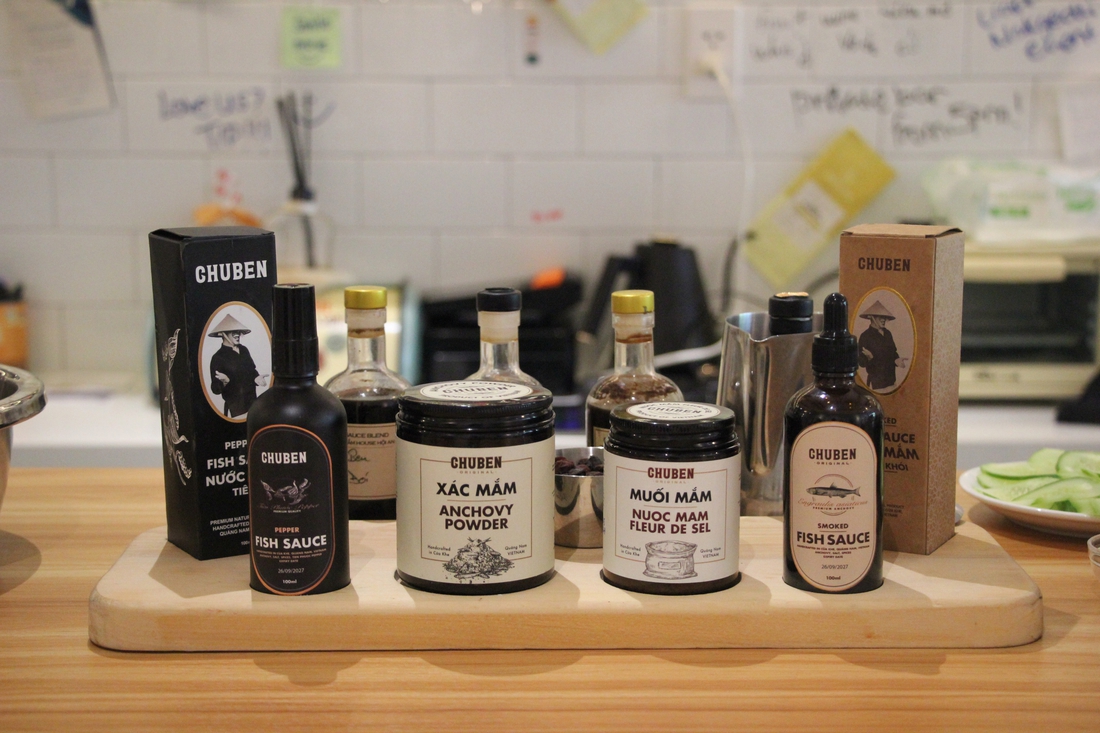
Fish sauce products
Fish sauce spray
Benoît's products also stand out for their distinctive format: instead of the usual half-liter or one-liter bottles, the fish sauce is packaged in spray or dropper bottles with a capacity of only 100ml. Benoît itself calls its fish sauce "Haute Couture" in the world of fish sauce.
Benoît Chaigneau wanted fish sauce to be present as a condiment that enhances the flavor of dishes, much like the small salt shaker we often see in the kitchen or on the table in restaurants.
Similarly, the pepper-flavored fish sauce that Benoît makes is the perfect alternative to the habit of sprinkling salt and pepper on dishes.
"I wanted something that had both a salty and a peppery flavor. For me, the spray form is the exact replica of 'a pinch of spice,' like how people sprinkle 'a pinch of salt and a pinch of pepper' on a dish."
For example, when a piece of grilled meat is served, instead of sprinkling salt and pepper, you just lightly spray it with fish sauce and pepper. The result is that the umami flavor of the fish sauce blends with the pepper, making the dish much richer and more flavorful," Benoît enthusiastically explained his idea.
Source: https://tuoitre.vn/benot-chaigneau-phieu-luu-cung-nuoc-mam-20260427133248117.htm
![[Photo] General Secretary and President To Lam works with the Party Committee of the Ministry of Health on the work of Vietnamese traditional medicine.](https://vphoto.vietnam.vn/thumb/1200x675/vietnam/resource/IMAGE/2026/05/20/1779294323718_a1-bnd-2978-3319-jpg.webp)


![[Photo] National Assembly Chairman Tran Thanh Man working with the Standing Committee of the National Assembly's Delegation Affairs Committee.](https://vphoto.vietnam.vn/thumb/1200x675/vietnam/resource/IMAGE/2026/05/20/1779294340023_ndo_br_1-1691-jpg.webp)

































































Comment (0)