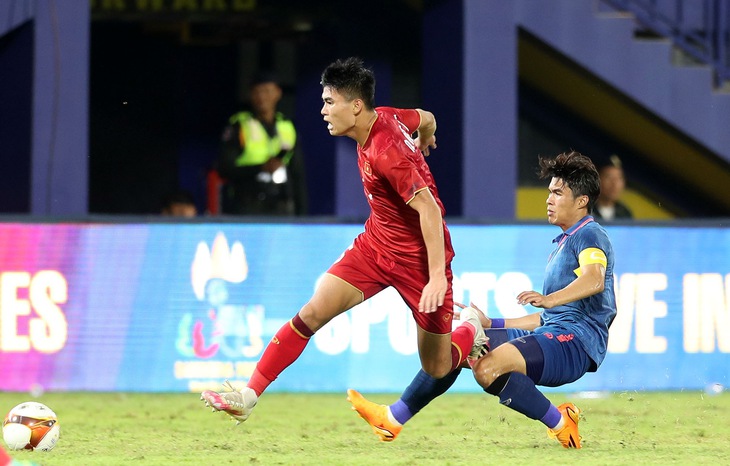
Young players will have their workload reduced at the SEA Games if Thailand's proposal is approved by the AFC - Photo: N.KHÔI
Specifically, the men's football tournament at the 2025 SEA Games may be divided into three groups, as proposed by host country Thailand, instead of the traditional two groups.
Overload pressure on young players.
First, let's talk about the traditional symmetry of football, which is the division of the tournament brackets. Throughout football history, fans have been accustomed to this symmetrical formula in all tournaments, where the number of teams and the number of groups are always a multiple of 2. For example, the number of teams participating in a tournament is often 4, 8, 16, or 32.
Due to the unique nature of the SEA Games, which only involves 11 countries and is a multi -sport event, the organizers cannot create a qualifying tournament (to reduce the number of teams to 8). Therefore, the group stage is divided into two groups: one with 5 teams and one with 6 teams. In the two most recent SEA Games, thanks to Brunei's absence, the number of teams participating in men's football was 10, divided into groups of 5 teams each.
At the 2019 SEA Games in the Philippines, Vietnam was drawn into a six-team group and had to endure a packed schedule with five matches in just 11 days. Up to the final, Vietnam had played seven matches in 17 days.
That's clearly not a suitable number for the physical condition of young players. In recent years, the world of football has faced intense debate about player overload.
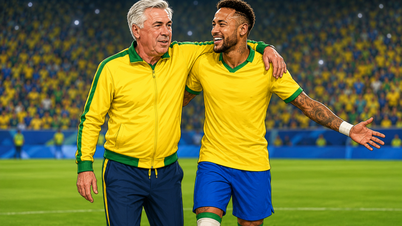
Many renowned coaches, such as Carlo Ancelotti, have bluntly stated that their teams will not play if the organizers and governing bodies (such as UEFA and FIFA) cannot guarantee a sufficient rest period of 72 hours (a full three days) between matches.
Compared to the SEA Games schedule of recent editions, the average rest time for players between matches is only about 67-70 hours.
Therefore, the proposal by host nation Thailand to divide the tournament into three groups to reduce the number of matches for each team is a reasonable suggestion.
It will increase the excitement.
Since the number of participating teams is odd, if we divide them into 3 groups, there will be 2 groups of 4 teams and 1 group of 3 teams (if the number of teams is 10, there will be 1 group of 4 teams and 2 groups of 3 teams).
Fairness is not guaranteed in this case. The reason is that teams competing in groups of three generally have more rest days. Therefore, they will have a certain advantage going into the semi-finals.
The calculations become more complicated when only the top 3 teams from each group qualify, and the second-placed team selected for the semi-finals will have to compete based on goal difference. Fairness also becomes uncertain because there will inevitably be more difficult groups and easier groups... To ensure that fairness, the football world has strived to maintain a symmetrical formula for many decades.
However, over time, FIFA and UEFA have gradually leaned towards an "asymmetrical" formula. For example, the Euro tournament has increased from 16 to 24 teams, the World Cup from 32 to 48 teams, and the Champions League from 32 to 36 teams.
Even a top-tier tournament, the center of football, like the Euro, applies a ranking system for the best third-placed teams in their groups, creating countless complex calculation methods. Fairness is difficult to guarantee, but excitement is certainly abundant. Matches with no real stakes are almost completely eliminated.
If the rest of the world has boldly stepped outside the box, there's no reason for the SEA Games to remain loyal to the old organizational methods.
Read more Back to Homepage
HUY DANG
Source: https://tuoitre.vn/bong-da-sea-games-theo-chan-the-gioi-20250425102859477.htm























































































Comment (0)