

The new contract signed until summer 2027 helps 21-year-old striker Bukayo Saka continue his journey of exploring his limits with Arsenal, where he has been since he was 8 years old.
Only 7,751 Arsenal fans witnessed Saka's first-team debut in person. On a freezing night in Kyiv, Ukraine, on November 29, 2018, Arsenal – and a select group of supporters – were present at the Olimpiyskiy Stadium to play Vorskla Poltava in the Europa League group stage.
With Arsenal leading 3-0 and having secured victory and qualification for the knockout round as group winners with one match to spare, manager Unai Emery brought Saka on to replace Aaron Ramsey in the 68th minute. Just weeks after celebrating his 17th birthday, the young Englishman, wearing the unfamiliar number 87 shirt, nearly made his mark with a goal.
Saka became the 862nd player in Arsenal's history to play for the first team and the 15th youngest player to debut for the club. But Saka's story at Arsenal didn't begin that night in Kiev, but almost 10 years earlier, when he joined the Hale End academy at the age of 8. Since then, the career of the player born in Ealing, London, has been on an upward trajectory, making him one of the biggest stars at both the club and the national team.
Nothing happens overnight; Saka's development is the result of hard work, ambition, and professionalism from the player himself, as well as those around him at the club. Moreover, at just 21 years old, time is certainly on Saka's side.
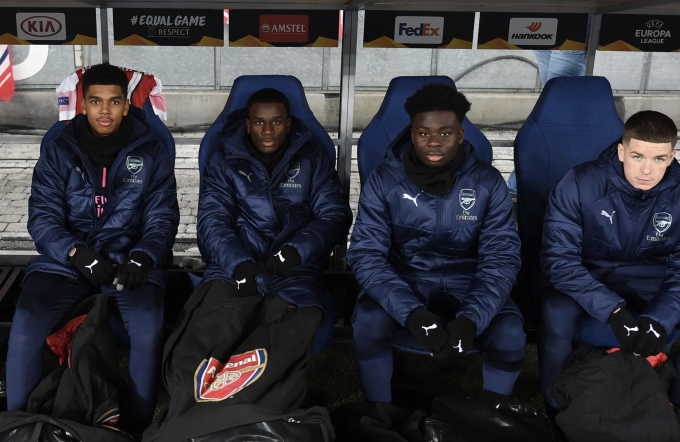
Saka (second from the right) was on the bench before coming on as a substitute and making his first-team debut for Arsenal in the match against Vorskla Poltava in Kiev on November 29, 2018. Photo: arsenal.com
Saka is a true product of Hale End – Arsenal's youth academy . After a short period of training and playing to assess his abilities, he signed his first official contract with the club on May 5, 2010, at the age of eight, joining the youngest age group at Hale End – the U9s. Emile Smith Rowe joined Arsenal that same month, although in the group two years older, while Reiss Nelson, Joe Willock, Alex Iwobi, and Ainsley Maitland-Niles were already part of the academy.
"Even when Saka was very young, under 11 years old, we had a roadmap in place to take care of him," said Liam Brady, Head of Youth Development. "The coaches and staff did a great job scouting and then taking care of these boys. I remember Saka at that age, very fast, muscular, strong, and as he got older, he quickly added the necessary football intelligence at the highest level. He didn't just score goals; Saka was involved in the play and linked up with everyone on the pitch. Saka was the best player on the pitch, basically like he is now, able to both score and create."
Liam Brady left his role as head of youth development in May 2014, around the time Luke Hobbs joined Arsenal's youth team from Southend United. Hobbs was then part of the U14 coaching staff, and Saka was rapidly rising through the ranks. "I joined the club in 2013 and remember the first time I heard Saka's name," Hobbs recalled. "It was my first week at the club, and Roy Massey spoke to Steve Leonard, who coached the U15s but was also responsible for the kit."
At the time, Massey and Leonard worried that assigning Saka the number 3 jersey might upset his family and the young player, as that number was usually reserved for defensive players. But as Hobbs recounts, neither Saka nor his father Yemi seemed bothered by the number.
It didn't take long for Hobbs – now Arsenal's head academy coach – to understand why colleagues like Massey and Leonard talked so much about Saka. He first coached Saka when he led Arsenal's U12 team to the Premier League futsal tournament – a 5-on-5 indoor, full-touch game. At that time, Hobbs chose an open approach and didn't put pressure on the players to win at all costs. He gave all 10 players a chance, with five playing in the first half and five in the second. Hobbs maintained this approach and personnel arrangement until the final against Chelsea.
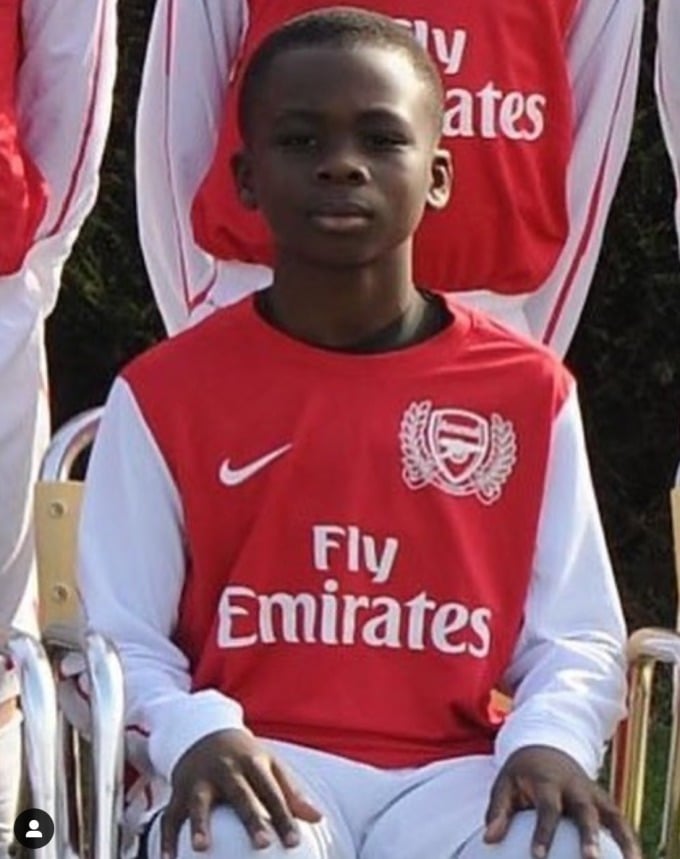
Saka during his time playing for Arsenal's youth team.
"I put Saka's team on the pitch first, and then substituted them after halftime when we were winning," Hobbs explained. "Chelsea were clearly a strong opponent and had leveled the score at 3-3. At that point, I remember thinking, 'If you want to win, put Saka on.' So, whether my method was right or wrong, I put Saka on, and he scored to make it 4-3, then 5-3, then a shot into the top corner, 6-3. They couldn't take the ball away from Saka, and then we lifted the Cup and had a good comeback. I remember that moment very clearly. Despite helping the team win, Saka wasn't arrogant at all."
The following season, as a member of the U13 team, Saka began to gain experience playing in various positions, primarily left-back – which proved useful in his early days in the first team, about six years later. At that time, Saka was frequently promoted to the older team – Hobbs' U14 team – to continue his progress and development. The coaching staff also didn't hesitate to test Saka's abilities, even having him play left-back in an 11-a-side match at Wembley.
When Hobbs discussed the idea of having Saka play as a full-back alongside older players, Mr. Yemi always happily agreed. And those matches against older players continued to help Saka improve. Playing as a full-back, Saka received the ball frequently, confidently dribbled into space, and became the team's first line of attack on the left flank, even when facing older players. Saka's first major achievement in this role was winning the 2015 Nike Trophy at Wembley, where he played left-back in the final, helping Arsenal beat Reading 1-0.
In 2018, at the age of 16, Saka's journey at the Hale End academy came to an end. Saka, along with 11 other young talents, was offered full scholarships by the club to train and play at London Colney – Arsenal's headquarters. Saka's family happily agreed to the offer, and they didn't go through any agents, instead having his father, Yemi, speak to the club. "As a top talent at Arsenal at the U15 level, he certainly had many offers from other clubs. But Saka's family always remained calm. I think that was an important part of Saka's journey. He was a fantastic kid. Whenever we took Saka away or abroad, we never had any problems. He was always very humble," Hobbs recounted.
With eight years of training at Hale End and a phenomenal rise, Saka is seen as a role model of the strong "Gunners" that Arsenal strives to create at its academy . "Saka inspires everyone, from the staff to the young players, to be better. Saka inspires not only through what he does on the pitch, but also through his behavior and what he does in the community. It's great that we can show the families of young players Saka's path as an example of what we mean, which is to create strong young Gunners," Academy Director Per Mertesacker proudly stated.
The former German center-back also admired how Saka handled the pressure of playing at the highest level. Mertesacker said: "He's overcoming all these challenges, with everything happening around him. Saka knows how to seize opportunities even when he's sometimes knocked down, misses a penalty, knows how to deal with racism and online abuse. Saka overcomes all the challenges and that's typical of the strong young Gunners. He's an inspiration to us."
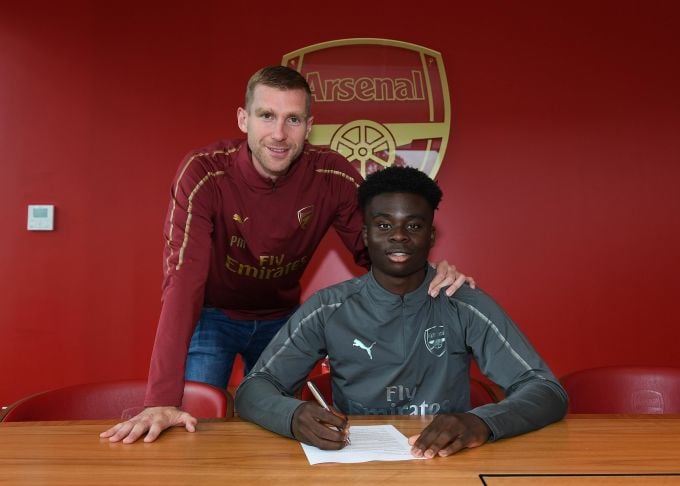
Mertesacker witnessed Saka sign his professional contract with Arsenal on September 14, 2018, when the striker was just 17 years old. Photo: arsenal.com
Moving from Hale End to London Colney, and soon being promoted to the first team, Saka quickly made his debut while still a schoolboy. The player born in 2001 started the following season by scoring his first goal for Arsenal against Eintracht Frankfurt in the Europa League in September 2019. That was certainly a special day, but what Saka did after that was even more special.
"What tells you everything about Saka is what he did with his shirt from that breakthrough match against Frankfurt," Mertesacker recounted. "The next day, Saka brought it back to Hale End and gave it to us as a gift. A shirt full of meaning, commemorating the moment Saka scored his first goal, and he brought it back to us, where it all began. The shirt is now on display in the entrance hall for everyone to see. That's Saka; he never forgets the people who were a part of his story, respecting the journey he's taken."
Prior to that pivotal match against Frankfurt, Saka had taken his first steps in professional football at the start of the 2018-2019 season. A new era had begun at the Emirates Stadium. Arsene Wenger left in the summer of 2018 after 22 years in charge, and Unai Emery replaced him as the club's first new manager in the 21st century. The academy also underwent changes, with Mertesacker appointed Director and Freddie Ljungberg as head coach of the U23 team. Prior to that, the Swedish legend had coached Arsenal's U15 and U19 teams, thus working directly with Saka.
"When he appointed Ljungberg to lead the U15 team, he placed a lot of faith in Saka," Hobbs recalled. "That helped Saka when he first came to London Colney for full-time training. Ljungberg knew Saka's style and that certainly benefited his transition from schoolboy to U23. Ljungberg also had a good relationship with Emery, which also helped Saka progress."
Initially, Emery only gave Emile Smith Rowe his debut in the Europa League group stage. It wasn't until the fifth round, when he had a significant advantage in securing first place, that Emery delved deeper into the academy's talent and included Saka in UEFA's squad for the match against Vorskla Poltava in Ukraine. The young English talent seized this opportunity to impress the first-team manager.
In the 68th minute of the match at the Olimpiyskiy Stadium on November 29, 2018, Saka came on as a substitute, and at the age of 17 years and 86 days, he became the 15th youngest player in Arsenal history to make his first-team debut. The stature of the league, the novelty of the first team, and the -14°C cold that day couldn't stop Saka from shining. Six minutes after coming on, Saka ran down the left wing and received a long pass from Mohamed Elneny. He controlled the ball neatly, dribbled past defender Vorskla Poltava, and unleashed a powerful left-footed shot towards the near corner, but it was saved by the goalkeeper. Saka also left his mark with an assist for Joe Willock.
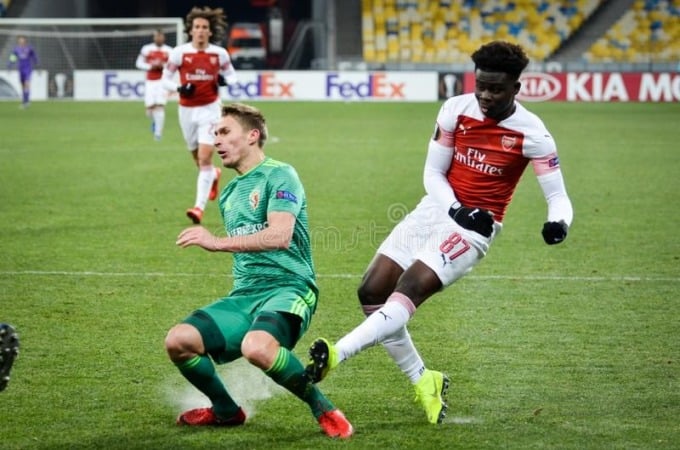
Saka making his Arsenal first-team debut at the Olimpiyskiy Stadium in Kiev on November 29, 2018. Photo: Dreamstime
But Saka didn't just impress on the pitch . Football consumed a lot of his time from a young age, but Saka didn't sacrifice everything else, at least not his studies. Born on September 5th, Saka was one of the oldest students in his school year, and he continued his education at Greenford High School when he joined Hale End. According to Matt Henly, head of education at the Arsenal academy for 10 years and closely followed Saka during his high school years, the boy was just as serious about his studies, always giving 100% effort as he was at playing football. "Saka graduated from high school in 2018 and achieved the highest score in his group, even though the team had many other intelligent boys at the time," Henly recounted.
What makes Saka's score even more remarkable is the timing of his final exams. "The 2018 European Under-17 Championships coincided with the exams. It was a nightmare for those young lads," Matt explained. "Saka was lucky that England hosted the tournament that year. So he could sit and study at school, instead of going abroad or studying in a hotel. Some players had their exams rescheduled, but Saka used that time to travel between London and St George's Park, between taking exams and playing for the national team. That makes Saka's result even more incredible."
So how did the current highest-paid player at the Emirates achieve his grades? "Well, Saka's group at the time had a mix of the old letter grading system and the current numbering system, depending on the subject. And Saka got an A* – the highest grade – in both business and economics , and A or A* in the other subjects, using the equivalent system," Matt revealed.
But intelligence, talent, and a burning desire to contribute weren't enough for Saka to rise in a football career – a sport that demands immense strength and physical prowess. Dr. Gary O'Driscoll, Arsenal's head of sports medicine, joined the club about a year after Saka joined the first team. Since then, he has witnessed the winger's incredible growth in stature, but he says there's no secret behind Saka's impressive physical development.
"Saka wasn't bigger, stronger, or exceptionally powerful when he joined the first team, and we didn't turn him into a machine. Saka was fouled more often than any other player in the Premier League, but he adapted physically to cope with it. Besides his physical development, Saka was also receptive and followed our instructions. If asked to improve his weightlifting, add some strength, or strengthen his core muscles, Saka would do it. Not every player can do that, no matter how hard they try," O'Driscoll recounted.
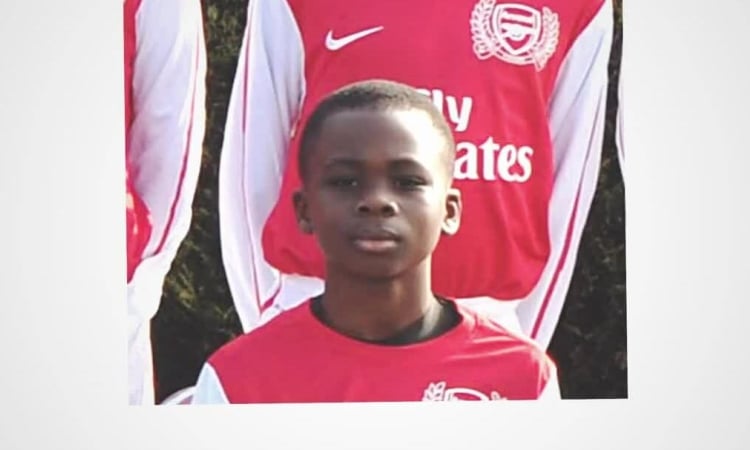
How has Saka changed over the years at Arsenal?
As O'Driscoll noted, Saka is one of the most fouled players in the Premier League. In the last three seasons, only five players have earned more free kicks than the English winger. But Saka rarely misses matches. Before this weekend's final round of games, he had played 79 consecutive Premier League matches and featured more than any other Arsenal player in the last three years. No player at any club has played more Premier League games than Saka since the start of last season.
O'Driscoll and his colleagues never had difficulty encouraging Saka to push himself beyond his physical limits. He recounted, "When we told Saka, 'You're going to play 90 minutes in two out of three games a week, can you do it?' Saka not only said he could, but he thrived on the challenge, and his body allowed him to do it. Not many players can do that."
According to Arsenal's Head of Sports Medicine, Saka wasn't the type of player who arrived at training first and left last each day, but he was always professional, giving his all in every training session. "He was motivated, competitive, and trained to win. Saka strictly followed the training plan, from lifting weights in the gym to preparing, training on the pitch, recovering, then going home and sleeping early. He was a unique player with a dedicated personality, and Saka's journey with football could continue for a long time," O'Driscoll added.
But Saka's journey has only just begun. The English midfielder will turn 22 at the start of next season, and many challenges lie ahead. Saka is close to reaching 200 appearances, is the team's top scorer with 37 goals, and also leads in assists with 37. He is therefore expected to shine even brighter in the Champions League – a competition Arsenal will return to next season after a year's absence.
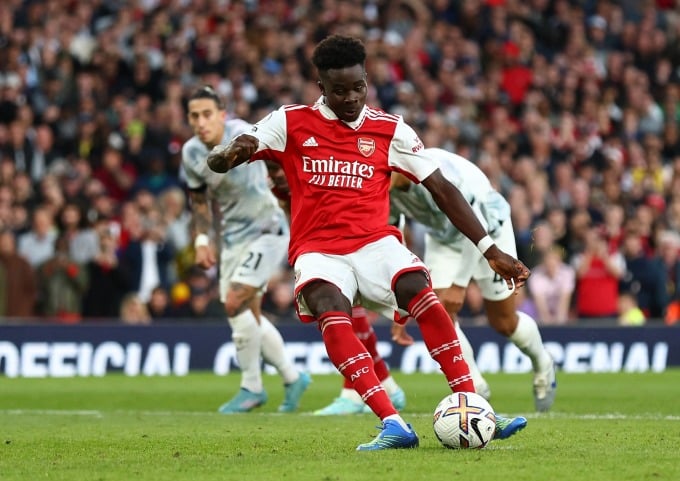
Saka scored from a penalty kick to give Arsenal a 3-2 victory over Liverpool at the Emirates Stadium in the Premier League on October 9, 2022. Photo: Reuters
"Saka is a fantastic player and seems to be getting better all the time," Liam Brady, who also wore the number 7 shirt for Arsenal, praised his younger compatriot. "Saka was at the highest level from a very young age, had an outstanding season and was one of the main reasons the club performed so well. I can't wait to see Saka play in the Champions League next season. That's the level Saka should be playing at, and he absolutely can shine in this competition."
From a physiological perspective, O'Driscoll agrees with this expectation: "It's amazing that we don't know Saka's limits. He's only 21, still has so much potential, and Mikel Arteta is very aware of this. It's rare to find a player who combines willpower, ambition, and motivation with physical potential whose limits we don't know like Saka. What he has achieved may only be the beginning."
Hong Duy (according to arsenal.com )
Source link
![[Photo] Prime Minister Pham Minh Chinh presides over a meeting on private sector economic development.](/_next/image?url=https%3A%2F%2Fvphoto.vietnam.vn%2Fthumb%2F1200x675%2Fvietnam%2Fresource%2FIMAGE%2F2025%2F12%2F20%2F1766237501876_thiet-ke-chua-co-ten-40-png.webp&w=3840&q=75)

























































































Comment (0)