

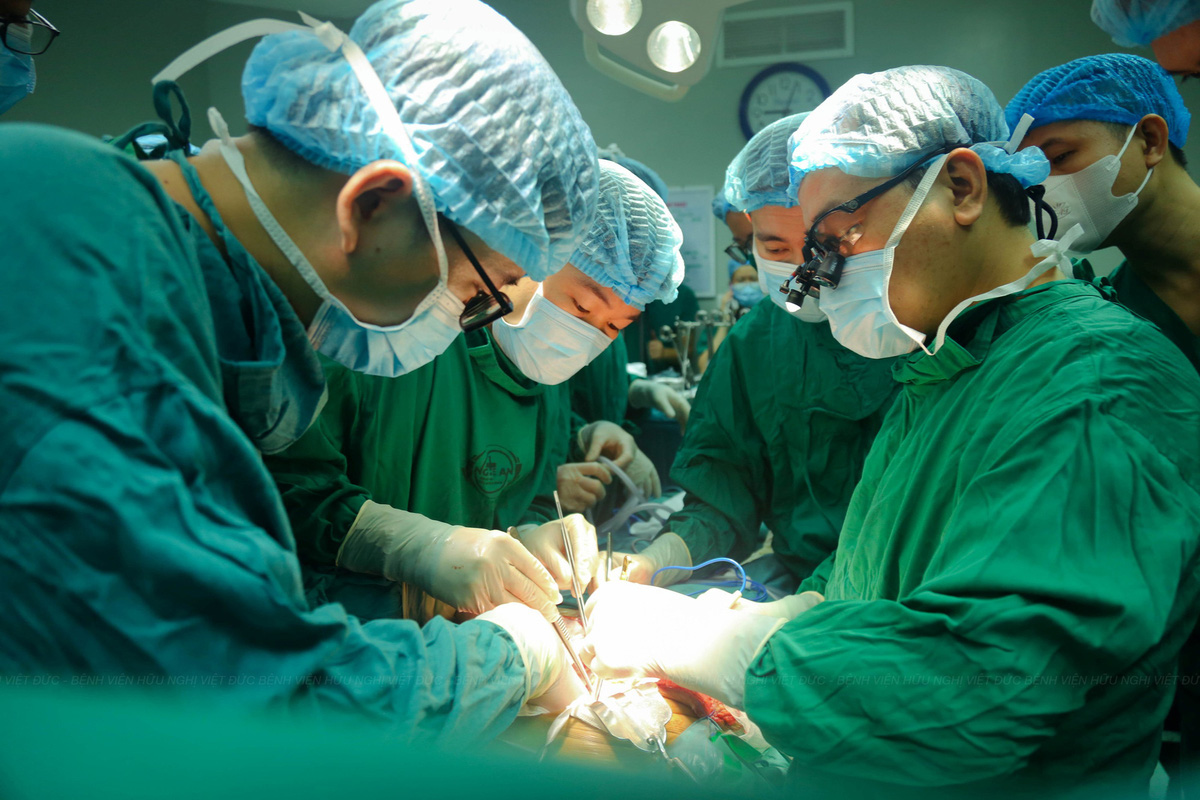
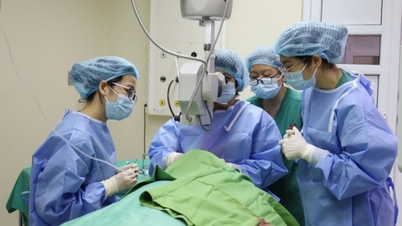
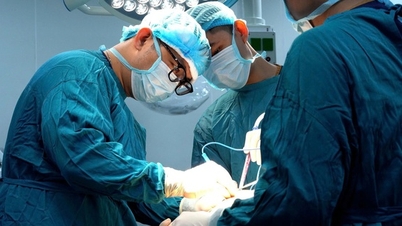
Doctors at Viet Duc Hospital perform heart and liver transplants on patients - Photo: Provided by the hospital.
Ten days after the transplant, 70% of the patient had been saved, whereas before, this man's life had been measured in days because conventional treatments had failed.
According to Mr. Duong Duc Hung, director of Viet Duc Friendship Hospital, major surgeries like this require a well-coordinated team, right from the organ retrieval stage.
On September 30th, upon receiving information about an organ donor in Nghe An, the doctors traveled to Nghe An, dividing into two groups. One group stayed to assist the Nghe An Provincial General Hospital in performing kidney transplants for two people (using the donated kidney), while the other group transported the heart and liver to Hanoi . Prior to this, they had to resuscitate the tissues and organs to ensure the best possible transplant outcome.
And even during the transplant surgery, failure can happen at any time; cardiac arrest can occur even after the transplant is complete, so anesthesiologists must monitor continuously to handle any issues.
A whole team of skilled doctors meticulously monitored every minute to achieve the best possible outcome.
Not only the patient, but also his entire family, including his parents, wife, and two young children, hoped for a happy ending. This joy was made possible thanks to the organ donor and the doctors.
But surprisingly, besides sharing about the hardships doctors face in saving patients' lives as a passion, Mr. Duong Duc Hung said that regardless of whether the surgery is long or short, even in special cases like this, the main doctors and anesthesiologists only receive an allowance of 280,000 VND, while the doctors assisting in the surgery and anesthesia/resuscitation receive only 200,000 VND.
For type 1 surgeries, the lead surgeon receives an allowance of 125,000 VND, equivalent to more than two bowls of pho in urban areas.
It would be inappropriate to compare the life-saving spirit of doctors and nurses with money. However, another perspective is that we need to be fairer so that doctors and nurses, especially young ones, not only have a passion for healing and saving lives but also have the motivation to learn and improve their knowledge and skills with new, complex techniques that the world already possesses. This would only benefit patients and the country's healthcare system.
In fact, not only within the country, but also Vietnamese people residing abroad have returned to register on the organ donation waiting list because they have great confidence in the skills of Vietnamese doctors.
And when doctors give presentations abroad, they are confident that Vietnamese doctors are not just there to listen as before, but also to share their experiences.
Many foreign doctors have come to Vietnam to study spinal surgery, endoscopic surgery, and dentistry. Vietnam is also providing undergraduate and postgraduate medical training to hundreds of students from India...
Achieving these results requires investment, not only from the State and hospitals, but also from individuals working in the profession. To invest, one needs funding, which for individuals means money.
While it's acknowledged that the medical profession is classified as a "special profession with special benefits," it's unclear whether those benefits, as reflected in the allowances issued in 2011, can still be considered "special" given the significant differences in cost of living today. The Ministry of Health is currently revising the regulations but hasn't implemented them yet.
Source: https://tuoitre.vn/ca-mo-dac-biet-va-khoan-phu-cap-280-000-dong-20241011100626902.htm
![[Image] National Assembly discusses the implementation of the socio-economic development plan.](https://vphoto.vietnam.vn/thumb/1200x675/vietnam/resource/IMAGE/2026/04/20/1776696707422_ndo_br_img-20260420-185419-jpg.webp)



![[Photo] General Secretary and President To Lam meets with National Assembly delegates from ethnic minorities.](https://vphoto.vietnam.vn/thumb/1200x675/vietnam/resource/IMAGE/2026/04/20/1776696701056_a1-bnd-8331-3342-jpg.webp)




















































Comment (0)