Reasons why Vietnam is "falling behind"
Experts assess that the durian market in China is experiencing stable growth and is expected to reach a size of $10 billion soon. Meanwhile, China is actively seeking new sources of supply to diversify its import markets.
According to statistics from Chinese customs authorities, in the first two months of the year, the country spent over $120 million to import 22,980 tons of whole durian fruit, a decrease of 56.8% in volume and 57.8% in value compared to the same period in 2024. The four main durian suppliers to the Chinese market are Thailand, Vietnam, Malaysia, and the Philippines.
In the first two months of the year, Vietnam's durian market share in China plummeted to 37%, compared to 61.7% in the same period last year. Meanwhile, Thailand increased its share to 62.3%, compared to 36.9% in the same period last year, surpassing Vietnam to reclaim the top spot. Malaysia ranked third with 0.6%, and the Philippines came in fourth with 0.2%.
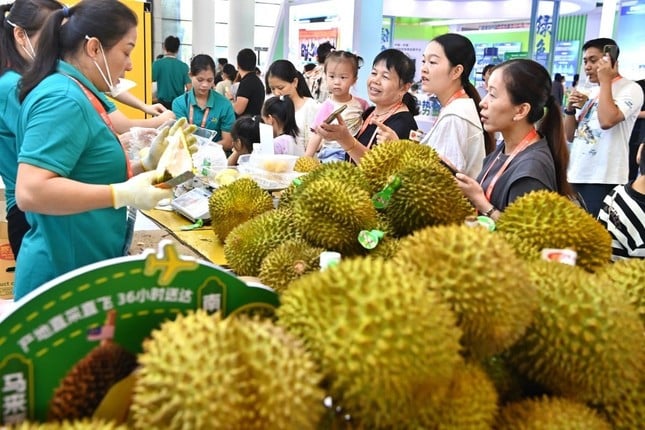
The Chinese market has a huge demand for durian. Photo: SCMP.
According to the Vietnam Fruit and Vegetable Association, the main reason why Vietnamese durian missed out on a large share of the market is that China has intensified its quality control of durian products since the beginning of this year. In addition to technical criteria such as pesticide residue and heavy metals (especially cadmium), China is also strictly checking for banned substances such as Yellow O, and the inspection rate for each export shipment has been raised from 10% to 100%.
Increased inspections have significantly extended customs clearance times, sometimes up to a week. Many shipments, even those that pass inspections in Vietnam, are damaged upon arrival at wholesale markets in China due to prolonged waiting times.
The Vietnam Fruit and Vegetable Association believes that the target of $3.5 billion in durian exports by 2025 is at risk of not being achieved if the current situation continues.
The race for market share
Amidst China's active search for new sources to diversify its durian import market, many Southeast Asian countries are immediately seizing the opportunity to gain market share in this multi-billion dollar industry. Malaysia, in particular, is focusing on producing the highest-quality products, targeting the ultra-wealthy.
According to SCMP , to cater to China's super-rich, durian farmers in Malaysia always let the fruit ripen naturally and fall to the ground before harvesting.
Immediately after harvesting, naturally ripened Malaysian durians are transported by air to China within just 48 hours. This short transit time helps the durians retain their freshness and deliciousness when they reach consumers in the world's most populous country.
This is a competitive advantage in the race for market share in this multi-billion dollar industry, especially as Chinese consumers are increasingly demanding about food quality and origin.
Mr. Sam Tan, Chairman of the Malaysian Durian Exporters Association, stated that the Chinese market is currently favoring naturally ripened, chemical-free durians. He also suggested that the government enact regulations prohibiting early harvesting to preserve the quality and reputation of Malaysian durians in the international market. Malaysian exporters currently expect to increase durian exports to China by 30% in 2025.
Laos has also recently launched national strategies aimed at becoming a significant durian supplier to the Chinese market. Specifically, Attapeu province in Laos has officially granted land use rights to three domestic companies to cultivate durian on an area of over 273 hectares for a period of 30 years.
Experts assess that Laos has a significant logistical advantage in exporting durian to China. The Vientiane-Kunming railway line can shorten container transport times, facilitating the export of Lao goods to China.
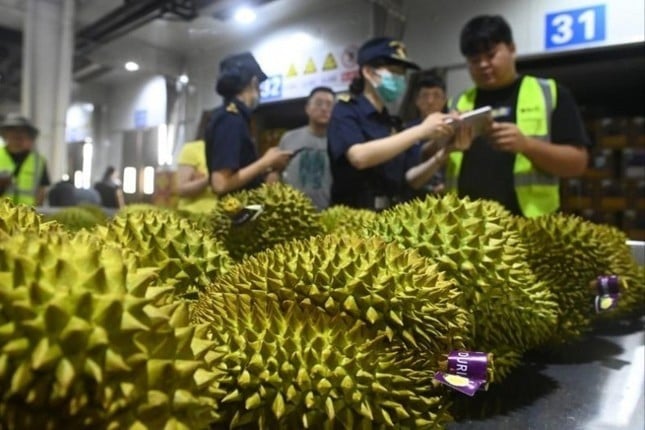
Countries wishing to export durian to China must meet stringent inspection requirements. Photo: Xinhua.
With an annual production of 1.83 million tons, Indonesia is currently one of the world's largest durian producers. According to the Bangkok Post, Indonesia is expanding cultivation and finalizing legal procedures to prepare for the start of durian exports to China.
Accordingly, Chinese customs authorities have completed inspections of durian growing areas and packing facilities in Indonesia. The Indonesian durian industry is now focusing on resolving logistical issues in preparation for exports to China.
A durian export company says that shipping durians directly from Pantoloan port in Central Sulawesi province to China could shorten the journey from a month to a week, potentially cutting shipping costs in half.
Besides competition from countries in Southeast Asia, domestic durian producers are also trying to grab a share of the market. Recently, domestic durian has been sporadically appearing on shelves in China, causing excitement among investors. Many investors have begun planting durian farms stretching across Hainan and southern border provinces such as Yunnan and Guangxi.
According to SCMP , a number of tycoons from various industries – from mine owners in Shanxi to manufacturing magnates in Guangdong – are investing heavily in durian cultivation. Michael Wang, known on social media as Maikou Wang, said that last year he received over 800 inquiries from investors interested in durian farming.
Once considered a "dead land" unsuitable for durian cultivation due to its harsh climate and unpredictable monsoon winds, Hainan is now a symbol of daring and perseverance. Durian growers in China are determined to focus on quality to meet the huge domestic demand.
Source: https://baoquangninh.vn/cac-nuoc-canh-tranh-khoc-liet-thi-phan-sau-rieng-trung-quoc-3354759.html


![[Video] Sunset at Lap An Lagoon – Where the sun sets over the fishing nets](https://vphoto.vietnam.vn/thumb/1200x675/vietnam/resource/IMAGE/2026/05/31/1780187239592_2222.jpeg)












![[Video] Sunset at Lap An Lagoon – Where the sun sets over the fishing nets](https://vphoto.vietnam.vn/thumb/800x450/vietnam/resource/IMAGE/2026/05/31/1780187239592_2222.jpeg)








































































Comment (0)