In Vietnamese culinary culture, stuffed snails, also known as black snails, are a core ingredient in famous specialties such as steamed stuffed snails with ginger leaves, snail noodle soup, or snails cooked with banana and tofu. However, the biggest obstacle that makes many people hesitant to prepare this food is their habit of living at the bottom of muddy swamps.
From a biological perspective, apple snails belong to the class Gastropoda, moving by secreting mucus and obtaining food through a filtering mechanism of organic matter. Their mantle cavity and digestive system accumulate a large amount of mud, algae, and parasites.
Traditional methods of cleaning snails usually require soaking them overnight in rice water for 8 to 12 hours. However, in modern life, chefs have deciphered the biological secrets that allow them to quickly expel mud from snails in just 1 to 2 hours.
How to quickly clean snails
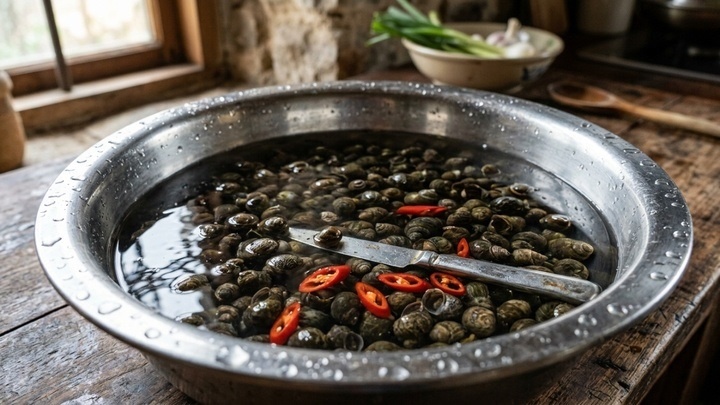 |
Knowing the trick to cleaning snails will help you get them to release all the mud and dirt, completely eliminating the fishy smell in a short time. Photo: CM. |
Phase 1: Forcing the snails to quickly release mud from inside their shells.
To shorten the time, we need to activate two natural reflexes of snails simultaneously: the reflex to defend against toxins and the reflex to search for food.
Soak the snails in a metal basin (aluminum or copper basin), or place a few stainless steel items such as knives, scissors, spoons, or even a few clean iron nails in a basin of water. When the metal comes into contact with water, it undergoes a mild oxidation process, releasing metal ions into the solution.



Snails are inherently sensitive to heavy metals and electrochemical changes in the water environment. As soon as they sense signs of metal contamination in the water, as a survival reflex, they will open their shells wide, continuously sucking and expelling water at extremely high speeds to cleanse their bodies, thereby expelling all the mud and dirt from their stomachs.
If you don't have a metal basin, use concentrated rice water mixed with 3-5 crushed chili peppers. Rice water contains a lot of starch and vitamins, acting as a nutritional lure that encourages snails to open their shells to eat. The moment they open their shells, the pungent capsaicin from the chili peppers will immediately irritate the snail's delicate mucous membrane. This chili-induced irritation forces them to aerate and accelerate their excretion process. Combining these two substances helps clean the snails of mud in just 1 hour and 30 minutes.
Phase 2: Cleaning the outer shell
After the snails have expelled all the mud inside, their outer shells still cling to green algae, dried mud, and parasite eggs. Regular rinsing won't wash away this buildup. The secret here is using rough friction. Wear thick rubber gloves, place all the snails in a coarse-mesh plastic basket, and sprinkle in a small bowl of coarse salt.
Using both hands, vigorously shake and rub the snails together under running water. The solid salt grains, combined with the friction between the shells, will act like sandpaper, scraping away the green moss clinging to the porcelain surface of the shells.
Phase 3: Processing the snail meat and eliminating the fecal sacs.
For dishes that require the snail meat to be used separately (such as snail patties, snail spring rolls), the process of cleaning the meat after it has been removed from the shell determines the crispness and sweetness of the dish.
When you open a snail from its shell, you'll see the meat is divided into two halves: a hard, white head and a soft, brownish-green spiral tail. This tail is actually the snail's digestive gland and fecal sac, where undigested mud and dirt accumulate, and where worms and parasites reside. It's essential to completely remove this spiral tail, leaving only the head and the snail's flesh.
The biggest mistake housewives make is rinsing opened snail meat with tap water; this only causes the snail cells to secrete more slime. The expert's method is: Put the snail meat in a bowl, sprinkle with 2 tablespoons of wheat flour or tapioca starch, and gently knead for 2 minutes. The tiny starch particles will mechanically bind to the snail's slime. When you rinse with clean water, the flour will wash away all the slime, leaving behind dry, crunchy snail meat.
Notes on cleaning snails



No matter how quickly you clean the snails, always remember that pond snails are intermediate hosts of the parasitic nematode Angiostrongylus cantonensis, which causes meningitis. Methods like soaking in chili peppers or vinegar are completely ineffective at killing this parasite.
Therefore, after physical cleaning, snails must be boiled and thoroughly cooked at temperatures above 100°C for a minimum of 10 to 15 minutes. The combination of quick and skillful kitchen techniques and medical caution will bring your family delicious country-style dishes that are both flavorful and absolutely safe.
Source: https://znews.vn/cach-lam-sach-oc-buou-nhanh-nhat-post1663082.html
![[Image] Ho Chi Minh City: Ma Lang area, Chicken-Rice Market about to change its appearance](https://vphoto.vietnam.vn/thumb/1200x675/vietnam/resource/IMAGE/2026/06/25/1782377698627_ndo_br_m1-jpg.webp)













































![[Image] Schools organize meetings and introduce teaching models to students admitted to grade 10.](https://vphoto.vietnam.vn/thumb/1200x675/vietnam/resource/IMAGE/2026/06/25/1782368077271_ndo_br_z7970052192242-1ec8daeb77a6eed1a4e9f58c564ddd3e-jpg.webp)