


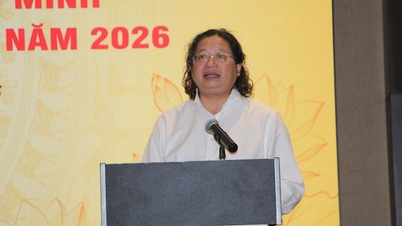
Dr. Nguyen Thi Phuong Mai, Institute of Mental Health, examines a patient - Photo: D. LIEU
When an elderly person suddenly becomes irritable for no reason.
His changes unfolded subtly over three years, until his daily activities became awkward, his speech became disjointed, and his personality was completely different from before.
Sharing about this case, Ms. Duong Thi To Uyen, M.Sc., from the Institute of Mental Health, Bach Mai Hospital, said that the patient was admitted with significant memory impairment, irritability, difficulty finding words when speaking, and many behavioral changes.
Through examination, psychological assessment, and cognitive testing, despite still being capable of basic self-care, the patient was diagnosed with late-onset Alzheimer's dementia, with an MMSE score of only 18.
Doctors emphasize that irritability and mood swings in the elderly are not simply "aging tendencies," but could be early signs of cognitive disorders – mental health issues that require timely detection and intervention.
Many families still view forgetfulness in the elderly as a natural consequence of aging. However, according to Dr. Nguyen Thi Phuong Mai from the Institute of Mental Health, Bach Mai Hospital, cognitive disorders are conditions characterized by a decline in important functions such as memory, thinking, language, problem-solving ability, orientation, and daily activities, exceeding the normal physiological aging process.
Statistics show that in 2020, more than 55 million people worldwide suffered from dementia – a severe form of cognitive impairment. This number is projected to increase to 82 million by 2030 and 139 million by 2050. For mild cognitive impairment, the prevalence among people aged 65 and older ranges from 10-20% and continues to rise with age.
Two levels of cognitive impairment to be aware of.
According to experts, cognitive disorders in older adults are generally divided into two main categories.
Mild cognitive impairment: Patients remain relatively independent but experience a significant decline in one or more areas such as memory, language, and concentration. This stage can progress to dementia, although not all cases follow this path.
Severe cognitive impairment (dementia): A significant decline in memory, thinking, language, and self-care abilities.
Alzheimer's disease accounts for approximately 60-70% of cases, in addition to vascular dementia, Lewy body dementia, etc.
A notable point is that personality changes—irritability, anxiety, depression, withdrawal—often appear early and are easily overlooked or misinterpreted by family as "being grumpy due to old age."
What symptoms require prompt medical attention?
In healthy elderly people, occasionally forgetting the names of acquaintances or the location of items is still possible and usually they remember later, without significantly affecting their daily lives.
Conversely, cognitive disorders often manifest as forgetting recent events, repeatedly asking for the same information; difficulty expressing oneself, forgetting familiar words; reduced ability to concentrate and plan; confusion with familiar tasks such as cooking or paying bills; confusion about time and place, possibly getting lost in places that were once very familiar; noticeable changes in personality and behavior, etc.
Notably, about one-third of people with mild cognitive impairment may develop dementia within five years if they do not receive appropriate monitoring and intervention.
According to doctors, early detection of cognitive disorders offers many benefits: increased effectiveness of interventions, slowing disease progression; prolonging the independence of the elderly; reducing the care burden on families and society; and helping to better control co-morbidities such as hypertension, diabetes, depression, or sleep disorders.
"Going for a check-up is not something to worry about or be ashamed of, but rather a positive action to protect the health and future of the patient," Dr. Mai emphasized.
For the elderly, especially when unusual changes in memory, behavior, or personality occur, such as irritability or short temper, families should not take it lightly.
Source: https://tuoitre.vn/cach-nao-chua-tinh-bong-dung-cau-gat-thay-tinh-doi-net-o-nguoi-lon-tuoi-20251218205204486.htm

![[Photo] Prime Minister Pham Minh Chinh presides over the conference announcing the establishment of the International Finance Centre in Vietnam.](/_next/image?url=https%3A%2F%2Fvphoto.vietnam.vn%2Fthumb%2F1200x675%2Fvietnam%2Fresource%2FIMAGE%2F2025%2F12%2F21%2F1766309817714_ndo_br_dsc-3400-jpg.webp&w=3840&q=75)


![[Photo] Prime Minister Pham Minh Chinh presides over a meeting on private sector economic development.](/_next/image?url=https%3A%2F%2Fvphoto.vietnam.vn%2Fthumb%2F1200x675%2Fvietnam%2Fresource%2FIMAGE%2F2025%2F12%2F20%2F1766237501876_thiet-ke-chua-co-ten-40-png.webp&w=3840&q=75)







![[Video] Bach Mai Hospital puts into operation a group of the world's most modern equipment.](https://vphoto.vietnam.vn/thumb/402x226/vietnam/resource/IMAGE/2025/12/17/1765931442107_dung00-58-18-13still010-jpg.webp)
























































































Comment (0)