For the past few weeks, at 7 PM every day, the family of Ms. Phan Thi Huong (Flora Fuji apartment building, Phuoc Long ward) has been hunting for blister beetles. The husband holds an insect spray, the wife shakes out the blankets and sheets, and their 6-year-old daughter points out the locations where the beetles appear. After 20 minutes, more than a dozen blister beetles are eliminated.
“Every night, my family has to check the entire apartment for blister beetles. Sometimes, we just lift the pillows and shake out the blankets and find them crawling on the bed. Many even perch on the walls, windows, and clothes. A few days ago, my daughter accidentally crushed a beetle and got blisters on her legs and neck. Every rainy season, my family worries because it’s very difficult to control the appearance of blister beetles,” Ms. Huong shared.
It's not just Ms. Huong's family; many families in this apartment building have also noticed an unusually large number of blister beetles. The building management has organized the spraying of insecticides from the hallways of all floors to the common areas. However, the insecticides are not strong enough to completely eliminate the blister beetles.


At the beginning of the rainy season, Nguyen Binh Duong's (25 years old, Binh Thanh ward) rented room was infested with blister beetles every day. He quickly became a victim with many red blisters spreading across his abdomen, arms, and legs, causing intense itching and burning, and had to seek treatment at Gia Dinh People's Hospital (Ho Chi Minh City).
Dr. Dao Trong Nghia, a specialist in General Medicine at Gia Dinh People's Hospital, explained that the initial treatment was improper, with patients rubbing the affected skin area, causing toxins to spread and creating conditions for bacteria to enter and cause infection.
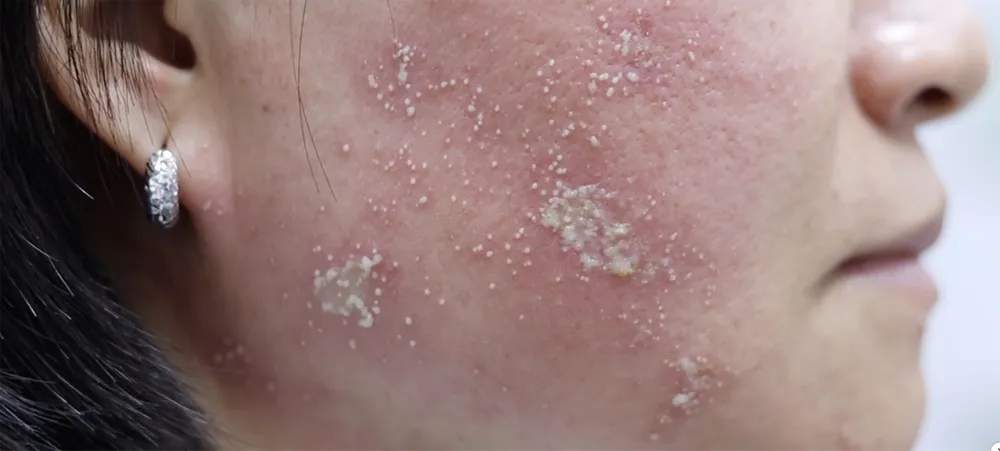
Rove beetles (Paederus beetles) typically live in damp, grassy areas and are attracted to light at night. Because they belong to the group of beetles capable of flight, rove beetles can be found in apartment buildings and high-rises. Rove beetles contain pederin, a toxin that causes burns. However, the toxin is only released when the beetle is crushed. Contact dermatitis caused by rove beetles manifests as erythema, slight edema, blisters, and pustules.
According to Dr. Dao Trong Nghia, wounds caused by rove beetles usually appear on exposed skin areas such as the face, neck, hands, and chest, especially in the form of long streaks (because the toxin sticks in the direction of the hand's swipe). They need to be examined and treated properly; absolutely do not treat rove beetle wounds with methods such as: applying toothpaste, medicated oil, garlic, or other unknown ointments; do not apply plant leaves directly to the wound; do not squeeze blisters...
Furthermore, many people still mistake blister beetle bites for mosquito bites, common allergies, or shingles. Dr. Dao Trong Nghia explains that contact dermatitis caused by blister beetles can spread to other areas if the patient accidentally touches them, causing the insect's secretions to stick to the skin. Shingles, on the other hand, follows the affected nerve, forming clusters of blisters and causing more pain than contact dermatitis.

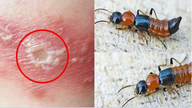

According to Dr. Nguyen Vu Hoang, Deputy Director of the Ho Chi Minh City Dermatology Hospital, absolutely do not use your hands to swat or crush blister beetles when you see them crawling on your body. Instead, chase them away by blowing on them forcefully or placing a piece of paper for them to crawl onto. If you discover that you have accidentally swatted or rubbed the beetle, immediately wash the affected skin area with clean water.
Source: https://www.sggp.org.vn/can-than-viem-da-do-kien-ba-khoang-post858113.html
![[Image] Schools organize meetings and introduce teaching models to students admitted to grade 10.](https://vphoto.vietnam.vn/thumb/1200x675/vietnam/resource/IMAGE/2026/06/25/1782368077271_ndo_br_z7970052192242-1ec8daeb77a6eed1a4e9f58c564ddd3e-jpg.webp)

![[Photo] General Secretary and President To Lam receives Palestinian Ambassador Saadi Salama](https://vphoto.vietnam.vn/thumb/1200x675/vietnam/resource/IMAGE/2026/06/25/1782365384740_a1-bnd-9423-8322-jpg.webp)
![[Image] Ho Chi Minh City: Ma Lang area, Chicken-Rice Market about to change its appearance](https://vphoto.vietnam.vn/thumb/1200x675/vietnam/resource/IMAGE/2026/06/25/1782377698627_ndo_br_m1-jpg.webp)


















![[Video] Weather forecast for tonight and tomorrow, June 26, 2026: Northern Vietnam to end heatwave from tomorrow, Central Vietnam to continue experiencing a heatwave.](https://vphoto.vietnam.vn/thumb/402x226/vietnam/resource/IMAGE/2026/06/25/1782392692278_thumb-dem-png.webp)