

Pressure from market glut and falling prices.

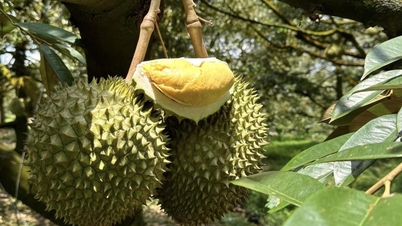
According to a report by the Department of Crop Production and Plant Protection of Can Tho City, the locality currently has 14,483 hectares of durian; of which, the area currently producing fruit is 8,635 hectares with an estimated harvest of 120,000 tons in 2026. However, this year's harvest has seen a significant drop in selling prices.
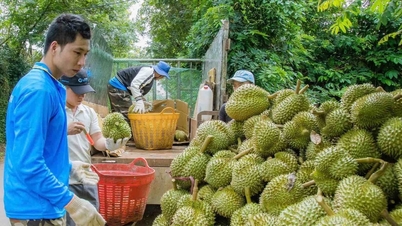
Observations in key durian-growing areas such as Phong Dien, Truong Long, and Truong Thanh communes show that the price of Ri6 durian (the main variety, accounting for over 86% of the cultivated area) currently ranges from 30,000 to 45,000 VND/kg, a decrease of about 20,000 VND/kg compared to the same period last year. In some orchards, traders are buying in bulk at only 20,000 to 35,000 VND/kg depending on quality.

The main cause of this situation has been identified as the overlapping harvesting times between Vietnam and countries such as Thailand, Laos, and Cambodia. In particular, although many orchards in the Mekong Delta have proactively managed to produce fruit a month earlier than the main season, they still clash with the main durian season of Thailand (usually from April to September). In addition, difficulties in exporting have made traders hesitant, mainly focusing on domestic consumption, leading to a localized oversupply.

Besides facing low selling prices, durian growers are also under pressure from rising input costs. Mr. Nguyen Van Viet (Truong Thanh commune) said that due to erratic hot and cold weather and strong winds, the flowering rate was not satisfactory, forcing farmers to re-treat their orchards multiple times. The cost of fertilizers, pesticides, and labor has pushed production costs from 15,000 VND/kg (last year) to 25,000-30,000 VND/kg.
At current selling prices, farmers' profits are very low, and they even face the risk of losses if they have to hire entirely laborers for cultivation. "Only when the selling price reaches 50,000 VND/kg or more will growers truly make a profit to reinvest properly," shared Mr. Tran Thong Lanh, a farmer in Truong Long commune.
Highlights from supply chain integration and quality control.

Despite the overall challenging situation, farmers participating in cooperatives and supply chains linked with businesses have maintained stability. A prime example is Truong Khuong A Cooperative, with over 20 member households, which has signed long-term contracts with an export company (Chanh Thu Company) at a fixed price of 35,000 – 45,000 VND/kg. This model helps farmers avoid being exploited or having their produce bought up by traders when the market fluctuates.
To maintain this connection, the cooperative sets strict quality standards. Mr. Tran Van Chien, Director of Truong Khuong A Cooperative, said that before harvesting, the cooperative sends fruit and soil samples for testing to control pesticide residues and heavy metals (cadmium). "Thanks to advising members not to use fused phosphate and implementing measures to remove toxins from the soil, for the past 3 years, the cooperative's products have been cadmium-free and meet export standards," Mr. Chien said.
In addition, applying cost-saving farming practices as guided by the cooperative has helped members reduce production costs to 15,000 – 17,000 VND/kg, ensuring a profit margin of 10,000 – 20,000 VND/kg even when the market is low.

To overcome long-term difficulties, Can Tho's agricultural sector is orienting towards promoting staggered and off-season production. Professor Tran Van Hau, former lecturer at Can Tho University, recommends that farmers in the Mekong Delta shift their harvesting focus to the period from November to March of the following year. This is the time when supply from Thailand is scarce, while demand from the Chinese market is very high, potentially doubling or tripling prices compared to the main season.
Currently, about 20% of durian growing areas in Can Tho have switched to off-season production. Techniques such as water restriction and covering the planting beds with plastic sheeting have been successfully applied by farmers, not only helping to "avoid the off-season" but also reducing problems such as hard flesh and premature fruit drop due to weather conditions.
At the same time, the City's Department of Crop Production and Plant Protection is strengthening management and issuing durian growing area codes. To date, the entire city has 127 codes covering an area of 2,704 hectares. This is considered a mandatory "passport" for Can Tho durian to penetrate high-end markets such as China, the United States, the EU, and ASEAN.

Ms. Pham Thi Minh Hieu, Head of the Crop Production and Plant Protection Sub-Department of Can Tho City, stated that although analysis results show that the cadmium content in the soil of Can Tho and the Mekong Delta is currently very low, the authorities are still paying special attention to guiding farmers to strictly adhere to cultivation procedures; at the same time, the department will continue to review the quality monitoring and traceability system. The goal is to ensure that the output products are completely free of heavy metal residues (including cadmium) and pesticide residues that affect export standards.
Besides technical factors, Ms. Pham Thi Minh Hieu emphasized the importance of improving sustainable economic efficiency through systematic farming knowledge for farmers. The core solution is to optimize investment costs so that growers can make a profit even when market prices are low. Simultaneously, linking production to form concentrated farming areas with a minimum size of 10 hectares is extremely urgent, minimizing spontaneous development in unsuitable areas.
With proactive measures from management agencies and a shift in farmers' production mindset, the durian industry in Can Tho is expected to soon overcome this period of volatility.
Source: https://baotintuc.vn/kinh-te/can-tho-go-kho-cho-nganh-hang-sau-rieng-20260512105511775.htm
















































































Comment (0)