

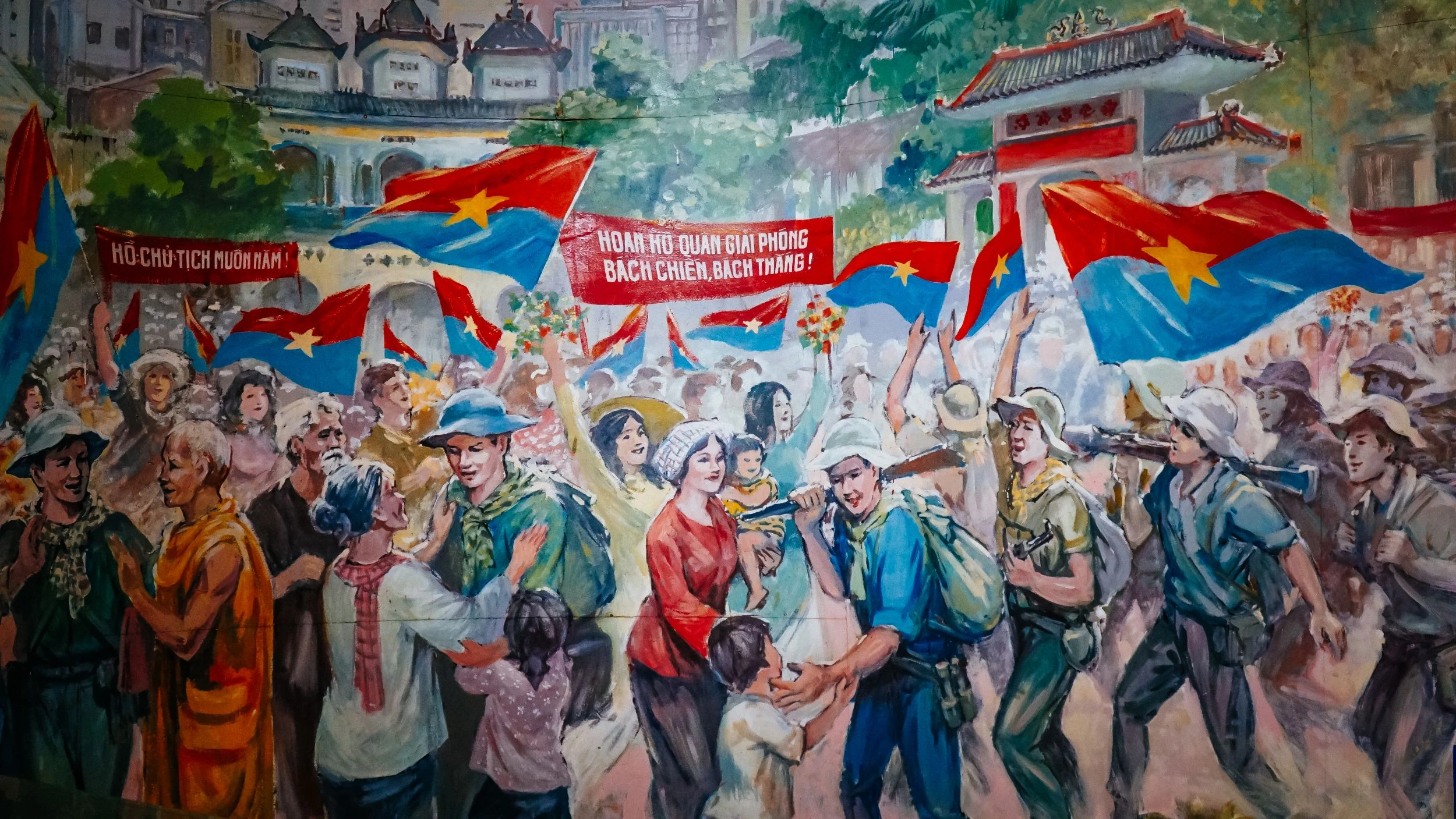
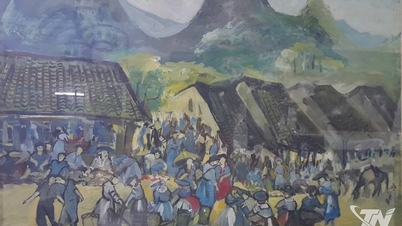
A section of a painting in the exhibition "The Spring 1975 General Offensive and Uprising in Can Tho Province" at the Can Tho City Museum. Photo: DUY KHOI
During the 1974-1975 dry season in Can Tho, despite the enemy's efforts to pacify and occupy the area, their troop numbers were severely depleted and morale was low. The enemy's strategy was to withdraw from their outposts and consolidate their forces in order to hold important positions and tightly defend the Ring Road to protect the headquarters of the IV Tactical Zone.
Given this situation, the Regional Party Committee decided to mobilize all forces, intensify the three-pronged attack, launch widespread offensives, implement the strategy of inflicting heavy casualties, expanding the liberated zone, and creating the momentum and strength to advance and achieve victory in the 1974-1975 dry season. Chosen by the Regional Party Committee as a key area, the Can Tho Provincial Party Committee was determined to win in the 1974-1975 dry season.
On December 5, 1974, we launched the campaign. The main force of the Zone, in combination with the Long My local militia, attacked the Fourteen Thousand sub-district, killing and capturing 50 enemy soldiers. In Phung Hiep, we destroyed the rear base of Battalion 478 near the town. In Chau Thanh, the Tay Do Battalion destroyed the Tam Ngan outpost (Tan Hoa commune). In O Mon, we destroyed the Ca Thien outpost. On the night of December 8, 1974, the Tay Do Battalion attacked and destroyed the One Thousand sub-district, destroying two 105mm cannons, a 50-ton ammunition depot, and eliminating 144 enemy soldiers. The people and soldiers of Chau Thanh A destroyed the Muong Khai outpost (Nhon Nghia), the Kinh Thay Cai outpost (Thanh Xuan)... Continuously in the last days of 1974 and the beginning of 1975, we attacked and won victories in many areas of the province. Many enemy outposts were destroyed.
Simultaneously, the political struggle movement was very vibrant, with tens of thousands of people rushing to the front lines alongside the armed forces to surround enemy outposts, and participating in civilian labor to support the battlefield... A typical example is in Thot Not, where the mass movement against conscription was strong. In January 1975, in O Mon and Chau Thanh, more than 10,000 people directly fought against enemy raids and looting. In Long My, hundreds of people resisted enemy raids and looting of rice fields, preventing enemy armored vehicles from raiding rice paddies.
The military mobilization effort also coordinated with the armed and political efforts, most notably the desertion movement of enemy soldiers who returned to the revolutionary side with their weapons, the uprising movement to seize enemy outposts and eliminate oppressors, and the vigorous movement of soldiers' families demanding that their husbands, sons, and brothers not be drafted into the army. This caused unrest and confusion within the enemy ranks.
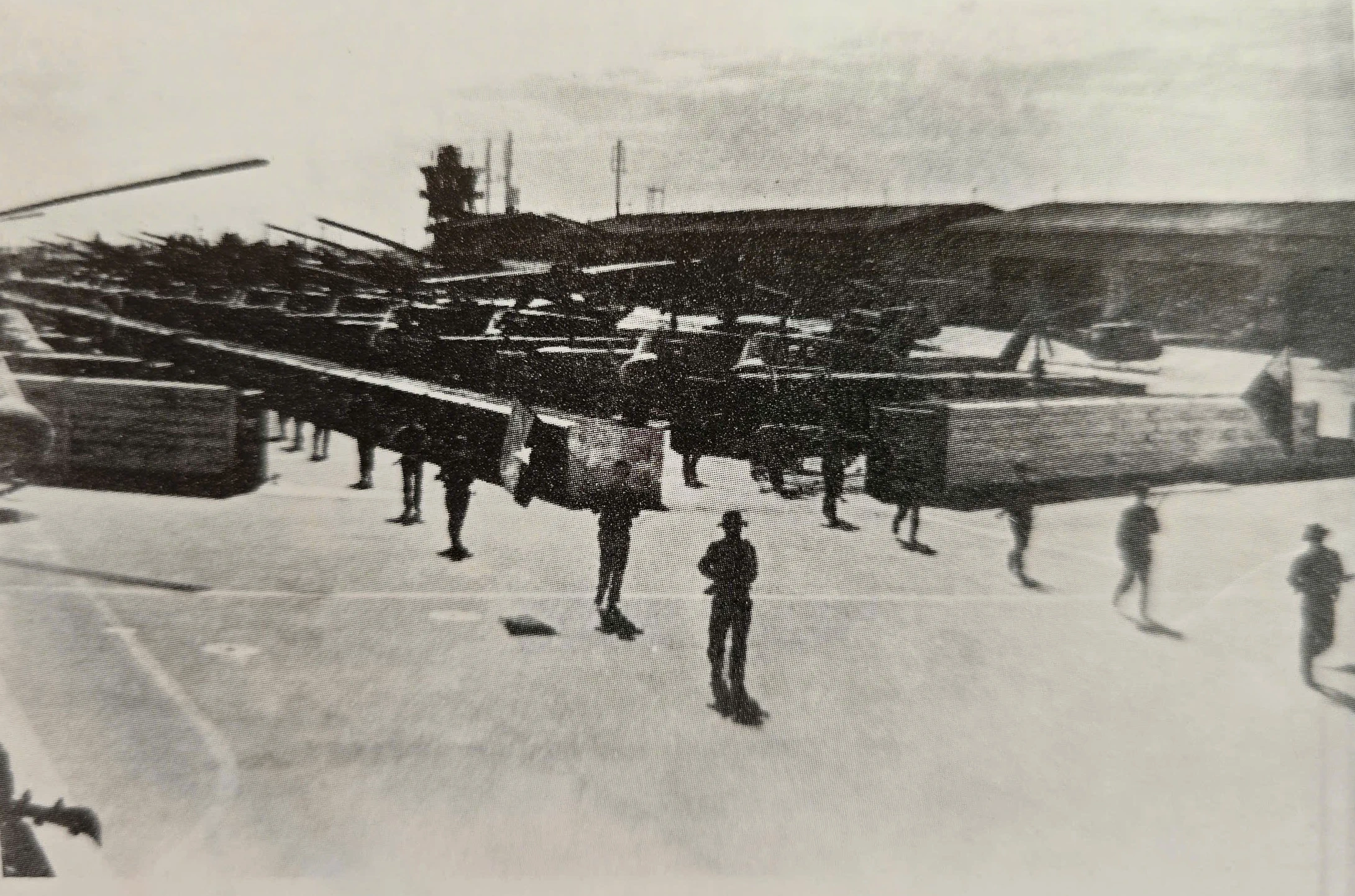
The insurgent forces took control of Tra Noc airport at noon on April 30, 1975. Source: "Can Tho Gazetteer", Can Tho Provincial Party Committee, Can Tho Provincial People's Committee, 2002
In the first four months of 1975, the people and armed forces of Can Tho eliminated 3,096 enemy soldiers, destroyed one battalion, five companies, two police platoons, one district, and one sub-district. They forced the surrender or withdrawal of 161 outposts and 12 bunkers, destroyed 12 vehicles, and sank 13 ships. Overall, during the 1974-1975 dry season campaign, we completely liberated five communes, essentially liberated seven communes and 25 hamlets with 45,000 inhabitants, bringing the total number of people in the liberated areas of the province to over 170,000.
From April 22nd to 24th, 1975, the Standing Committee of the Provincial Party Committee met at Chu Hang Port, Vinh Tuong commune, Long My district, to implement the Central Committee's Resolution, assess the situation, review plans, and deploy armed forces, resolving to liberate Can Tho province and contribute to the liberation of Southern Vietnam.
On April 26, 1975, Nguyen Van Thieu resigned, further increasing the enemy's confusion and panic.
The revolutionary opportunity had arrived. On April 26, 1975, the Standing Committee of the Regional Party Committee issued the order to attack. Can Tho was the primary target of the region, and our forces were divided into two directions: the first direction approached the Ring Road, preparing to advance into Can Tho City; the second direction advanced towards Xom Chai, preparing to cross the Can Tho River and enter the city.
On April 28, 1975, the US consulate in Can Tho withdrew, causing extreme panic among high-ranking officers of the South Vietnamese army and government.
Throughout the night of April 28th and 29th, 1975, our main forces marched past the enemy's defensive lines. At 10:00 AM on April 30th, 1975, the Tay Do Battalion and the main forces of the Vong Cung Road approach area crushed two enemy main regiments and armored vehicles guarding the Vong Cung Road.
Simultaneously, on April 28th and 29th, 1975, the masses in the city center rose up and stormed American bases at the beginning of Highways 19 and 67 Hung Vuong. Workers at the BGI soft drink factory took over the management of machinery when the owners fled with the Americans, and were ready to hand it over to the revolutionary forces. In some areas of Can Tho City, such as An Binh commune and Hung Loi ward, the masses rose up, taking control of the facilities of the puppet regime's apparatus in the wards and hamlets, gathering weapons for civil defense to equip the self-defense forces, raising the National Liberation Front flag, and guiding the troops into the city. Our revolutionary base in Thoi Thuan hamlet seized Tra Noc market and held the Tra Noc bridge. The masses took advantage of the soldiers at Tra Noc airport to seize weapons and threaten the Colonel commanding the airport (Ba Do), causing all the soldiers there to surrender. Afterward, the 20th Regiment, the main force, arrived and occupied the airport at 6 PM.
At 11:00 AM on April 30, 1975, our internal network released 4,000 captured new recruits and laborers at Recruitment Camp No. 4, Mac Tu Sanh Street (now April 30th Street). By 11:30 AM, the field police company of Battalion 410 stationed at Dau Sau fled, and three civil defense units seized the outpost, gathering 60 weapons and handing them over to the insurgent forces. At 12:00 PM, under the guidance of the insurrection command, Dr. Le Van Thuan, General Secretary of the Red Cross, went to the two prisons, Kham Lon and Cau Bac, opened the gates, and released over 6,000 political prisoners.
common offender.
Political prisoners and common criminals in the two prisons, along with new recruits in the military training camp, were released and poured into the streets to cheer the revolution. Military prisoners in the prisoner-of-war camp were guided by our network to break into the prisons, seize weapons and equipment depots, and establish two "Victory Battalions" I and II, totaling over 700 soldiers, to take over and maintain order in the city.
At 2:30 PM on April 30, 1975, our armed self-defense forces seized the Can Tho Radio Station. At the station, there was a company of security guards and four vehicles, commanded by Captain Nguyen Van Hao, an inside agent of ours. He ordered his soldiers to disband and gather their weapons into storage, creating favorable conditions for our forces to seize the station. At 3 PM, Comrade Nguyen Van Luu (Nam Binh), on behalf of the Can Tho City Uprising Committee, read a call to arms, urging the people to rise up and join the armed forces in liberating the city.
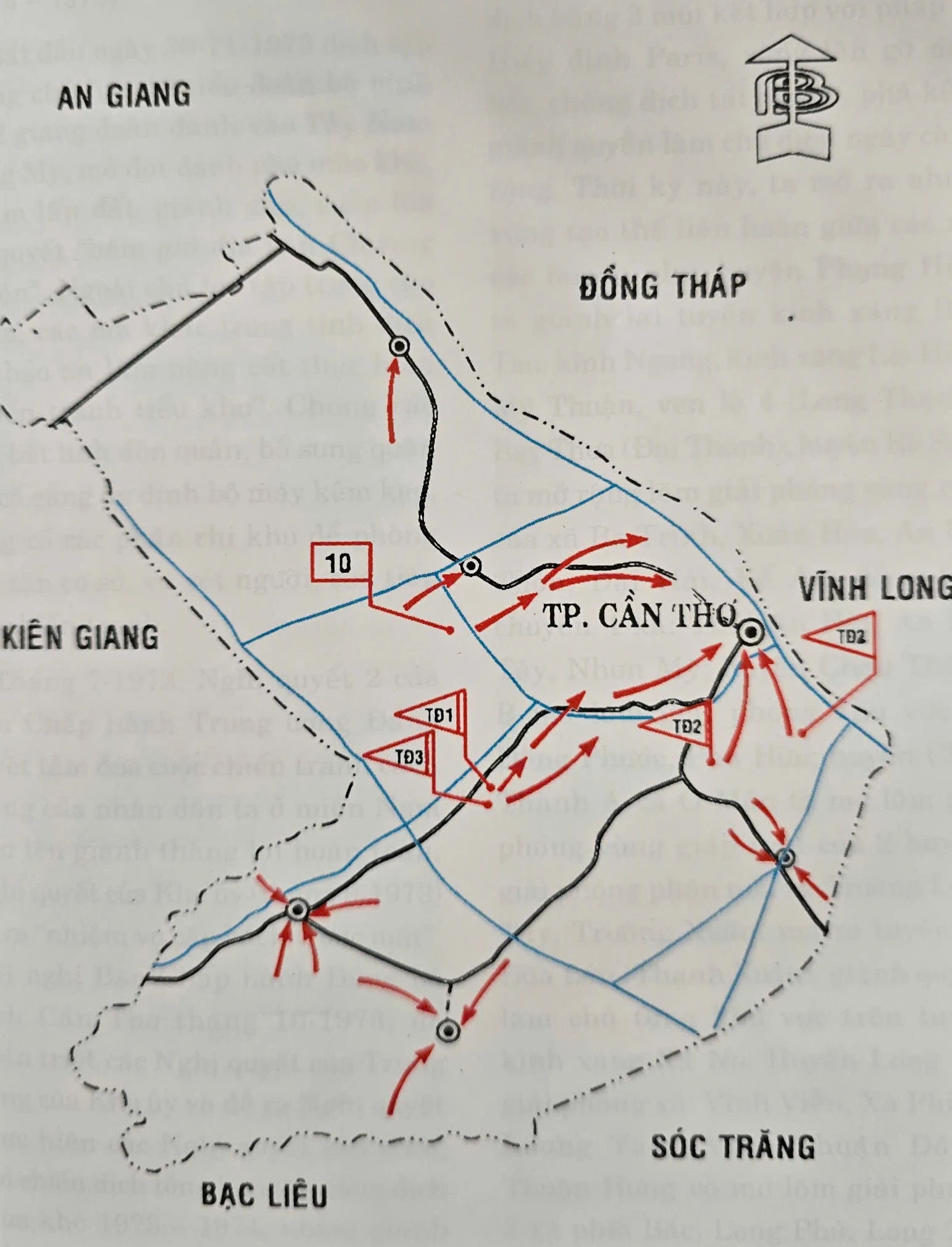
Map showing the events of the Spring 1975 General Offensive and Uprising in Can Tho province. Source: "Can Tho Gazetteer", Can Tho Provincial Party Committee, Can Tho Provincial People's Committee, 2002
At 5 PM on April 30, 1975, the Tay Do Battalion and the City Commando Unit crushed a South Vietnamese commando company at Rau Ram, opening the way to Cai Rang to coordinate with the political mobilization forces to seize an armored vehicle detachment advancing from Dau Sau onto Hoa Binh Boulevard to capture the Provincial Palace.
Chief of the Nguyen army.
At 6:30 PM, our forces threatened and seized the puppet provincial governor's residence, overwhelming and controlling the commanders of the 21st Division, creating additional strength and power for the Provincial Front Command, forcing General Mach Van Truong, commander of the puppet 21st Division, to order his subordinates to lay down their arms and surrender. Nguyen Khoa Nam, the commander, and Le Van Hung, the deputy commander of Region IV, had no escape and committed suicide at their residences at 8:30 PM on April 30, 1975.
With the support of the Regional forces, the army and people of Can Tho province completely liberated Can Tho city at 6:30 PM on April 30, 1975, eliminating the entire puppet army and government system of Phong Dinh province and the headquarters of the IV Tactical Zone, the last stronghold of the US-puppet regime in the Western region.
The districts within the province also launched attacks and uprisings, liberating themselves.
Phung Hiep District was liberated at 7:00 AM, Ke Sach District at 4:00 PM, Chau Thanh District at 5:00 PM, and O Mon District at 9:00 PM on April 30, 1975. Long My District was liberated at 8:00 AM the following day, May 1, 1975. Thot Not District was liberated at 3:00 PM on April 30, 1975; however, the two communes of Tan Loc Dong and Tan Loc Tay were not liberated until May 4, 1975.
The province's second key target was Vi Thanh town - the provincial capital of Chuong Thien. Provincial Governor Ho Ngoc Can stubbornly and fiercely counterattacked to defend it to the death. The town's armed forces, in coordination with provincial forces and the rebellious masses, surrounded and fought fiercely day and night on April 30, 1975, before finally repelling the enemy. The governor was captured, and the soldiers surrendered. Vi Thanh town was liberated at 8:00 AM on May 1, 1975.
The Spring Offensive and Uprising of 1975 by the people and army of Can Tho province achieved complete victory, liberating our beloved homeland of Can Tho and contributing to the liberation of the South and the reunification of the country.
These were milestones from half a century ago for the army and people of Can Tho. These historical events further enriched the glorious and heroic historical tradition of Can Tho.
PV
(This article is excerpted from the book "Geography of Can Tho", published by the Provincial Party Committee and People's Committee of Can Tho Province, 2002)
Source: https://baocantho.com.vn/can-tho-nhung-ngay-thang-tu-lich-su-a185360.html





























































Comment (0)