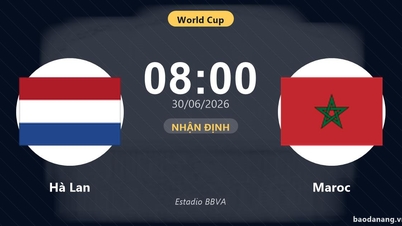
Ahead of them could be the Netherlands or Morocco, two opponents both considered stronger. But even if that journey ends in Houston, the big question remains: has Canadian soccer truly become big enough after the 2026 World Cup?
The victory wasn't beautiful, but it was big enough.
The victory against South Africa wasn't a spectacular performance. Canada controlled the game more, created more chances, but also found themselves caught in the stalemate of a physically demanding knockout match.

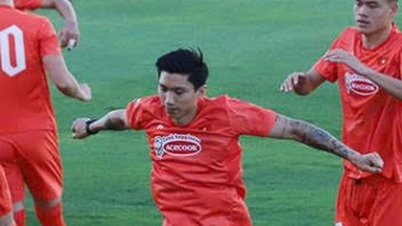
Canada (right) beat South Africa 1-0 to qualify for the World Cup Round of 16.
South Africa opted for a low defensive approach, slowing down the pace of the game, stifling spaces, and waiting for Canada to lose patience. For much of the match, the home team struggled. They attacked frequently, but lacked sharpness. They had possession, but lacked the finishing touch needed for a clinical finish. Stephen Eustaquio's set pieces were arguably the brightest spot in Canada's play.
Then, just when the match seemed destined for extra time, Eustaquio appeared. A chest control, a low volley into the far corner, and Canada walked through the door of history.
That goal was valuable not only because it put Canada through to the next round. It was valuable because it came in the kind of game that rising teams desperately need to know how to win: not beautifully, not easily, not with flair, but with enough patience and character.
The first milestones
The 2026 World Cup has become a special milestone for Canadian football. Before the tournament, Canada was still a footballing nation seeking recognition on the big stage. They had participated in the World Cup, had outstanding players, and had attracted attention in the CONCACAF region, but their mark on the world stage was still thin.

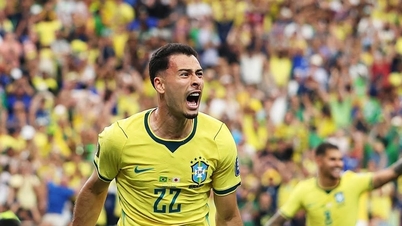
The 2026 World Cup has become a special milestone for Canadian football (left).
Yet, at the World Cup on home soil, Canada achieved almost every first: their first point in a World Cup final tournament, their first victory, their first to advance beyond the group stage, and their first knockout win.
These are no longer just a few moments. It's a series of steps. And when a footballing nation knows how to climb those steps, one has the right to say that it has grown and is growing.



Of course, growing up doesn't mean instantly becoming a powerhouse. Canada isn't at that level yet. They still have a gap to bridge compared to teams with more experience, greater squad depth, and knockout prowess honed through numerous World Cups. But Canada is no longer a team that relies solely on host status, fan support, or a few isolated stars.
They had a team that knew how to compete. They knew how to handle pressure. They knew how to win a game they absolutely had to win.
Limited to the round of 16.
The Round of 16 will be a much tougher test. If Canada faces the Netherlands, they will be up against a team with superior organization, speed of transition, and knockout experience. The Netherlands may not always be brilliant, but they often know how to control big matches with their technical ability and experience.

Canada is no longer a team that relies solely on its role as the host nation.
If they face Morocco, the challenge will be no easier. Morocco reached the semi-finals of the 2022 World Cup and are accustomed to defeating or causing problems for stronger footballing nations. They have a well-organized defense, fast counter-attacks, a very tough mentality, and are not afraid of big matches.
In other words, regardless of their opponent, Canada will enter the Round of 16 as the underdog. The win against South Africa may have given them confidence, but it can't mask the fact that the Netherlands or Morocco are of a higher caliber. A moment like Eustaquio's shot might have opened the door against South Africa, but against the Netherlands or Morocco, Canada will need more: precision in escaping pressure, maximizing set pieces, Davies in better form, and Jonathan David and the other attacking players to make a real difference.
Therefore, the realistic prediction is that Canada's journey could very well end in the round of 16. Not because they failed, but because this could be the point where their dreams clash with their current limitations.
Greater than yourself
But even if Canada stops there, the 2026 World Cup won't end as an unfinished story. Football doesn't just grow by winning championships or defeating the big teams. Some footballing nations grow by discovering for the first time that they can belong on this stage. Canada is at such a moment.

Canada is no longer a small football nation in its own World Cup story.
From a professional standpoint, they proved they could truly compete. From an organizational perspective, Canada leveraged the World Cup on home soil to bring soccer closer to the public, to the younger generation of players, and to a nation that has long considered hockey its number one sporting pride. From an emotional standpoint, this team created memories that Canadian soccer can use as a foundation for many years to come.



A footballing nation doesn't grow overnight. But sometimes, a World Cup can be a turning point.
Canada may not be strong enough to go very far. They might be stopped by the Netherlands or Morocco. But after what they have achieved, from their first point, their first win, their first knockout round, to their first knockout victory, Canada is no longer a small footballing nation in its own World Cup story.
The Round of 16 may have been the limit of Canada's professional capabilities. But the 2026 World Cup opened up something much bigger: Canada now has a foundation to believe that next time, they won't just be coming to the World Cup as hosts or apprentices.

Source: https://nld.com.vn/thang-nam-phi-canada-da-lon-tu-nhung-lan-dau-tien-196260629093334226.htm
![[Image] A look back at the capital's preparations for the century-long master plan.](https://vphoto.vietnam.vn/thumb/1200x675/vietnam/resource/IMAGE/2026/06/29/1782750453122_quy-hoach-100-nam-minh-duy-1-2118-jpg.webp)

![[Photo] General Secretary and President To Lam works with the Party Committee of the Government on the work of preventing and combating storms, floods, extreme natural disasters and climate change.](https://vphoto.vietnam.vn/thumb/1200x675/vietnam/resource/IMAGE/2026/06/29/1782729441945_a1-bnd-0385-9454-jpg.webp)
![[Photo] National Assembly Chairman Tran Thanh Man attends the Conference to announce the Master Plan for Hanoi Capital City with a 100-year vision.](https://vphoto.vietnam.vn/thumb/1200x675/vietnam/resource/IMAGE/2026/06/29/1782709639728_ndo_br_1-jpg.webp)

































































![[Image] Building an elevated road through the Ma Da forest.](https://vphoto.vietnam.vn/thumb/402x226/vietnam/resource/IMAGE/2026/06/29/1782724737750_anh-man-hinh-2026-06-29-luc-16-18-43.png)