

The long-simmering conflict between Albanians and Serbs in Kosovo escalated after the mayoral election, sparking clashes between protesters and NATO troops.
Tensions between Serbia and Kosovo erupted into violence this week after Kosovo police raided Serb-inhabited areas in the north and seized control of local government buildings.
Serbian protesters then took to the streets, attempting to storm the town hall of Zvecan on May 29, leading to clashes with Kosovo police and NATO peacekeeping forces (KFOR), resulting in dozens of Hungarian and Italian soldiers participating in the mission being injured.
Tensions have escalated to the point where Serbia has placed its army on high alert and warned it will not stand idly by if Serbs in Kosovo are attacked again, raising fears of a new conflict in Kosovo.
Kosovo is a territory with a predominantly Albanian population. The region was formerly a province of Serbia, but declared independence in 2008. However, Serbia does not recognize this independence and continues to consider it part of its territory.
Around 100 countries have recognized Kosovo's independence, including the United States, while Russia, China, and five European Union (EU) countries have sided with Serbia. This situation has perpetuated tensions and hampered stability in the Balkan region following the bloody wars of the 1990s.
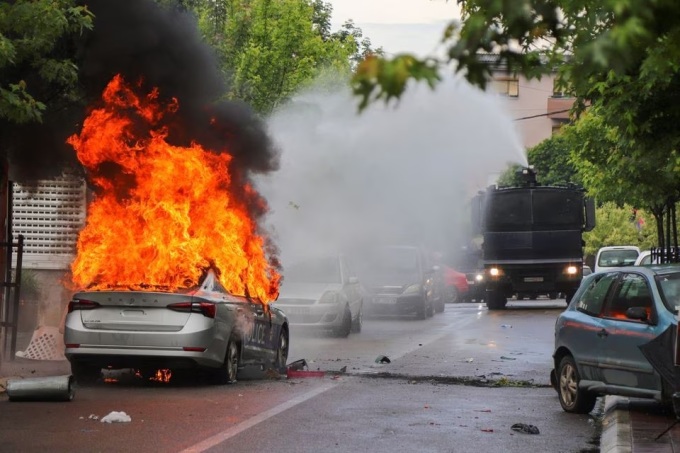
A police car bursts into flames during clashes between Serbian protesters and Kosovo police in the town of Zvecan on May 26. Photo: Reuters
The dispute over Kosovo has lasted for centuries. Serbia views the region as its religious and cultural center, with many Serbian Orthodox Christian monasteries located there. Serbian nationalists see the 1389 battle against the Ottomans in Kosovo as symbolic of their national struggle.
However, the majority of Albanians in Kosovo consider it their own country and accuse Serbia of deliberate occupation. Albanians launched an uprising in 1998 to break free from Serbian rule.
Belgrade's aggressive crackdown on this rebellion led NATO to intervene with an air campaign in 1999, forcing Serbia to withdraw its troops and cede control of Kosovo to international peacekeeping forces.
Since then, tensions between the Kosovo government and the Serbs living in the north of the country have not eased. Attempts by the Kosovo government to gain more control in the north have often met with strong resistance from the Serbs.
The town of Mitrovica in northern Kosovo has been divided in two, one part controlled by Albanians and the other by Serbs. Southern Kosovo also has smaller areas with large Serb populations. Meanwhile, central Serbia is home to tens of thousands of ethnic Kosovars who fled with the withdrawal of the Serbian army in 1999.
Numerous international efforts have been made to find common ground between the two sides, but so far without success. EU officials have mediated negotiations to normalize relations between Serbia and Kosovo. The two sides have reached several agreements in these talks, but these have rarely been strictly adhered to.
The idea of changing borders and swapping territories between Kosovo and Serbia to resolve the conflict has been rejected by many EU countries due to concerns that it could lead to a chain reaction in other disputed areas, further destabilizing the Balkan region.
Both Kosovo and Serbia are led by nationalist leaders who are unwilling to compromise.
In Kosovo, Albin Kurti, a former leader of the student protest movement, is in power and plays a key role in the EU-mediated negotiations. He is also known as a strong supporter of Kosovo's unification with Albania and opposes any compromise with Serbia.
Meanwhile, Serbia is led by populist President Aleksandar Vucic, a former information minister during the Kosovo war. This ultra-nationalist leader insists that any solution must be a lasting compromise, adding that his country will not agree to resolve the conflict without achieving something in return.
The situation escalated last month when local elections in northern Kosovo elected four new Albanian mayors to replace Serbian officials who resigned en masse in November 2022. When the newly elected Albanian mayors moved into their offices on May 26, Serbs attempted to obstruct them, forcing Kosovo riot police to use tear gas.
Three days later, Serbs staged protests in front of town halls, leading to serious clashes between them and Kosovo peacekeeping forces and local police.
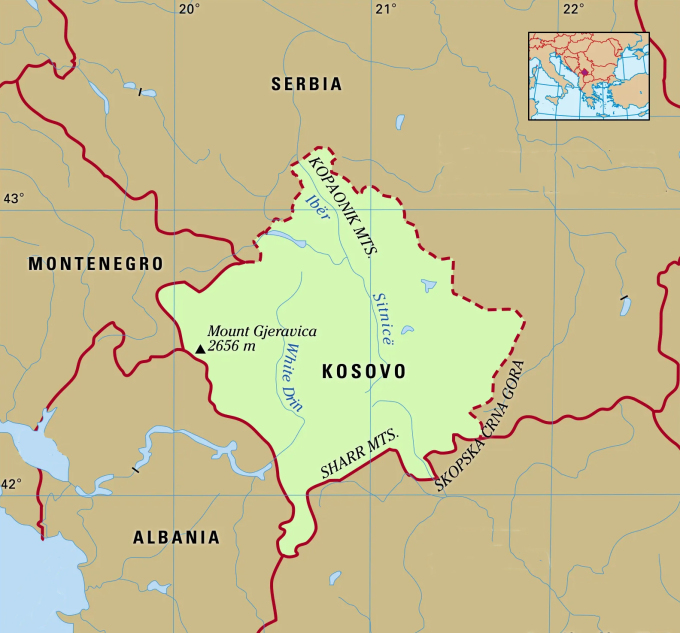
Location of the breakaway territory of Kosovo. Graphic: Britannica
International officials are hoping to accelerate negotiations and reach a solution in the coming months. Both Kosovo and Serbia must normalize relations if they want to become members of the EU. A failure to achieve a major breakthrough in the negotiations would mean prolonged instability, leaving both sides facing the risk of economic decline and ongoing conflict.
Any intervention by the Serbian military in Kosovo would mean clashes with NATO peacekeeping forces there. Belgrade controls the Serbs in Kosovo, while Kosovo cannot become a member of the United Nations or a real state without definitively resolving its dispute with Serbia, according to AP commentator Dusan Stojanovic.
Thanh Tam (According to AP )
Source link
![[Photo] National Assembly Chairman Tran Thanh Man attends the policy seminar to promote Vietnam-Türkiye cooperation.](https://vphoto.vietnam.vn/thumb/1200x675/vietnam/resource/IMAGE/2026/04/16/1776351415367_vna-potal-chu-tich-quoc-hoi-tran-thanh-man-du-toa-dam-chinh-sach-thuc-day-hop-tac-viet-nam-tho-nhi-ky-8705791-jpg.webp)


















![[Image] Bridges and roads connecting the eastern part of Ho Chi Minh City](https://vphoto.vietnam.vn/thumb/1200x675/vietnam/resource/IMAGE/2026/04/16/1776328595108_ndo_br_bh-vt5-jpg.webp)























![[Infographic] Details of the Hanoi-Quang Ninh High-Speed Railway Project](https://vphoto.vietnam.vn/thumb/402x226/vietnam/resource/IMAGE/2026/04/16/1776338188424_anh-man-hinh-2026-04-16-luc-18-16-10.png)

![[Photo] National Assembly Chairman Tran Thanh Man meets with the Speaker of the Georgian Parliament](https://vphoto.vietnam.vn/thumb/402x226/vietnam/resource/IMAGE/2026/04/16/1776338494029_anh-man-hinh-2026-04-16-luc-18-21-21.png)





















Comment (0)