


Pepper plants that are 15 years old still yield high productivity.
Previously, in Thanh Binh town, Bu Dop district, almost every household grew pepper, but now only a few remain. This is partly due to low prices and partly due to traditional farming methods that use a lot of chemical fertilizers, resulting in short-lived plants. However, those households that have managed to maintain and continue growing pepper all have relatively large areas of land. Most impressive is Mrs. Nguyen Thi Lien's household in Thanh Binh town, which still maintains a pepper garden over 15 years old with 3,000 plants. The plants are healthy, and the average yield is 2.5-3 kg per plant. Despite the large garden, only about 50 plants have died. This is a result achieved thanks to the application of sustainable organic farming and care practices.
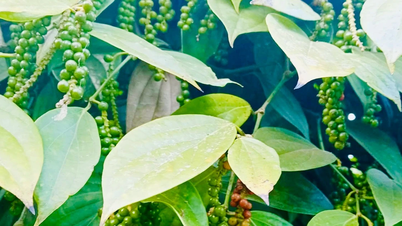
 Although Mrs. Lien's family pepper garden is 15 years old, it is still lush and produces high yields.
Ms. Lien shared: “Our family's pepper garden received guidance and care from the district's agricultural extension officers. The officers came to the garden to advise us on fertilizing the plants with manure, organic fertilizer, and microorganisms. Initially, the yield wasn't high when we started organic farming, but the plants grew well and produced a stable harvest. As a result, the peppercorns are firmer and heavier compared to traditional farming methods.”
According to Master's degree holder Do Huu Duc, a technical officer at the Agricultural Service Center of Bu Dop district: Pepper plants belong to the climbing vine family and are easily susceptible to external influences. Therefore, if chemical fertilizers are applied, the plants grow quickly but also decline quickly and lack resilience. When the root system is affected, the plant is damaged, making it more vulnerable to pests and diseases, leading to the risk of plant death and reduced yield.
According to Master's degree holder Do Huu Duc, Mrs. Lien's household is a prime example of organic pepper cultivation in the locality. Even during periods of drought, her pepper garden remained healthy and maintained stable yields. For many years, the center has often selected this pepper garden and 2-3 other models to conduct field workshops, guiding and sharing organic farming methods with pepper growers in the district.
"Growing pepper organically offers many benefits. It uses very little chemical fertilizer and pesticides, prevents soil compaction, maintains soil looseness and fertility, and provides resilience for plant growth. At the same time, farmers' health is well protected, and the product delivered to consumers is guaranteed to be safe and hygienic," Ms. Lien shared.
Create a dual income stream.
In Dong Phu district, growing pepper to develop family economy is also a choice for many farmers. However, to ensure sustainable pepper cultivation, minimize pests and diseases, and achieve high yields, combining intercropping and applying many effective solutions to increase value per unit area, the household of Mr. Duong Van Phe in Hamlet 4, Tan Lap commune is a prime example.

 With 1 hectare of pumpkins intercropped for their shoots in their pepper garden, the family of Mr. Duong Van Phe, in Hamlet 4, Tan Lap Commune, Dong Phu District, earns an average of nearly 1 million VND per day.
Having been involved with pepper cultivation since 1996, Mr. Phê has accumulated extensive experience in investing in and caring for his pepper garden of over 7,000 plants. What's special about this farmer is that he grows pepper in both Dak Nong and Binh Phuoc provinces. Because he cultivates pepper in two completely different soil and climate conditions, Mr. Phê has learned from experience and adapted the strengths of each location to his family's pepper garden.
 The pepper garden of Mr. Duong Van Phe's family (far right) is invested in and cared for organically, remaining lush and green all year round, yielding high productivity and ranking first in Tan Lap commune as well as Dong Phu district.
Mr. Phê affirmed: Pepper is a finicky crop, intolerant of waterlogging but very much in need of water. Therefore, when growing organic pepper, the abundant weeds in the garden help retain moisture in the soil. The sufficient amount of organic fertilizer provides nutrients and creates a suitable environment, helping the pepper plants thrive for a long time, producing firm, spicy, and flavorful peppers.
Mr. Phê's large pepper garden grows two varieties: Vinh Linh and Indian pepper. He practices organic farming, using organic fertilizers. All the pepper plants are grown in cages. Instead of keeping each pepper plant 3-4 meters tall, Mr. Phê keeps them 5 meters high. The plants thrive, yielding an average of over 5 kg per plant, and each hectare produces 7-9 tons of dried pepper.
 Weeds in Mr. Phe's pepper garden are controlled using a lawn mower, without affecting the root system or damaging the pepper plants.
“After many years of farming, I find Binh Phuoc to be a very fertile and good land. When pepper plants are flowering, if the temperature is suitable, they will bear many fruits; conversely, if the weather is unfavorable, with too much sun or rain, the plants will be sparse (with few seeds). The solution is to increase the application of biological and organic fertilizers to nourish the flowers. If it rains heavily, the roots will be low and waterlogged, so we have to dig them out; if it's sunny, we have to mulch the roots again,” Mr. Phe shared.
In pepper plantations, intercropping wild peanuts to attract predators and retain moisture is a common practice among many pepper farmers. However, Mr. Phe boldly decided to intercrop pumpkins to sell the shoots. After two months of planting, the pumpkins will yield a harvest lasting over three months. With retail prices ranging from 40-45 thousand VND/kg and wholesale prices at 25 thousand VND/kg, Mr. Phe's family earns nearly 1 million VND per day, equal to, or even higher than, the income from one hectare of rubber trees currently being harvested. After harvesting, the remaining parts of the pumpkin plants are cut and piled around the base of the pepper plants to retain moisture and add organic matter to the pepper garden.
In the commune, there are currently about 100 hectares of pepper plants being harvested. Mr. Duong Van Phe's pepper garden is a model example in the area. Besides the organic farming practices, I was particularly impressed by his method of intercropping pumpkins for their shoots in his pepper garden. The peppers are clean, the vegetables are also clean, and importantly, it provides a very high additional income. The pumpkin plants help increase humidity, attract predators, and when harvested, they become fertilizer for the pepper plants. This can be considered one of the effective pepper farming models for other farmers to learn from and apply. Chairman of the Farmers' Association of Tan Lap Commune, Nguyen Van Chuyen |
Despite cultivating thousands of pepper plants across two provinces hundreds of kilometers apart, Mr. Phe can monitor and manage his pepper garden anytime, anywhere, thanks to a comprehensive camera system installed throughout the farm. With his scientific and rational approach to planting and managing the pepper garden, Mr. Phe has created a model that yields many benefits from pepper cultivation.
Currently, the price of dried pepper on the market is fluctuating at a high level, exceeding 156,000 VND/kg. Among these, organically grown pepper, meeting VietGAP and GlobalGAP standards, consistently commands significantly higher prices. The rebound in pepper prices also motivates growers to invest in and care for their pepper gardens, contributing to the development of environmentally friendly agriculture, protecting health, increasing farmers' income, ensuring food safety and hygiene, and contributing to the sustainable development of the province's agricultural sector.
Source: https://baobinhphuoc.com.vn/news/4/169073/canh-tac-ho-tieu-ben-vung
















![[Infographic] Strategic Resolutions Leading Vietnam into a New Era](https://vphoto.vietnam.vn/thumb/402x226/vietnam/resource/IMAGE/2026/03/01/1772371472793_ky-nguyen-vuon-minh-1920x800-copy.jpeg)
![[Infographic] Official list of candidates for the 16th National Assembly in Cao Bang province](https://vphoto.vietnam.vn/thumb/402x226/vietnam/resource/IMAGE/2026/03/01/1772371167639_anh-bia-1-copy-qh.jpeg)
















































Comment (0)