

In Phu Tho province, allowing rice to regenerate during the current cropping season may not yield much economic benefit, but it still has environmental significance because it eliminates the need for chemical fertilizers and pesticides.
The rice plants are receding.
Mr. Luong Trung Tuyen, Director of Bao Yen Commune Agricultural Cooperative (Thanh Thuy District, Phu Tho Province), said that about 20 years ago, ratoon rice, or what people still call sprouted rice or young rice, could be harvested by anyone who took the time to cultivate it.
Back then, rice was still valuable, so people erected shelters right in the fields to prevent buffaloes and cows from destroying the regenerated rice crop. On average, each family managed about 10 acres. After that period, people gradually leased their fields during the harvest season to raise fish, while the contractors harvested the regenerated rice or raised ducks, flooding the fields to feed the fish, thus saving on feed costs. Mr. Nguyen Van Thang in Zone 3 (Bao Yen commune) raised fish and tended to the regenerated rice crop, harvesting a ton of rice each season.
In recent years, although people in Bao Yen commune rent out their rice fields for fish farming, most still harvest the regenerated rice. Currently, each area has about 10 people who go out to harvest this regenerated rice. Rice is no longer as valuable as before, so no one needs to set up tents to guard it anymore. On average, they harvest about 50kg of rice per sao (a unit of land measurement) of regenerated rice.
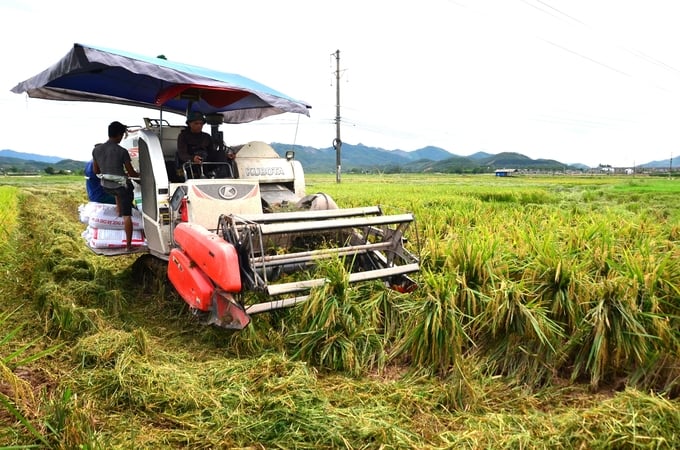
The tracks of the combine harvester crush the rice stalks, preventing them from regenerating. Photo: Duong Dinh Tuong.
When hand harvesting was still common, the area of regenerated rice in Bao Yen commune reached 150 hectares. Since the development of machine harvesting, the area has shrunk to only about 50 hectares, concentrated in the fields in front of the communal house, Trang field, and Thang field. Meanwhile, the area of one rice crop and one fish crop per year in the commune has expanded to 187 hectares (including 50 hectares of regenerated rice that is currently yielding a harvest). The remaining area is either crushed by the tracks of the combine harvesters or submerged too deeply, preventing the regenerated rice from developing.
Due to labor shortages, combine harvesters are an irresistible trend in rural areas today. Bao Yen commune recently received support from Thanh Thuy district and the agricultural sector to develop a rice cultivation model applying VietGAP standards on 30 hectares, with 140 participating households. Participating farmers received technical training, used the same Thuy Huong 308 rice variety, and reduced the use of chemical fertilizers and pesticides, yet still achieved yields of 2.6 - 2.7 quintals per sao (approximately 260-270 kg per 1000 square meters).
However, because the workforce is mostly elderly, they are hesitant to keep proper records as required by VietGAP. More importantly, VietGAP-certified rice is still sold at the same price as regular rice, and there is no buyer guaranteeing the purchase of the product. Therefore, maintaining and expanding the area of rice cultivation according to this standard remains a difficult challenge today.
Due to a severe labor shortage, a recent heavy rain and strong winds flattened many rice fields, but the farmers still tried to prop them up, waiting for the harvesting machines instead of harvesting by hand to collect the regenerated rice as they had done before. When I arrived, the harvesting machines crawled back and forth across the fields like giant crabs, extending their sharp claws into the large clumps of rice, leaving behind muddy tracks and crushed stubble.
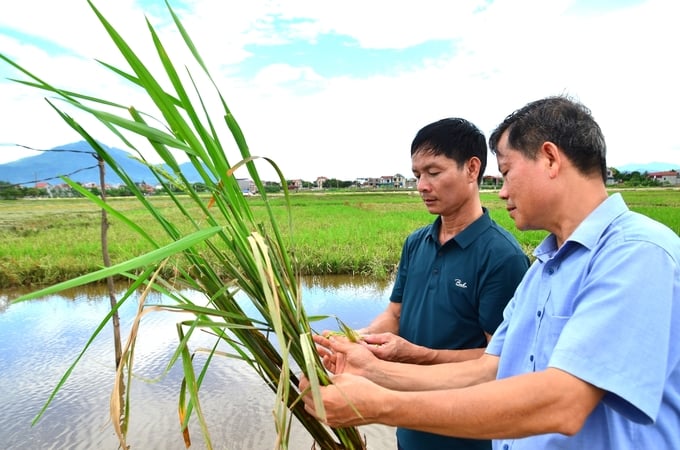
In Bao Yen, only about 50 hectares of regenerated rice fields remain. Photo: Duong Dinh Tuong.
Ms. Luong Thi Tuyen, residing in Zone 3 (Bao Yen commune), stated that areas where straw floats on the surface of the rice fields after machine harvesting indicate the absence of any regenerated rice, leaving only a gray, muddy landscape. Only scattered patches of green remain in the fields harvested by hand, indicating the presence of regenerated rice. Previously, Ms. Tuyen cultivated over one acre of rice, allowing it to regenerate after the spring harvest, yielding 6-7 quintals of rice. However, with machine harvesting in recent years, she has been able to harvest much less and has to let others tend and harvest her crops.
Previously, when the rice fields had little water, people in Bao Yen commune would apply a few kilograms of fertilizer to help the rice regenerate, but now that contractors have released fish and raised the water level to vast areas, they no longer apply fertilizer.
The fish are overflowing the field.
While ratooning rice in Bao Yen during the cropping season is no longer as economically efficient as before, it still offers environmental advantages by eliminating the need for chemical fertilizers and pesticides. Ramtooning also facilitates the sustainable development of aquaculture in the fields, promoting organic, circular, and ecological agricultural production. The commune has over 10 households that lease land for fish farming, with some leasing at least 20 acres and others as much as 40-50 acres. They rent land from local farmers from June 1st to December 1st, then hand it back for replanting, with an average payment of 100,000-120,000 VND per sao (approximately 1000 square meters).
Mr. Nguyen Van Quy leased 37 acres of rice fields jointly with his brother-in-law, Nguyen Duc Dan, to raise fish in this way. Previously, when farmers harvested by hand, allowing the rice to regenerate, the stubble never rotted, so the fish raised in the fields were very healthy and grew quickly. Now, with machine harvesting, the stubble rots, the water quality deteriorates, and oxygen levels decrease, causing the fish to suffocate and die.
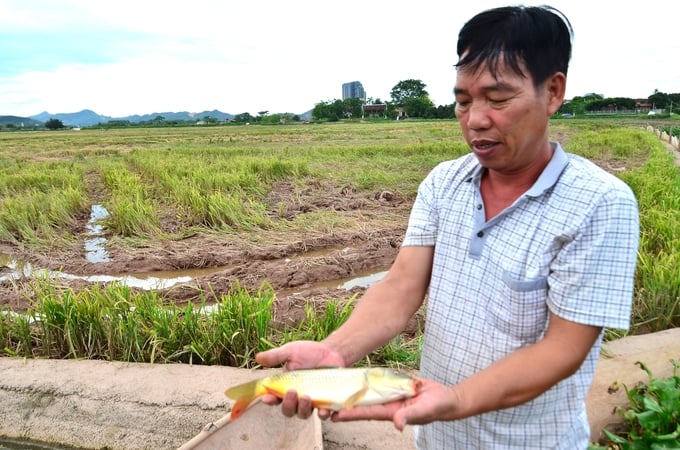
Mr. Tang Van Binh inspects the fish before releasing them into the rice field. Photo: Duong Dinh Tuong.
“In 2021, my brothers and I lost 4.5 tons of fish because there was no rain, the water in the rice paddies rotted and spread, and it happened during days when the power was out, preventing us from running the aeration pumps. In 2023, we lost over 2 tons of fish in the same way. Previously, we harvested 16-17 tons of fish each year, but now some years we only get less than half that amount.”
"The fish raised in the rice paddies feed on insects, snails, shrimp, corn, and bran, so their meat is very delicious. In the past, they sold for a good price, but now they sell like 'dog fish,' at a very low price. The market now demands large fish without regard for quality, so those of us who raise them in the rice paddies are at a disadvantage. In the past, carp weighing 800 grams were considered Grade A, selling for 70,000 VND/kg, but now they need to be 1.6 kg to be Grade A, and we only sell them for 45,000 VND/kg," Mr. Quy lamented.
Mr. Tang Van Binh, residing in Zone 5 (Bao Yen commune), has been raising fish jointly with two other households in the fields for 20 years. After each spring harvest, they rent 70 acres of rice paddies to release the fish fry. One rice crop followed by one fish crop is the most effective way to utilize the low-lying, flooded areas, clearing the fields, reducing weeds, making planting and harvesting easier for the farmers, and generating profit for the landowners.
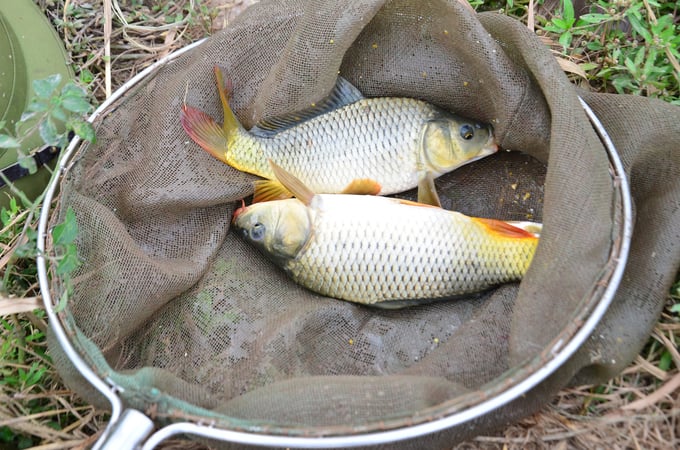
Fish are being prepared to be released into the rice field. Photo: Duong Dinh Tuong.
“Previously, before we started raising fish during the cropping season, the fields were very overgrown. To plant rice, farmers had to hire people to weed and plow, which was very expensive. Now that we've finished raising fish and returned the land, the farmers just need to plant rice; they don't have to weed or plow anymore. The contract is renewed every 5 years at a price of 100,000 - 120,000 VND per sao (approximately 1000 square meters) per cropping season, so both sides benefit,” Mr. Binh explained.
Initially, when the fish were small, they raised them in ditches, feeding them bran mixed with corn and grass. They waited until the farmers finished harvesting the spring rice crop, when the fish reached a weight of about 20 fish per kilogram, before releasing them into the fields. They released various types of fish such as grass carp, common carp, silver carp, tilapia, snakehead, and catfish to take advantage of the strengths of each species. Grass carp eat grass, common carp dig in the mud and eat worms, silver carp eat plankton and waste from other fish, and snakehead fish eat shrimp and small fish...
In early summer, 5-7 tons of fish fry are released into the fields. If all goes well, by late autumn, they can harvest over 30 tons of marketable fish. Despite the large area and the joint efforts of three families, only Mr. Binh is regularly present in the fields 24/7; the rest are only called upon when fishing is underway.
Besides raising fish, they also raise 10,000 ducks annually, including 5,000 high-egg-laying ducks and 5,000 meat ducks, so that the ducks can utilize the scattered rice grains in the fields, and the shrimp and snails in the water. The quality of eggs and meat from these free-range ducks is significantly better than that of industrially raised ducks; however, sadly, the selling price remains the same as conventional products.
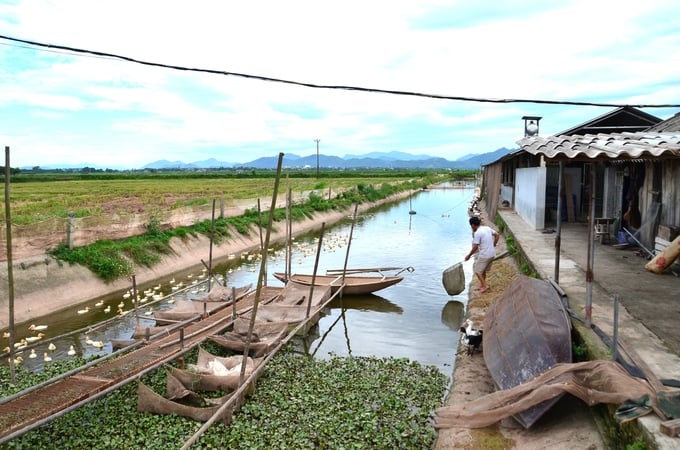
The combined fish and duck farming area in the fields of Mr. Tang Van Binh. Photo: Duong Dinh Tuong.
Previously, when farmers harvested by hand and allowed the rice to regenerate, the water environment was good, and fish farming was usually successful. However, in recent years, machine harvesting has destroyed the rice stubble, and out of the 70 acres of rented land, only about 10 acres still have regenerated rice, resulting in a decrease in natural food sources and poor water quality. The total income from fish and ducks per season for each family in the contracting group is 50-70 million VND, but in some seasons, when the water is foul and the fish die en masse, they break even or lose money on the farming costs.
Mr. Phan Van Dao, Head of the Crop Production and Plant Protection Sub-Department of Phu Tho province, affirmed that the agricultural sector in Phu Tho province is encouraging production according to the formula of one spring rice crop, one ratoon rice crop plus fish farming in the autumn crop because it has the lowest investment but the highest efficiency.
However, this method should only be applied in low-lying fields where combine harvesters have difficulty reaching the land and manual harvesting is necessary. It is not recommended for high-lying fields where combine harvesters can reach the land and which are included in the seasonal planting plan. Each year, the province has over 2,000 hectares of regenerated rice in the seasonal crop, yielding 4,300 tons of paddy rice, concentrated mainly in the districts of Thanh Thuy, Phu Ninh, and Cam Khe…
Source: https://nongsanviet.nongnghiep.vn/canh-tranh-lua--ca-tren-nhung-canh-dong-luoi-d388264.html
![[Photo] First session of the 14th Congress of the Vietnam Trade Union](https://vphoto.vietnam.vn/thumb/1200x675/vietnam/resource/IMAGE/2026/06/03/1780465947883_ndo_br_img-3852-jpg.webp)
![[Photo] General Secretary and President To Lam presides over a meeting with the Central Organizing Committee.](https://vphoto.vietnam.vn/thumb/1200x675/vietnam/resource/IMAGE/2026/06/03/1780482764658_a1-bnd-4741-3342-jpg.webp)
![[Photo] Secretary of the National Assembly Party Committee, Chairman of the National Assembly presides over the meeting of the Standing Committee and Executive Committee of the National Assembly Party Committee.](https://vphoto.vietnam.vn/thumb/1200x675/vietnam/resource/IMAGE/2026/06/03/1780480353201_ndo_br_bnd-2585-jpg.webp)



















![The Essence of Viet Bac Villages: [Part 3] The Precious Fragrance of Nghinh Tuong](https://vphoto.vietnam.vn/thumb/402x226/vietnam/resource/IMAGE/2026/05/29/1780020600366_5237-tinh-tuy-ban-lang-viet-bac-bai-3-chuyen-o-nghinh-tuong-050626_700.jpeg)
![The Quintessence of Northern Vietnam's Villages: [Part 2] The Famous Cassava Noodles of Kunming](https://vphoto.vietnam.vn/thumb/402x226/vietnam/resource/IMAGE/2026/05/28/1779937455892_3929-3144-mien-dong-15-nongnghiep-023138.jpeg)
![The Essence of the Village: [Part 1] Wine on the mountain, tea in the clouds - Bang Phuc](https://vphoto.vietnam.vn/thumb/402x226/vietnam/resource/IMAGE/2026/05/27/1779841729178_3821-1jpg-nongnghiep-103814.jpeg)
























![[Video] Sunset at Lap An Lagoon – Where the sun sets over the fishing nets](https://vphoto.vietnam.vn/thumb/1200x675/vietnam/resource/IMAGE/2026/05/31/1780192137701_beach-landscape-sea-water-nature-grass-745871-pxhere-com.jpeg)























Comment (0)