

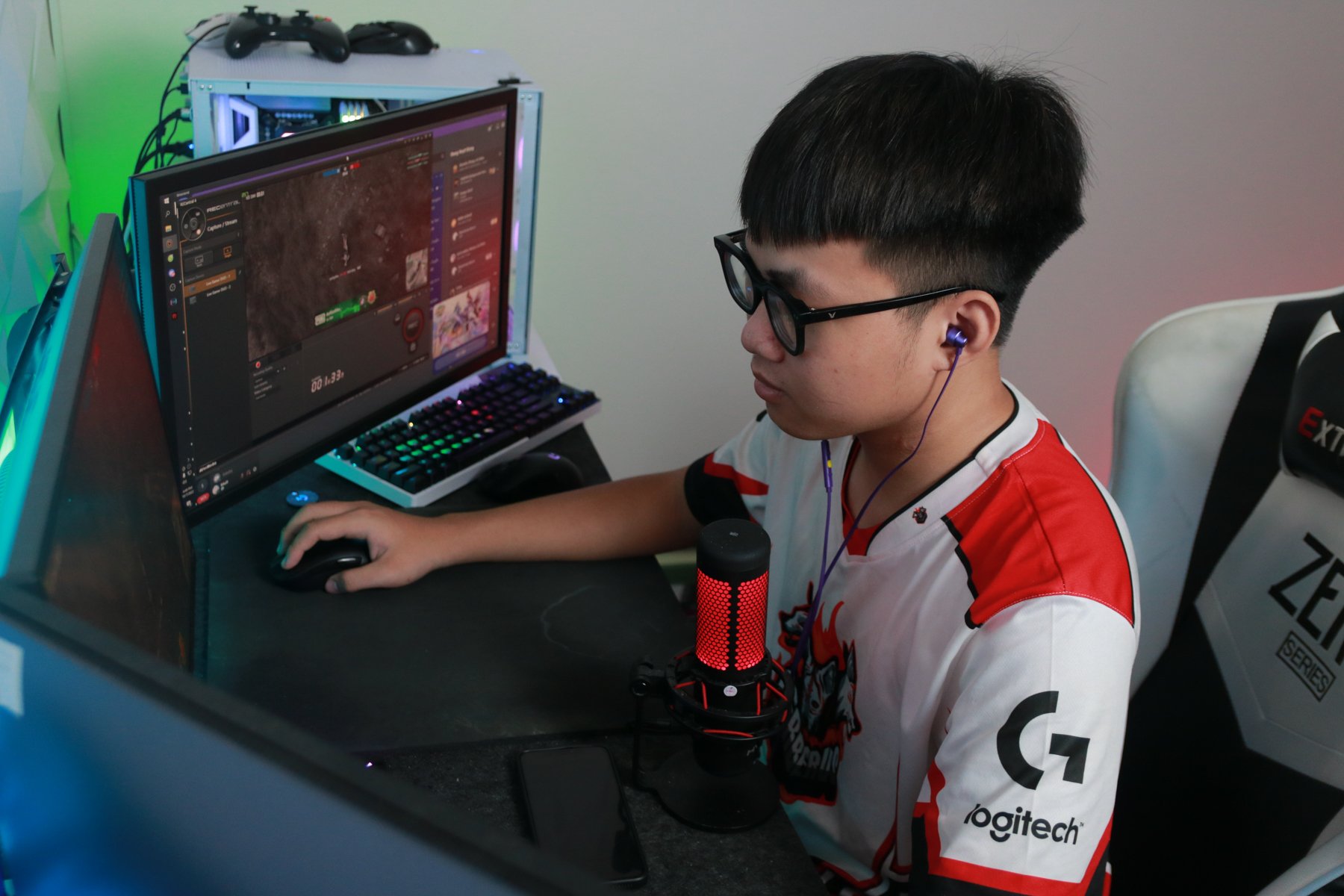
Many young esports players have proven that it is possible to achieve financial stability and fame through professional gaming.
Remove the "lens" of the previous generation.
TA, a student at the University of Social Sciences and Humanities in Ho Chi Minh City and a big fan of the girl group BlackPink, recently spent over 5 million VND to attend a music event organized by the group in Hanoi, with nearly 2 million VND of that going towards tickets. "This decision shocked my parents; they scolded me for being wasteful, even though it was money I had saved up myself. My mother said it would be better to use that money to buy more books and clothes. But for me, this was a once-in-a-lifetime opportunity I couldn't miss, and those other things can always be bought," the student confided.
Meanwhile, a female student residing in District 1, who recently graduated from Bui Thi Xuan High School (Ho Chi Minh City), shared that her parents "toughly" control her life, and the inability to find common ground when sharing her interests and passions with them has become a "common occurrence." "When a problem arises, my mother talks to me a lot. Sometimes gently, sometimes harshly, sometimes physically, and even during cold wars, as long as I do what she wants," the student explained.
"Initially, I felt very guilty. But later, I really wanted my mother to listen to and respect my decisions, instead of relentlessly nagging and criticizing me to make me follow her advice. Gradually, whenever I had to make a decision or a problem arose, I no longer shared it with my mother but went through it alone," this person added.
Such conflicts are not uncommon. However, parents should understand that in the digital age, the "times" of parenting have changed, according to Ms. Pham Nguyen Ngoc Nguyen, co-founder of Care Cube. Specifically, Ms. Nguyen believes that children today enjoy playing games, following idols, and viewing these as sources of emotional support, not only bringing joy but also providing motivation to overcome academic pressure, exams, and life's difficulties.

Master's degree holders Nguyen Minh Thanh and Pham Nguyen Ngoc Nguyen (second and third from the left) at an event sharing parenting advice.
"Technology is the breath, the 'language' of young people that parents need to engage with if they want to be on the same 'wavelength' as their children. Let's shed the 'lens' of the previous generation, take the time to understand the games their children play, the idols they admire, with all respect and love, because this will be the 'bridge' for parents to have dialogues and become friends with their children," Ms. Nguyen shared at the "Learning to Be Proactive Parents" seminar held in August in Ho Chi Minh City.
However, psychologists also advise that alongside being a friend to their children, parents need to set rules to build parental authority. Parents also need to empower their children with guided autonomy in a way that is appropriate to the context. "Parenting should be based on two axes: the vertical axis representing boundaries and discipline, and the horizontal axis representing acceptance and love," Ms. Nguyen suggested.
According to Master's student Nguyen Minh Thanh, a PhD candidate at the Catholic University of Louvain (Belgium), children today are very different from those of the past. They are now more open to sharing their views on human rights and the rights of minority groups with less influence in society. "Given this different context, the journey of raising children will also be different," Thanh concluded.
According to Mr. Thanh, generational conflict between children and parents mainly stems from one side violating the upper or lower boundaries of the other. Therefore, both sides need to determine what their "acceptable" boundaries are and find solutions that allow for mutual gain and loss, instead of being overly extreme or prohibitive. "However, the dialogue needs to be age-appropriate for the child," the psychologist noted.
Ways to accompany your child.
Speaking with a reporter from Thanh Nien Newspaper, Ms. Pham Tran Kim Chi, a positive psychology practitioner and founder of the "My Child" app, explained that accompanying children means putting yourself in their shoes to understand their thoughts, desires, and standards. This allows parents to correctly understand their children's behavior and reactions, and to communicate with and guide them appropriately.

Ms. Pham Tran Kim Chi, a positive psychology practitioner and founder of the "My Child" app.
"Parents need to accompany their children like older friends, not like 'peers' who only listen and understand without setting expectations or responsibilities. This older friend knows how to support their child's growth and maturity, and most importantly, they should slow down, not use their own generational thinking, and not use adult mindsets to judge right and wrong, good and bad, for young children," Ms. Chi emphasized.
Accordingly, a 2019 study of 361 New Zealand teenagers aged 11 to 13 indicated that factors strongly influencing young people's happiness are joy, feeling safe, and feeling useful. Many other studies have reached similar conclusions, stating that children are happier when they are confident and capable, and this happiness is not related to gratitude or living a planned life as parents often teach them .
"Therefore, to be happy and joyful, teenagers need things that are different from their parents' way of thinking. If parents judge, 'Why are you playing that game? It's just for fun, what long-term benefits does it bring?' or, 'It's wasteful, this is a one-time game, what's the point?', then it means parents are using adult wisdom to judge their children's thinking. And of course, it won't be accepted by the children," Ms. Chi said.
However, this does not mean that parents have to respect every wish and preference of their children. For example, if parents have to understand and accept their children buying expensive things or attending expensive idol concerts, "that would be too difficult for parents."

According to experts, avoiding judgment, breaking down prejudices, and setting boundaries are key principles to remember for children to grow up happily.
"Parents don't need to agree with and support every thought their children have. Parents don't need to understand or be passionate about a game or an idol like their child. If it's an area parents aren't interested in, that's perfectly normal. Children don't need their parents to like the same things as them. What children need is for their parents not to judge them. Only then can we create a supportive relationship," the psychologist suggested.
"It's easy to understand that choosing to be a friend without interfering is easy. Choosing to impose your will on your child is also easy. But wanting to be a supportive parent is difficult. This needs to be learned," Ms. Chi added.
The story of idol worship
To help parents better understand how to support their children, Ms. Chi gave an example of a situation where a child wants to buy a very expensive item from their idol. Accordingly, in step 1, parents need to put themselves in their child's shoes to understand that this item is a source of joy and happiness for the child. "An idol's item is not just a product; it represents the child's story and emotions," Ms. Chi said.
Having understood this, in step 2, parents need to ask themselves what they want to teach their children through this story, rather than judging. If the lesson is to teach children how to save money, then try giving them small, fixed amounts of money weekly or monthly. After saving, how they spend it will be up to them, and they may realize that saving money to buy something else would be more meaningful.
If the lesson is to teach children self-acceptance and that everyone is special, parents can try searching for childhood photos and mementos of both of them to create a commemorative album or recreate those moments. Or, set goals or challenges together and find ways to achieve them, Chi suggested.
"Most parents can set goals and encourage their children. Most children will also learn to acknowledge themselves. What most parents fail to do is stop judging, 'Why are you a fan of that person? It's not worth it,' and what most children can't agree with is, 'Why isn't it worth it? It's very worthwhile to call them an idol.'"
"In a child's experience, whether someone is worthy of admiration or not is not something parents should judge. The child's experience may change, and later they might look back and think they shouldn't have admired them so much. It's a process of cognitive transition, a part of growing up. And parents can't force that to happen prematurely," the psychologist advised.
Source link
















































































































Comment (0)