|
AI chatbots can offer unreliable advice when shopping. Photo: Reuters . |
In the age of the AI chatbot boom, scammers have also found their own way to leverage this immense power: using ChatGPT for marketing.
According to The Guardian , the fraud detection service Ask Silver discovered that OpenAI's chatbot suggested fake retail websites, designed to collect payment information from unsuspecting shoppers.
Scam websites mimic real stores and use URLs that look like the official website, making them difficult to detect without careful verification.
Specifically, fraudsters intentionally target brands that have recently closed or been acquired, creating a gap between consumer demand and their official online presence.
Ask Silver expert Anna Jones cites Russell & Bromley, the British shoe retailer that went bankrupt in January, as a case study.
After Next acquired the brand, and with no official website remaining, scammers created an "identical" copy and optimized it to appear in ChatGPT's search results. Customers who inquired with the chatbot about Russell & Bromley products were redirected directly to the fake website.
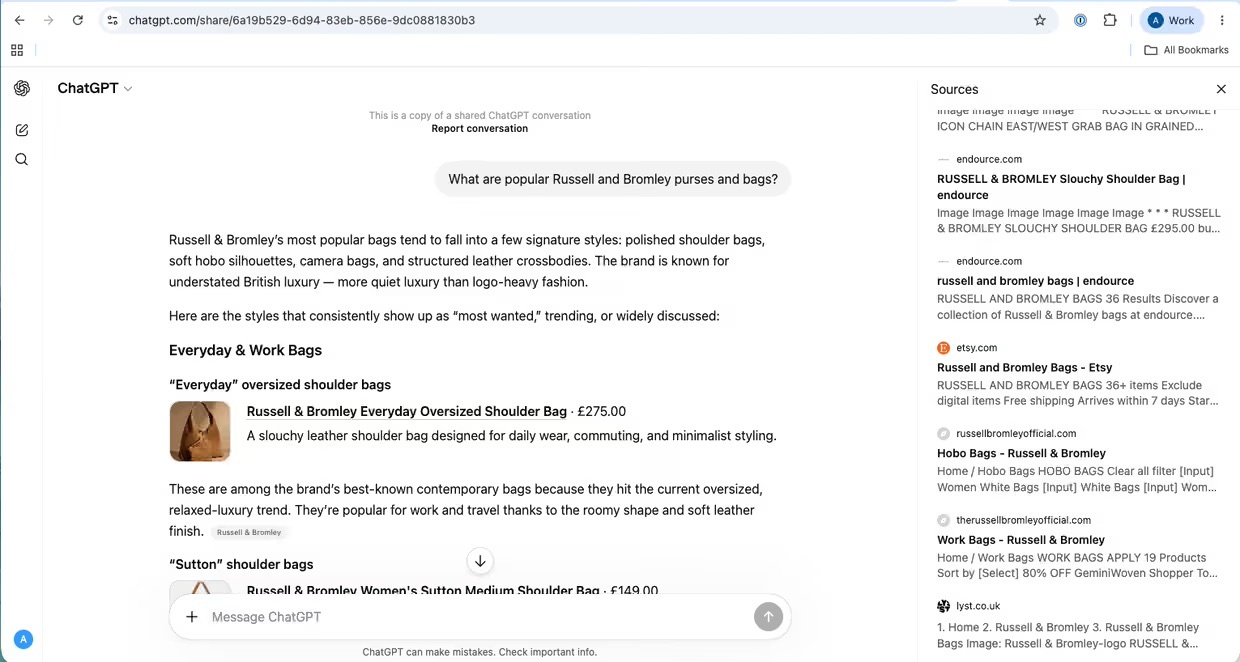 |
One of the sources of ChatGPT results is a fake Russell & Bromley website. Photo: The Guardian. |
According to Jones, a plausible explanation for this phenomenon is that malicious actors are embedding ChatGPT's training data with content designed to promote phishing websites, a technique known as "data poisoning."
Currently, OpenAI updates search results for shopping queries related to Russell & Bromley and now displays a warning: "Some websites advertising Russell & Bromley products with 80% off appear suspicious and may not be official retailers. Recent reports indicate the appearance of fake Russell & Bromley stores in AI-powered search results."
Previous studies have shown that ChatGPT has struggled to provide consistent and reliable product recommendations, but redirecting users to fraudulent websites is a major failure. This problem is likely to worsen as AI becomes a more significant part of the shopping process.
Speaking to The Guardian , Louise Baxter of the UK's National Trading Standards Agency said that scammers adapt very quickly to new technologies. People shouldn't trust a website just because it's suggested by AI.
Source: https://znews.vn/chatgpt-huong-dan-mua-hang-tren-website-lua-dao-post1658692.html
![[Image] Schools organize meetings and introduce teaching models to students admitted to grade 10.](https://vphoto.vietnam.vn/thumb/1200x675/vietnam/resource/IMAGE/2026/06/25/1782368077271_ndo_br_z7970052192242-1ec8daeb77a6eed1a4e9f58c564ddd3e-jpg.webp)
![[Image] Ho Chi Minh City: Ma Lang area, Chicken-Rice Market about to change its appearance](https://vphoto.vietnam.vn/thumb/1200x675/vietnam/resource/IMAGE/2026/06/25/1782377698627_ndo_br_m1-jpg.webp)

![[Photo] General Secretary and President To Lam receives Palestinian Ambassador Saadi Salama](https://vphoto.vietnam.vn/thumb/1200x675/vietnam/resource/IMAGE/2026/06/25/1782365384740_a1-bnd-9423-8322-jpg.webp)