 |
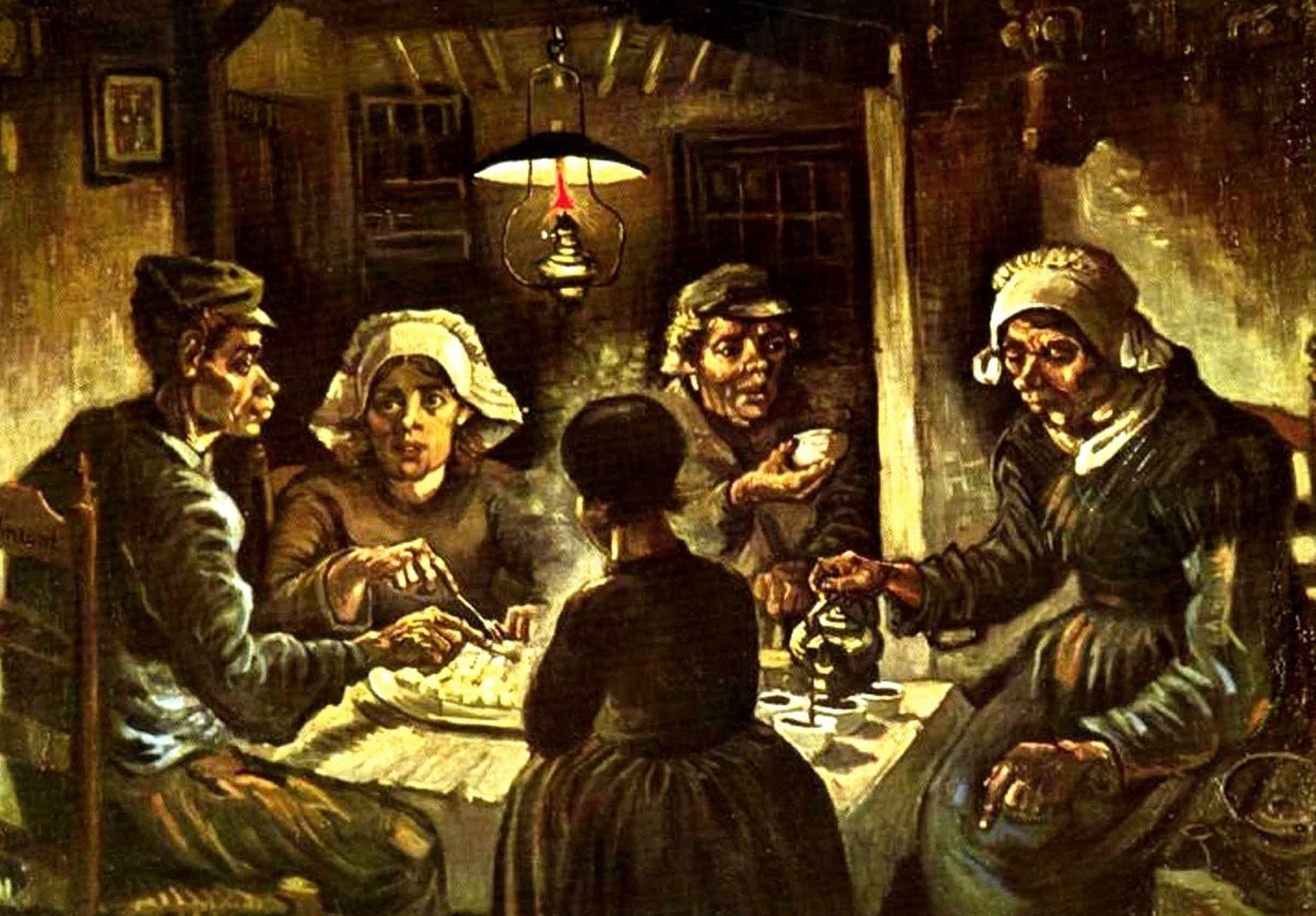
Van Gogh's painting *The Potato Eaters *. Photo: Wikipedia |
“Of all his works, he ultimately considered the painting of peasants eating potatoes, painted in Nuenen, to be his best work.” Van Gogh wrote these words in 1887, two years after creating the painting.
These words may come as a surprise from someone who was never satisfied, but importantly, they help us identify The Potato Eaters as a true milestone in his artistic career.
The monotony is transformed.
One evening in Nuenen, Vincent arrived at the De Groote family's cottage. It was dinnertime, and it was so dark that only the faces of the family were faintly visible in the dim light of the oil lamp. On the table, there was only a plate of potatoes and a few cups of coffee, prepared by the hostess.



The impression was immediate, but the creative process was lengthy. The artist had to add a second light source for better visibility. This light source was hidden behind the little girl, who was facing away from the viewer; the flickering light of the lamp was insufficient to highlight the details of the house.
Although contemporaries were somewhat reserved about the work's awkwardness and stiffness, all were shaken by the dramatic impact emanating from this strikingly dull scene.
Searching for the everyday
Five members of a farming family gather around a table; a woman pours coffee for the man on the left. Their faces stand out with a rough, almost caricatured quality. Vincent had drawn many sketches before creating the painting.
In particular, the movement of the hands reveals the artist's attention to everyday gestures and his intense desire to remain grounded in reality. The central axis is created by the figure of the little girl with her back to the viewer, and above her, a swaying oil lamp casts a dim, faint light upon the impoverished interior.
As a Dutchman , Van Gogh was a descendant of the 17th-century Dutch masters – led by Rembrandt – who knew how to imbue interior lighting with all the secret nuances of intimacy.
It is the depth of the shadows that gives thickness to the objects of everyday life. Specifically, in this painting, the arrangement of accents of light plays a key role in ensuring the vibrancy of the colors, which are handled with restraint. Earthy red and ochre are the dominant tones of the work, with almost exclusively yellow, often mixed with blue, used to dispel the darkness.



Notable details
The head of the peasant woman on the right corresponds perfectly to what Van Gogh sought in his many studies: “rough and flat faces, low foreheads and thick lips.” Such expressive power can only be found in the works of Hals and Rubens.
Source: https://znews.vn/kiet-tac-dau-tien-cua-van-gogh-post1663180.html
![[Photo] General Secretary and President To Lam receives Palestinian Ambassador Saadi Salama](https://vphoto.vietnam.vn/thumb/1200x675/vietnam/resource/IMAGE/2026/06/25/1782365384740_a1-bnd-9423-8322-jpg.webp)



![[Image] Ho Chi Minh City: Ma Lang area, Chicken-Rice Market about to change its appearance](https://vphoto.vietnam.vn/thumb/1200x675/vietnam/resource/IMAGE/2026/06/25/1782377698627_ndo_br_m1-jpg.webp)
![[Image] Schools organize meetings and introduce teaching models to students admitted to grade 10.](https://vphoto.vietnam.vn/thumb/1200x675/vietnam/resource/IMAGE/2026/06/25/1782368077271_ndo_br_z7970052192242-1ec8daeb77a6eed1a4e9f58c564ddd3e-jpg.webp)