

In April, many economic indicators such as foreign direct investment attraction, business registrations, total retail sales, freight transport, and industrial production showed improvement compared to previous months, creating momentum for the following months.
However, according to the socio-economic report for April 2023 and the first four months of the year, recently published by the General Statistics Office, the economy continues to face many difficulties, requiring the determination of both the political system and the business community to achieve the targets for the whole year of 2024.
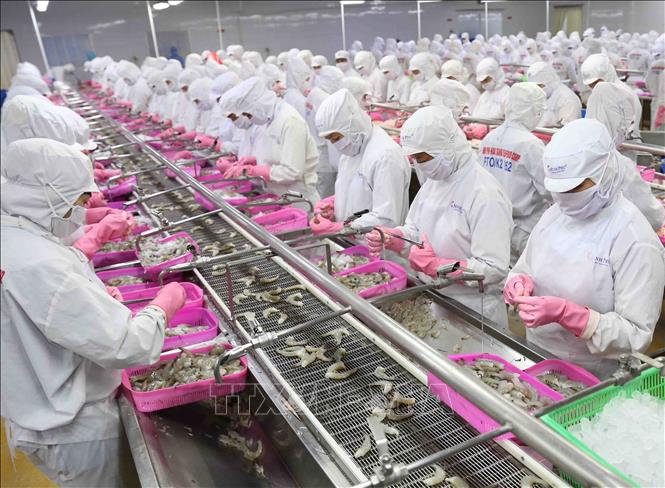 |
| Processing line for export shrimp products at Minh Phu Seafood Group's factory in Ca Mau province. Photo: Vu Sinh/TTXVN |
The recovery process continues, but it is still slow.
According to the General Statistics Office: Amidst global difficulties and challenges, Vietnam's socio-economic situation in April continued to show quite positive developments, contributing to improving the overall results of the first four months of the year and creating momentum for the following months.
Specifically, the macroeconomic situation remains stable, inflation is under control, major balances are ensured, and the consumer price index (CPI) in April 2024 increased by 0.07% compared to the previous month. Compared to December 2023, the CPI in April increased by 1.19%, and compared to the same period last year, it increased by 4.4%. On average for the first four months of the year, the CPI increased by 3.93% compared to the same period last year; core inflation increased by 2.81%.
Furthermore, the monetary market remained fundamentally stable; lending interest rates decreased; exchange rates stabilized in line with market developments; and the banking system was ensured. Total state budget revenue in April 2024 was estimated at VND 175.6 trillion; cumulative total state budget revenue for the first four months of 2024 was estimated at VND 733.4 trillion, equivalent to 43.1% of the annual forecast and an increase of 10.1% compared to the same period last year.
Also in April, total merchandise exports and imports were estimated at US$61.2 billion, a decrease of 5.2% compared to the previous month and an increase of 15% compared to the same period last year. For the first four months of the year, total merchandise exports and imports reached US$238.88 billion, an increase of 15.2% compared to the same period last year; of which, exports increased by 15%; and imports increased by 15.4%. The trade balance showed a surplus of US$8.4 billion.
Foreign direct investment (FDI) implemented in Vietnam in the past four months is estimated at US$6.28 billion, an increase of 7.4% compared to the same period last year. This is the highest FDI implemented in the first four months of the year in the past five years.
Also in April 2024, the whole country saw the registration of 15,300 new businesses with a registered capital of 175.8 trillion VND. This figure represents a decrease of 4.1% in the number of businesses but an increase of 13.7% in registered capital compared to the same period in 2023. However, compared to March 2024, the number of new businesses in April 2024 still increased by 8.4%.
Economist and former Director General of the General Statistics Office, Nguyen Bich Lam, commented: The economy in April and the first four months of 2024 continued its recovery process, but it was still slow. The Industrial Production Index (IPP) in April 2024 increased by only 0.8% compared to the previous month. Compared to the same period last year, the industrial sector recovered slowly, with some key industries experiencing low growth or decline.
Furthermore, the agricultural sector, which has been the backbone of the economy in recent years, is facing drought and saltwater intrusion, affecting food production; livestock farming has declined. Although the weather has been favorable, fisheries exploitation has increased only slightly.
Furthermore, goods exports in April decreased compared to the previous month. While export turnover for the first four months of 2024 still increased, the growth rate was lower than in the first quarter of 2024. The number of businesses withdrawing from the market remains higher than the number of businesses entering the market, reflecting the continued difficulties faced by the business sector.
The global economy is facing instability, with forecasts predicting slower US economic growth in the first quarter of 2024, significantly lower than previous forecasts and 1.8 percentage points lower than the GDP growth rate of the fourth quarter of 2023. US inflation accelerated again in March 2024, the US dollar appreciated, consumer spending decreased, and the Federal Reserve (Fed) decided to keep interest rates unchanged for the sixth consecutive time, indicating that the Fed will postpone lowering interest rates. Along with this, the exchange rate between the VND and USD is increasing, creating pressure for imported inflation and hindering the growth of our country's economy.
Coordinate solutions seamlessly.
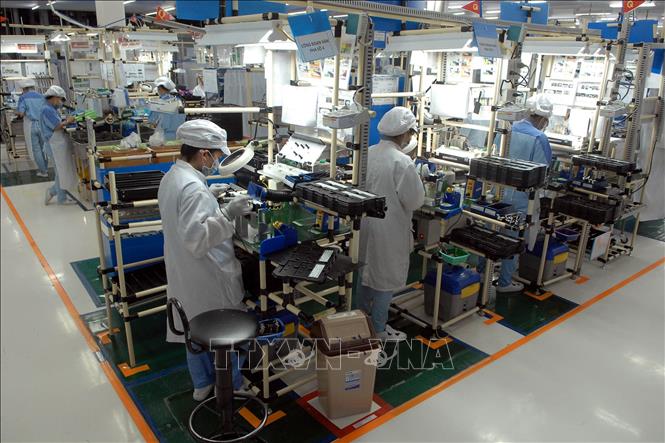 |
| Production line for electronic devices and lighting equipment in cars and motorcycles at Stanley Electric Vietnam Co., Ltd. (a Japanese-invested company) in Hanoi. Photo: Danh Lam/TTXVN |
Amidst ongoing domestic and global economic challenges and uncertainties, coupled with extreme weather events, the agricultural, forestry, and fisheries sectors are facing difficulties, leading to slower growth. To help Vietnam overcome these challenges and achieve a faster and more sustainable recovery, economic experts propose that the Government and local authorities focus on boosting domestic consumer demand, implementing promotional programs; offering preferential credit programs for consumption; improving service quality; and reducing or stabilizing transportation costs, especially airfares, to encourage domestic tourism and attract international tourists.
To overcome difficulties and unlock capital to create liquidity for businesses, it is necessary to continue implementing fiscal and monetary policies in a synchronized and consistent manner. At the same time, tax refunds for businesses should be expedited; credit policies should be tailored to the characteristics of production and business and the needs of each industry and sector; and preferential credit packages should be implemented for key industries, sectors, and businesses involved in production and export in the economy.
In addition, relevant agencies implement policies to exempt, reduce, and extend tax and land rent payments; and exempt or reduce various fees and charges to lower costs and enhance the competitiveness of businesses. In particular, they ensure a sufficient supply of electricity and fuel for production and business; and establish regulations requiring the electricity sector to compensate businesses when power outages cause damage to production.
The government is also urgently finalizing legal documents on import and export; implementing fiscal and monetary policies to support businesses in addressing the exchange rate issue between VND and USD, increasing supply, reducing costs, and enhancing the competitiveness of Vietnamese goods.
On the other hand, it is necessary to strengthen market information and trade promotion; diversify export and import markets, especially import markets, to minimize the impact of shocks from these markets. In addition, support businesses in effectively utilizing opportunities and commitments from trade agreements to boost exports; strengthen communication about rules of origin and the issuance of certificates of origin; and focus on building a reputable image for Vietnamese export businesses.
Along with government solutions, export businesses are grasping market signals, maintaining traditional markets, proactively seeking orders, and opening up new markets.
Deputy Minister of Planning and Investment Tran Quoc Phuong stated that ministries and localities also need to continue to accelerate the effective disbursement of public investment capital. In particular, they should complete the detailed allocation of the 2024 state budget investment plan in accordance with regulations, ensuring a focus on key areas, avoiding a scattered approach, and aligning with implementation capacity.
"Focus investment on large-scale projects, eliminate scattered investments, minimize project implementation time, expedite the commissioning of projects, and improve the efficiency of public investment," Deputy Minister Tran Quoc Phuong emphasized.
To create a breakthrough in attracting and disbursing FDI capital in 2024, the Government has solutions to strengthen the competitiveness of the investment and business environment, develop infrastructure, and focus on improving the capacity of transportation infrastructure, industrial infrastructure, technology, information and logistics in a synchronized manner.
Simultaneously, it is necessary to improve the institutional framework and legal environment, ensuring clarity, transparency, and clarity in procedures related to land use rights and fire prevention and control. Furthermore, mechanisms should be in place to encourage FDI projects that utilize environmentally friendly technologies, produce and use renewable energy, and train skilled human resources with competitive salaries in the region and globally.
To control inflation according to targets, the Government and local authorities ensure adequate supply at stable prices for food items; ensure national energy security, adjust electricity prices in accordance with the domestic economic situation, and publicly disclose electricity production costs.
In the second quarter and the remaining months of 2024, facing immense pressure to proactively address challenges in price management, Deputy Prime Minister Le Minh Khai has requested ministries, sectors, and localities to focus on implementing several key solutions. First, it is necessary to closely monitor domestic and international economic developments, and to make detailed forecasts of factors impacting the general price level, especially for essential goods and services. This will allow for the proactive development of detailed scenarios for each sector and field, ensuring accuracy and relevance to reality. Through these scenarios, appropriate, timely, and effective price management solutions can be proposed and implemented.
Regarding price adjustments for essential goods and services, the Deputy Prime Minister requested that ministries and agencies carefully consider the appropriate timing in conjunction with the implementation of the new wage policy, ensuring that inflation is controlled according to the set targets.
Economist Nguyen Bich Lam believes that the government is also implementing flexible fiscal and monetary policies, reducing inflationary pressure on the economy; and adjusting exchange rates flexibly to stabilize the prices of imported raw materials and enhance the competitiveness of domestically produced products.
At the same time, assess the impact of price increases in healthcare and education services on inflation and economic growth to determine the extent and timing of price adjustments for state-managed services, meeting the goal of controlling inflation and reducing negative impacts on people's living standards.
"Vietnam's economy in May 2024 may still maintain its recovery process, but it will be slow, bumpy, and uncertain," predicted economist Nguyen Bich Lam.
According to VNA
.
Source



![[Photo] General Secretary and President To Lam meets with National Assembly delegates from ethnic minorities.](https://vphoto.vietnam.vn/thumb/1200x675/vietnam/resource/IMAGE/2026/04/20/1776696701056_a1-bnd-8331-3342-jpg.webp)
![[Image] National Assembly discusses the implementation of the socio-economic development plan.](https://vphoto.vietnam.vn/thumb/1200x675/vietnam/resource/IMAGE/2026/04/20/1776696707422_ndo_br_img-20260420-185419-jpg.webp)

























![[Infographic Series] Historical Sites in Dong Nai: Long Khanh Provincial Administrative Building, Long Khanh Town Party Committee Base, Xuan Loc Temple - Xuan Hoa Pagoda Complex](https://vphoto.vietnam.vn/thumb/402x226/vietnam/resource/IMAGE/2025/9/26/1331532306fb4ad18e4a849e5c64202a)





























































Comment (0)