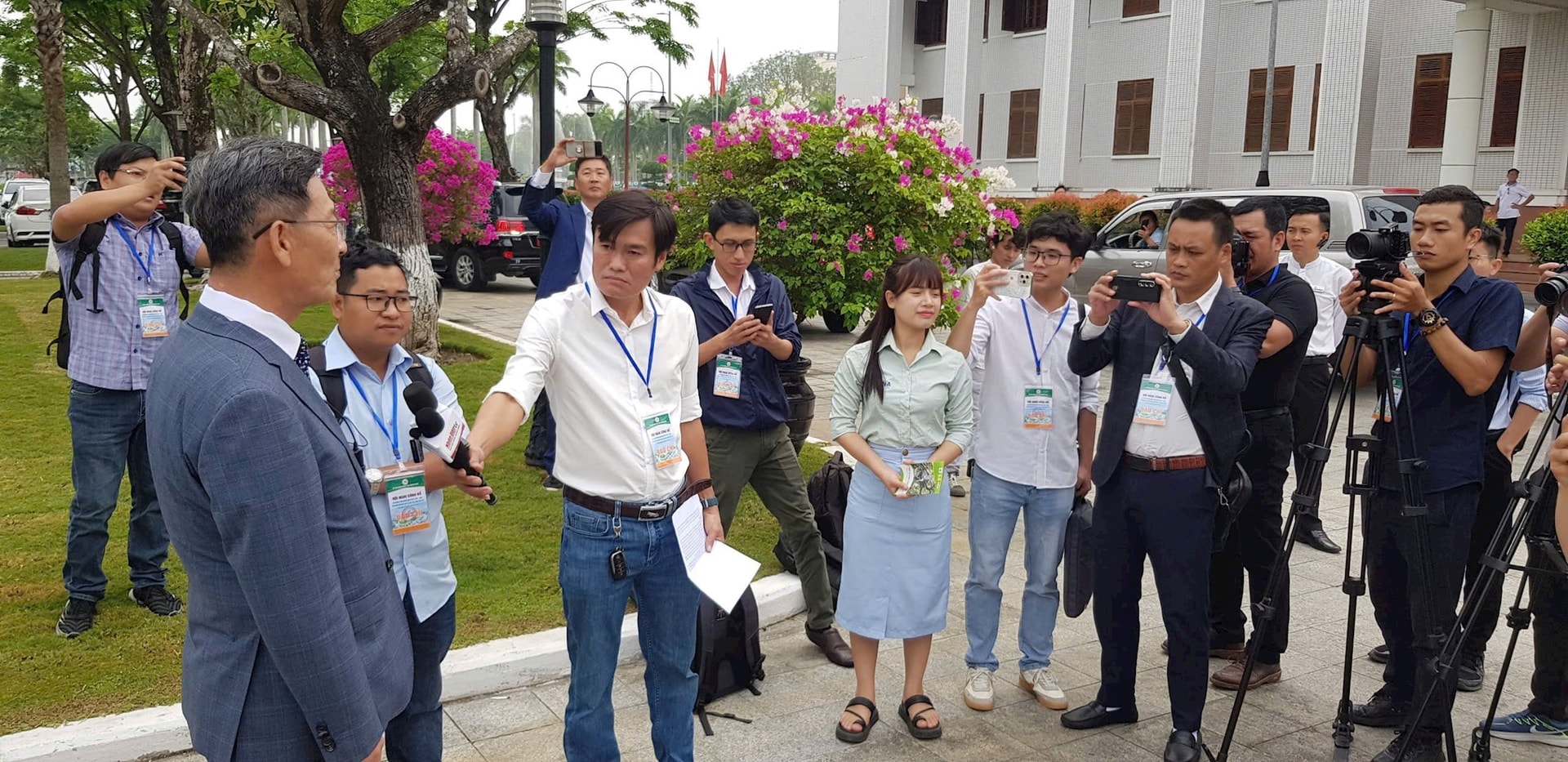
Every profession has a uniform that makes it easy for others to identify them. Journalism, however, is an interesting exception, though it's a little embarrassing to mention: if you see someone wearing soft, mud-stained dress shoes, a slightly wrinkled shirt, a faded backpack, greasy hair, eyes darting in all directions, and asking questions about everything they encounter, then that's definitely a journalist.
That's a joke (but it's true), the issue we're trying to discuss here is: what is the true "beautiful garment" of a journalist? What is the truly "beautiful garment" that every journalist must build for themselves? How can one live, work, interact, behave, and make decisions without becoming tacky or vulgar, but rather refined?
In reality, in the public imagination, journalists are often associated with an image of elegance, neatness, and sharpness. However, in real life, one can easily encounter them in a completely different state: a wrinkled shirt after hours of travel, shoes covered in road dust, disheveled hair after a day on location, or a hurried meal on the sidelines of a reporting assignment.
Journalism is not a profession meant for leisure. It's a job of unexpected trips, sleepless nights chasing news, midnight phone calls, and being in places many people are trying to leave.
Investigative journalists must persistently follow clues that others deliberately conceal. Social reporters may endure the rain in flood-stricken areas, stay awake all night in hospitals, or quietly sit for hours beside a person suffering great loss. If you view journalism from these perspectives, it's difficult to associate it with the word "glamorous."



But it is precisely at this point that a thought-provoking question arises: why do many prominent journalists, in the public memory, always appear with a special demeanor, a unique elegance, despite their careers being intertwined with countless hardships? Could it be that we are misunderstanding what elegance truly means?
In journalism, prestige is measured by a completely different frame of reference. It's the ability to remain calm amidst turmoil. It's the precision of language when dealing with potentially inflammatory topics. It's the respect shown to the subjects, whether they are famous or insignificant. And above all, it's the capacity to remain faithful to the truth in a world where truth is sometimes not the easiest choice.
Perhaps no one exemplifies this better than Walter Cronkite, once called "America's most trustworthy man." Remarkably, Cronkite never built his image on ostentation. He wasn't known for shocking statements or flamboyant public displays. What earned him the trust of millions of Americans was his near-absolute composure and respect for the truth.
When reporting on the assassination of President John F. Kennedy in 1963, Cronkite became the face that the entire United States turned to during that turbulent time. The image of him subtly removing his glasses, glancing at his watch, and then announcing the sad news in a voice meticulously controlled down to his breath remains one of the classic moments in world journalistic history. In that moment, one didn't see a news announcer reading the news. One saw the demeanor of a journalist who understood his responsibility to millions of people.
Looking at them, we see the "beautiful garment" formed in their work style and work results.
Today, with artificial intelligence capable of writing news, synthesizing data, and generating content at unprecedented speeds, the story of the former luxury of journalism becomes even more thought-provoking. What keeps professional journalism valuable is no longer the speed of information transmission.
Machines may be faster than humans. Algorithms may process data better than humans. But technology still cannot replace the ethical judgment, compassion, and social responsibility of a true journalist. In a world overflowing with information, what the public needs most is perhaps not more information, but trustworthy people who can help them discern the truth.



On the occasion of Vietnam Revolutionary Press Day, June 21st, perhaps this is a time for those in the profession to reflect on the true "garment" they wear every day. Time may fade the color of real clothes. Technology may change the way people do journalism. But that garment, if carefully preserved, will become the very thing that creates the true elegance of a journalist.
And perhaps, it was the most beautiful ceremonial uniform the journalism profession had ever seen.
Source: https://baodanang.vn/chiec-ao-that-su-cua-nha-bao-3341215.html

![[Photo] General Secretary and President To Lam receives Palestinian Ambassador Saadi Salama](https://vphoto.vietnam.vn/thumb/1200x675/vietnam/resource/IMAGE/2026/06/25/1782365384740_a1-bnd-9423-8322-jpg.webp)

![[Image] Ho Chi Minh City: Ma Lang area, Chicken-Rice Market about to change its appearance](https://vphoto.vietnam.vn/thumb/1200x675/vietnam/resource/IMAGE/2026/06/25/1782377698627_ndo_br_m1-jpg.webp)
![[Image] Schools organize meetings and introduce teaching models to students admitted to grade 10.](https://vphoto.vietnam.vn/thumb/1200x675/vietnam/resource/IMAGE/2026/06/25/1782368077271_ndo_br_z7970052192242-1ec8daeb77a6eed1a4e9f58c564ddd3e-jpg.webp)