

 |
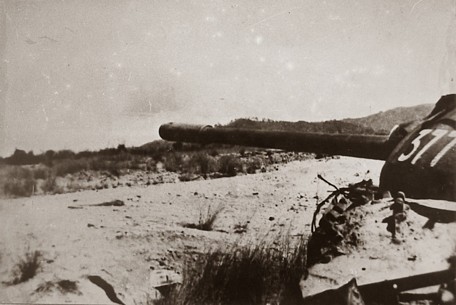
| Tank 377 during the Battle of Dak To in 1972. Photo: archival material. |
During the 1972 attack on the Dak To stronghold, surrounded by enemy tanks that outnumbered it many times over, our T59 tank, numbered 377, bravely and skillfully maneuvered back and forth, confronting two opposing forces of 10 M41 tanks, achieving a legendary feat: destroying 7 enemy tanks before being destroyed by enemy fire.
In 2000, the entire tank crew was posthumously awarded the title of Hero of the People's Armed Forces by the State, and that heavily damaged tank was recognized as a "National Treasure" along with tank T54B number 843 and tank T59 number 390.
In 1971, Tank Company No. 7 (C7) of Battalion 297, Regiment 203 marched from Hoa Binh to Quang Binh to participate in the Southern Laos Route 9 Campaign with its entire crew consisting of T54 tanks supplied by the Soviet Union. Later, C7 was reinforced with 8 T59 tanks (*) to advance into the Central Highlands, including tank number 377 of Platoon 3 (this was the first time the Central Highlands battlefield saw the appearance of tank and armored forces of the Liberation Army).
In 1972, to counter the Liberation Army's offensive in the Northern Central Highlands and the Tri Thien region, the US and Saigon forces established three defensive clusters in the Northern Central Highlands: Dak To-Tan Canh, Kon Tum town, and Pleiku town. The Dak To-Tan Canh cluster was considered a "steel belt," housing the headquarters of the 22nd Infantry Division and several other units.
When our troops launched the Northern Central Highlands Campaign, the first target chosen by the Campaign Command was the "steel belt" of Dak To-Tan Canh, and Tank T59 No. 377 (Tank 377) was deployed in the assault force along with Tanks 352 and 369. At the start of the campaign, at 4:30 AM on April 24, 1972, our troops opened fire and attacked the Tan Canh stronghold. On the northwest side of this stronghold, the first rounds fired by Tanks 377 and 352 destroyed the water tower and observation post.
Immediately afterwards, Tank 377 bravely overcame obstacles, fortifications, and trenches, striking directly at the enemy's 42nd Regiment headquarters. At the same time, Tank 352, leading the infantry, broke through all enemy resistance, penetrating deep into the area occupied by the American advisors and closing in on the command post. Tank 369 advanced from behind, providing support to the two leading tanks. After three hours of fierce fighting, our forces completely took control of the Tan Canh stronghold.
Subsequently, C7 and a self-propelled artillery piece, attached to the 1st Infantry Regiment of the 2nd Division, advanced towards the Dak To stronghold. Our troops were met with intense enemy air and artillery fire. Platoon leader Nguyen Nhan Trien, on tank 377, ordered the driver to accelerate to full speed, leading the troops through the enemy's firepower.
Upon approaching the Dak To stronghold, the enemy discovered Tank 377 advancing alone and deployed 10 M41 tanks, divided into two columns, to encircle and attack it. The entire crew of Tank 377 resolved to fight even if only one man remained. Platoon leader Nguyen Nhan Trien directed driver Tran Quang Vinh to maneuver back and forth so that the two gunners, Nguyen Dac Luong and Hoang Van Ai, could successively destroy the seventh enemy tank. Just then, Tanks 354 and 369 arrived to provide support.
But as Tank 354 arrived at the edge of Phuong Hoang airfield, having just destroyed an enemy tank behind an earthen embankment, Tank 377 was also destroyed by enemy fire. Not long after, our troops completely took control of the Dak To base.
The victory at Dak To-Tan Canh played a crucial role in the success of the Northern Central Highlands Campaign and the 1972 strategic offensive of the Liberation Army, which the enemy considered a disaster in a "fiery summer".
A touching event occurred after the battle when the tanks of C7 returned to their hiding place, only to find Tank 377 missing. A search party discovered Tank 377, destroyed by enemy fire, in a dirt alley beside Highway 18. About 40 meters in front of the tank's gun was the wreckage of an enemy M41 tank.
Initially, the crew believed that the entire tank crew had escaped and had left the burning tank to join other units during the fierce fighting. It wasn't until a second inspection that they discovered a small amount of ashes of their comrades in the positions of the driver and gunner on the burned tank. The ashes of their comrades from Tank 377 were respectfully brought back and buried at Tan Canh Martyrs' Cemetery.
Knowing the remarkable achievements of Tank 377, after liberation, in 1977 the Dak To District Military Command brought the tank's remains back for preservation. Eighteen years later, the tank was repainted and displayed in the grounds of the Dak To-Tan Canh Victory Monument. Two years later, the tank underwent a second restoration, but still retained dozens of dents on its body from enemy bullets.
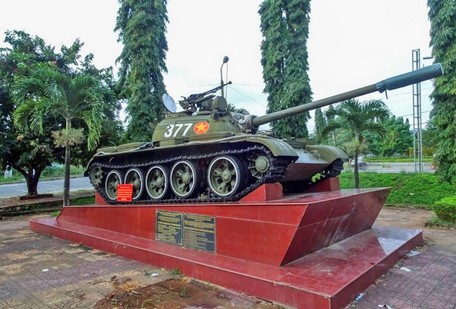 |
| Tank 377 is on display at the Dak To-Tan Canh Victory Monument. Photo: Archival material. |
In 2000, the entire tank crew was posthumously awarded the title of Hero of the People's Armed Forces by the State, and Tank 377 was recognized as a national treasure. The document from the Department of Cultural Heritage proposing that the Prime Minister consider awarding this title noted: "Tank 377 achieved the highest performance in a battle by the tank and armored forces. The crew demonstrated a spirit of bravery, resilience, indomitability, and courage."
This article uses material from VnExpress.
(*) The T59 tank, made of steel and weighing 36 tons, was manufactured in China and supplied to Vietnam in the 1960s. It has one 100mm main gun, one 12.7mm anti-aircraft gun, and two 7.62mm machine guns.
Tank 377's opponent in this battle was the M41, a US-made tank supplied to the Saigon army. This was a light tank, weighing 23 tons, equipped with a 76mm cannon, a 12.7mm machine gun, and a 7.62mm machine gun.
HONG VAN
Source link
![[Photo] The General Secretary, President and his wife meet with Vietnamese-Chinese friendship leaders.](https://vphoto.vietnam.vn/thumb/1200x675/vietnam/resource/IMAGE/2026/04/15/1776264829725_vna-potal-tong-bi-thu-chu-tich-nuoc-to-lam-gap-mat-nhan-sy-huu-nghi-viet-nam-trung-quoc-8703641-3130-jpg.webp)
![[Photo] My Son at night: A thousand-year-old heritage site amidst the Milky Way](https://vphoto.vietnam.vn/thumb/1200x675/vietnam/resource/IMAGE/2026/04/15/1776261039184_ndo_br_chon6-jpg.webp)
![[Photo] National Assembly Chairman Tran Thanh Man attends the opening session of IPU-152](https://vphoto.vietnam.vn/thumb/1200x675/vietnam/resource/IMAGE/2026/04/16/1776277863731_ctqh5-jpg.webp)
![[Photo] Mrs. Ngo Phuong Ly meets and exchanges views with Mrs. Peng Li Yuan](https://vphoto.vietnam.vn/thumb/1200x675/vietnam/resource/IMAGE/2026/04/16/1776277858080_phu-nhan-1-jpg.webp)

















































Comment (0)